
Your needs, this model
Does it fit your priorities?
Do you need a motorized auger juicer rather than a centrifugal basket?
Nama identifies the J2 SJ200 as a powered cold-press auger juicer and its manual describes ON/OFF/REV operation.
Explore this need in the finder →Is an included hopper and batch-loading auger plan suitable, even though its volume is not listed?
The exact J2 package includes a hopper and lid with a powered auger. Nama does not publish hopper or receiver capacity, so a hard numeric need stays unknown.
Explore this need in the finder →Must the included juice receiver hold at least 32 fl oz?
The product page's 20–30 oz figure is ingredient-dependent yield, not receiver volume; the exact receiver capacity is unknown, so this need is not confirmed.
Explore this need in the finder →Must the package include the specific large batch pitcher set and sorbet attachment?
Those are not in the standard J2 package list; they are listed as included with J2 XL instead.
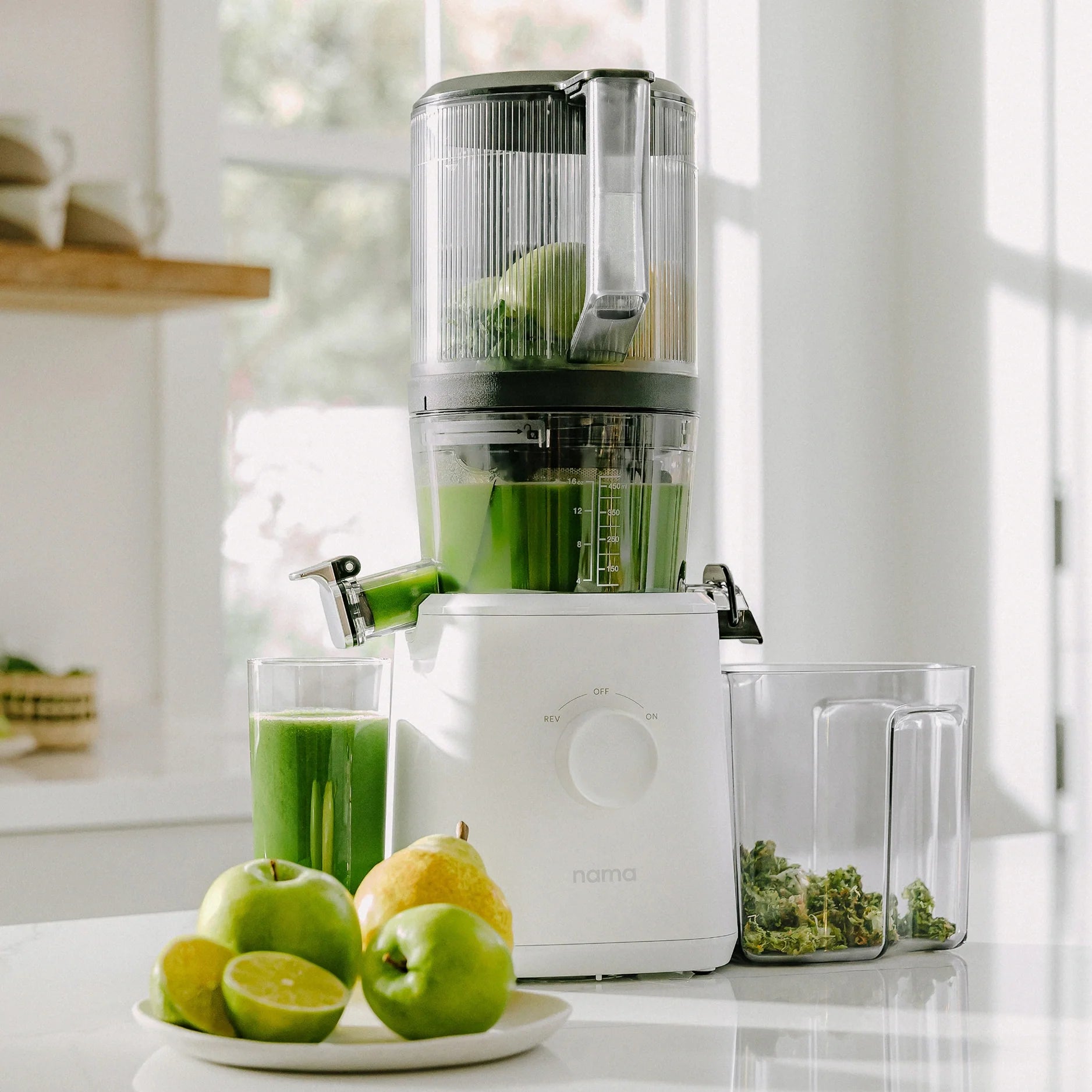
Explore this need in the finder →The Nama J2 is the full-size, hands-free auger juicer in the maker's current four-product U.S. juicer range. Its batch hopper, 200-watt motor and separate juice and pulp containers create a different routine from Nama's smaller J3 and from the J2 XL bundle. The key question is whether the standard J2 package is enough: its published juice yield is not the same thing as a receiver-capacity label.
What the standard J2 actually includes
The exact U.S. product page identifies the model as J2/SJ200 and lists White, Black and Sage Green finish SKUs. The included-parts list names the base, hopper and lid, chamber, spinning brush, auger, juice container and lid, pulp container, juice and coarse strainers, pusher and cleaning brush. This is a complete juicing package, but the page does not give a numeric volume for the hopper, juice container or pulp container. It does give an ingredient-dependent 20–30-ounce yield estimate. That is not a pitcher capacity, not a guaranteed amount from every batch, and not a reason to satisfy a hard 24-ounce vessel requirement in the finder.
The page describes the J2 as hands-free: load prepared produce into the hopper and let the auger process it. That changes the task from feeding each piece continuously, but it doesn't eliminate all preparation. Use the supplied manual's directions for cutting, removing pits and handling produce rather than treating the hopper as permission to drop in any whole item. Nama does not provide a numerical hopper volume, so this is a batch-loading convenience, not a published quart-size loading bin.
One forward speed, a manual reverse, and a real run limit
Nama lists 200 watts and 50 rpm, while the manual shows an ON/OFF/REV switch. Reverse is a clearing direction for a jam, not automatic reverse, a second juicing speed or an ingredient-sensing program. Those distinctions matter when answering ordinary questions: the J2 meets a masticating/auger preference, but not a request for variable speed, automatic reverse or a maker-documented automatic ingredient mode.
The linked U.S. manual says to operate for 30 minutes or less, then let the motor cool for about five minutes after a full 30-minute session. That is the documented juicing plan. It is not a yield claim and shouldn't be used to infer how many servings a load will make. The parts call for hands-on cleaning: unplug, disassemble promptly, use the included brush under running water, and dry/store them as directed. The manual specifically prohibits the dishwasher and dish dryer. This is a meaningful ownership tradeoff for someone who expects to put the strainer and chamber into a machine wash.
Counter fit: measure more than the base
The U.S. page and manual list the body at 9.8 inches wide, 9.0 inches long and 17.7 inches high, with the chamber set weighing 12.1 pounds. Nama names “length” rather than “depth,” so the finder does not quietly reinterpret that axis as the whole counter footprint. Leave room above the assembled hopper, for the juice and pulp containers, and for removing the chamber during cleanup. If lifting weight or exact under-cabinet clearance is a hard constraint, these official dimensions help more than a category name like “full-size,” but they are still listed body measurements.
The standard J2 and J2 XL share the broad auger routine. The XL page adds a Large Hopper, a Large Pitcher Set and a sorbet attachment to its box; the exact XL page calls its included large pitcher 100 ounces. Those are extra bundled pieces, not proof the J2 hopper is small or that the J2 cannot juice a larger quantity over multiple passes. The C2 instead adds a separate blender configuration; the compact J3 has a lower body height and weight. Decide which difference matters before treating an upgrade as automatically useful.
Who should compare it—and who should keep looking?
J2 fits a household that wants a motorized auger, an included hopper, the standard strainers, a named manual jam-clear control and a routine of washing parts by hand. The 15-year all-parts warranty is Nama's published U.S. offer; check written terms for the seller and owner rather than assuming any resale is covered. The maker's own page also promotes flavor, nutrition and yield benefits, but those are manufacturer claims; no independent yield, noise, nutrient or durability testing is represented here.
Keep looking if your non-negotiable is an exact receiver size, a numeric hopper volume, dishwasher-safe removable parts, a selectable speed or a confirmed long session beyond the manual's limit. For a 100-ounce included pitcher and sorbet attachment, compare the J2 XL. For a compact appliance with a separately named smoothie strainer, compare the J3. For an actual blender on the same base, the C2 is the relevant sibling, but it changes to a different jug and a high-speed blending procedure. The questionnaire should return a model only when the chosen plan and its documented measurements meet the need—not because one product family sounds familiar.
Sources: Nama's U.S. J2 product page, its current U.S. juicer directory, and the linked U.S. J2/SJ200 manual. Compare the J2 XL, C2 and J3. No ownership, independent test result, price or retail ASIN is claimed.
Key details at a glance
| Extraction method | Slow-compression masticating extractor |
|---|---|
| Speed control | Single-speed on/off |
| Motor electrical rating | 200 W |
| Listed width | 9.8 in |
| Listed height | 17.7 in |
| Juice jug and lid dishwasher-safe | No |
| Filter basket dishwasher-safe | No |
| Fast/firm juicing guidance | The linked U.S. manual says 30 minutes or less and directs a five-minute cool-down after a full 30-minute run. |
| Blender mode on the same base | No |
| Maximum continuous run listed by maker | 30 min |
| Body-fit measurement note | Nama names width, length and height. Measure the full working setup and overhead loading clearance; the 45 mm-equivalent hopper is not captured by the body dimensions. |
| Electrical-rating caveat | Maker-listed rated power consumption; not a yield or durability measurement. |
| Filter configuration | Stainless and ul tem strainers |
| Continuous operation before rest | 30 min |
| Removable parts dishwasher-safe per manual | No |
| Automatic ingredient-sensing mode | No |
| Batch-loading hopper | Yes |
| Included blank/sorbet strainer | No |
| Manufacturer-listed voltage | 120 V |
Use the exact model’s instructions for operating limits, supplied equipment and version differences.
Sources for this assessment

Now check the model against your kitchen.
Use the finder for extraction style, batch, cleanup, control, and counter-fit requirements.