
Your needs, this model
Does it fit your priorities?
Do you want a slow-compression auger rather than a centrifugal cutting basket?
The CSJ-300 series is documented as a masticating slow juicer; it does not provide a centrifugal cutting-basket mode.
Explore this need in the finder →Would you rather have a maker-described mesh-free filter than two interchangeable pulp screens?
Cuisinart calls the CSJ-300 filter mesh-free; the manual still lists a two-piece strainer assembly. It does not include the Ninja JC151's labeled Less Pulp and Lots of Pulp screen choices.
Explore this need in the finder →Must the removable juicing parts be top-rack dishwasher-safe?
The CSJ-300 Series booklet allows the named removable parts on the dishwasher top rack; the motor base remains wipe-clean only.
Explore this need in the finder →Can an 18.27-inch listed body height fit your cabinet or counter limit?
The exact pages list an 18.27-inch body height. With the finder’s 0.1-inch increments, a 18.3-inch maximum accommodates the listed body; reserve additional room for loading produce and lifting the pusher or cover.
Explore this need in the finder →The Cuisinart Easy Clean Slow Juicer is for someone who wants an auger-and-strainer routine rather than a fast spinning cutting basket. Its useful distinction is the maker's “mesh-free” filter description paired with a removable assembly that Cuisinart says can go on the dishwasher's top rack. The countertrade is uncertainty: the maker does not publish a numeric juice-container capacity or a feed-tube width, so this is not a safe pick when either number is an essential minimum.
Keep the two U.S. model codes straight
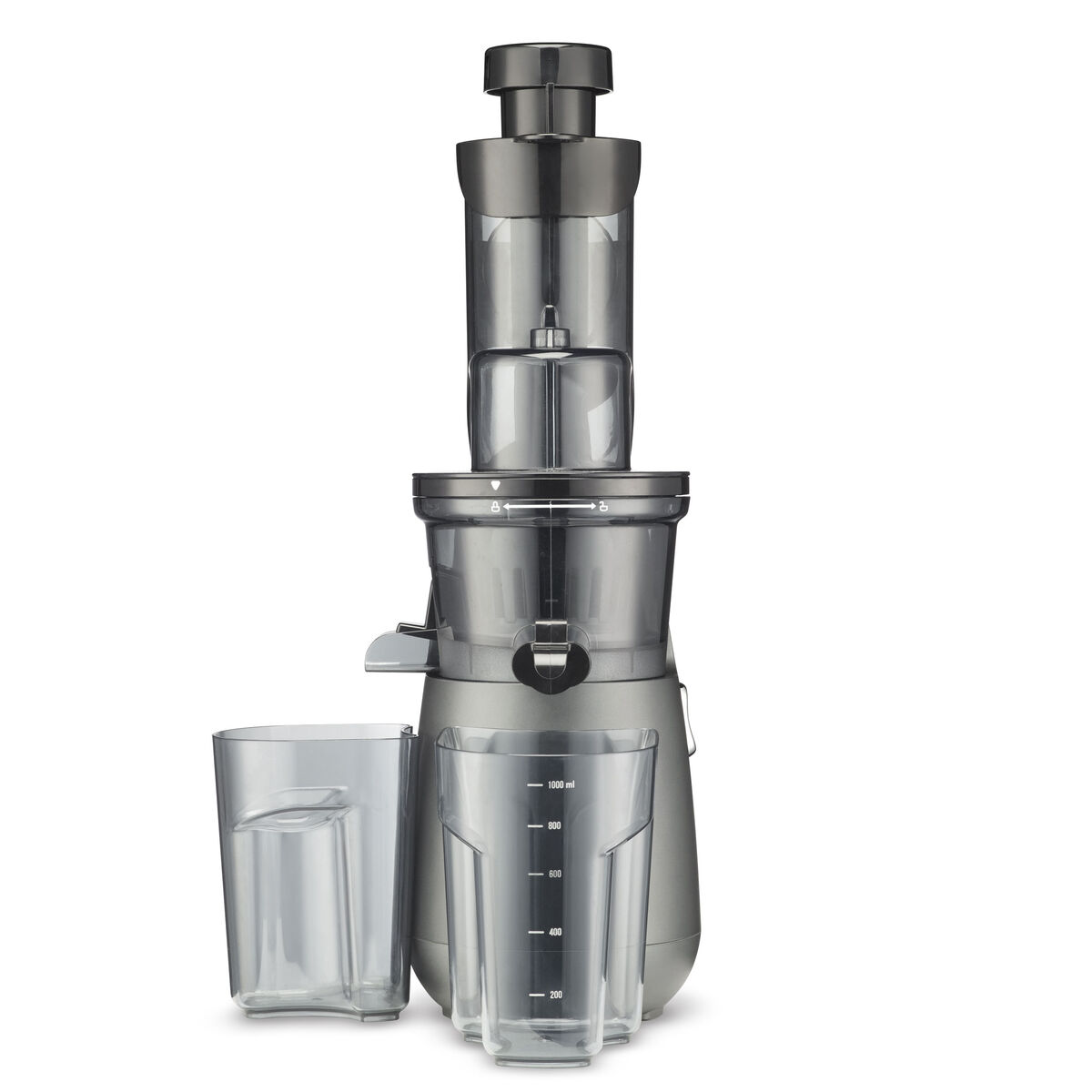
The active exact U.S. page names the gray-finish CSJ-300P1 Easy Clean Slow Juicer. Cuisinart also maintains an exact U.S. CSJ-300 page for a plain Gray version; that page marks the unsuffixed model discontinued and out of stock. Both manufacturer pages show the same listed dimensions, describe the same masticating function and link the same CSJ-300 Series instruction booklet and two-page quick reference. This review assesses their documented shared operation, while preserving the difference in code, finish and status. The main image here shows CSJ-300P1 Gray P1, not the older Gray CSJ-300. The shared booklet is not proof that every replacement part fits both codes.
How the slow-press setup works
The assembly uses a motor base, juicing bowl, auger, two nested juice-strainer pieces, cover and pusher. Juice and pulp leave through separate outlets into separate containers. It is not a centrifugal basket or a citrus reamer. The page calls it a masticating slow juicer but gives no measured extraction rate, independent yield test or sound level.
Cuisinart calls the filter “mesh-free” and easy to clean under a tap. The booklet still calls for assembling, removing and washing the inner and outer juice strainers. That makes the maker's wording a useful design distinction from a fine mesh screen, not a promise of effortless cleanup or a pulp-free result. The booklet gives no selectable Less Pulp/Lots of Pulp screens. If adjusting pulp with interchangeable filters matters, compare the Ninja JC151, whose package has two named pulp filters, rather than assuming the Cuisinart's single strainer assembly offers the same choice.
Budget time for preparation and feeding
The manual lets users feed smaller produce through the tube and says larger items can be added by lifting the cap and placing them on the plate hopper. Produce wider than 2¾ inches must be cut. That is preparation advice, not a measured feed-opening specification; the exact pages do not publish the chute's internal width. A hard chute-width minimum should exclude this model rather than convert the prep threshold into a measurement.
Follow the booklet: wash produce, use the pusher, peel items with inedible skins, remove hard pits and seeds, soak nuts, and feed softer ingredients before firmer ones. It recommends placing leafy greens and herbs between other ingredients. The closed juice spout can help mix juice or nut milk before dispensing. Reverse is for clearing the auger, not a second extraction speed. If the motor stops, the manual gives a reverse-and-restart sequence and a 20-minute cooling interval; it does not publish a general continuous-run limit.
Check counter height and collection volume separately
Cuisinart lists 10.24 inches long by 6.97 inches wide by 18.27 inches high. Length is treated as front-to-back depth in counter comparisons, but leave room to feed produce, lift the pusher or cap, place both containers and carry wet pieces to the sink. Listed height is not working clearance beneath a cabinet.
The page and booklet identify supplied juice and pulp containers but state neither vessel's capacity. A pitcher image has graduations, but that is not enough to establish its stated usable capacity. The finder therefore cannot use this model to satisfy a firm juice-container minimum such as 32 fluid ounces. Do not confuse pulp separation or a yield chart for selected ingredients with a pitcher-capacity specification.
Dishwasher guidance has boundaries
The quick reference and full booklet allow the cover, pusher, feed tube with hopper, pulp container, juice container and strainer assembly to be washed by hand or on the dishwasher top rack. They explicitly keep the motor housing out of the dishwasher and away from immersion; wipe that base with a damp cloth. Cuisinart also says not to use a metal brush or pad on removable pieces and recommends removing pulp promptly so it does not dry on the parts. “Top-rack safe” is helpful, but the juicer still needs disassembly and several wet pieces need a place to dry.
Which alternative fits a different routine?
Choose CSJ-300P1 if slow compression, the maker-described mesh-free filter and top-rack-cleanable removable parts suit you. The Ninja JC151 adds Less Pulp and Lots of Pulp filters, but its U.S. sources conflict on jug capacity and publish no chute diameter. The discontinued Breville BJS700 Big Squeeze has Forward/Off/Reverse control and hand-wash directions; its maker leaves jug capacity and chute width unquantified. For a centrifugal routine with a stated small vessel, the earlier Cuisinart CJE-500 family review covers a 16-ounce juice pitcher and fine mesh basket. These are different prep and cleaning plans, not a better/worse ranking.
When the unknowns matter more than the feature list
The current P1 product page lists a three-year limited warranty; the booklet says U.S. warranty eligibility depends on retail household purchase and original proof of purchase. That is materially different from assuming the same coverage for a used, discontinued CSJ-300 offer. Check the exact code, condition and seller terms before buying. Neither model should be selected on a claimed motor wattage, speed setting, measured noise level, yield advantage or numeric jug size: the inspected U.S. materials do not establish those values.
In the finder, masticating and top-rack-safe removable parts fit the CSJ-300-series plan. A numeric 32-ounce vessel minimum or published chute-width minimum does not: both values are unknown. Its 18.27-inch body height also leaves work clearance to plan. These facts make the Cuisinart a specific slow-juicer fit, not a universal batch or counter answer.
Key details at a glance
| Extraction method | Slow-compression masticating extractor |
|---|---|
| Listed width | 6.97 in |
| Listed depth | 10.24 in |
| Listed height | 18.27 in |
| Dedicated Quiet selector label | No |
| Juice jug and lid dishwasher-safe | Yes |
| Filter basket dishwasher-safe | Yes |
| Controls and use | The booklet identifies ON, STOP and REVERSE controls. Reverse is for clearing the auger, not a speed selector. The manual supplies a jam-recovery sequence and a 20-minute cooling interval when the motor stops; no continuous-run limit is published. |
| Cleanup note | The maker describes a mesh-free filter, but cleanup still requires removing the auger, two-part strainer, bowl, cover and containers. Rinse promptly before pulp dries; no metal brush or pad; wipe the unplugged base only. |
| Manufacturer jug label | No numeric juice-container capacity published in the inspected exact pages or CSJ-300 Series booklet; do not use the container image to infer a capacity. |
| Fast/firm juicing guidance | The manual says to wait 20 minutes for cooling if the motor stops during normal operation; it does not specify a general continuous run-time limit. |
| Supplied cup nozzle | No |
| Blender mode on the same base | No |
| Body-fit measurement note | Both exact pages list 10.24 in L x 6.97 in W x 18.27 in H. Allow separate working clearance for loading produce, lifting parts, placing the juice and pulp containers and cleaning. |
| Electrical-rating caveat | The inspected exact product pages and CSJ-300 Series booklet do not publish a wattage or measured performance rating. |
| Filter configuration | Maker-described mesh-free filter (removable two-piece strainer) |
| Removable parts dishwasher-safe per manual | Yes |
| Manufacturer-listed voltage | 120 V |
Use the exact model’s instructions for operating limits, supplied equipment and version differences.
Sources for this assessment
- Cuisinart U.S. exact CSJ-300P1 product page; rendered page observation retained
- Cuisinart U.S. exact discontinued CSJ-300 product page; rendered page observation retained
- Cuisinart CSJ-300 Series instruction and recipe booklet, original 31-page PDF linked by both exact pages
- Cuisinart CSJ-300 Series two-page Quick Reference, linked by both exact pages
- Cuisinart U.S. Juicer Manuals directory; 9 of 9 results, with the CSJ-300P1 card
- CPSC Recall Retrieval API: retained exact CSJ and Cuisinart/juice query responses
- Exact CSJ-300P1 main image linked from its U.S. Cuisinart page
- Exact CSJ-300 Gray main image linked from its discontinued U.S. Cuisinart page


Now check the model against your kitchen.
Use the finder for extraction style, batch, cleanup, control, and counter-fit requirements.