
Your needs, this model
Does it fit your priorities?
Is a simple single on/off control enough, or do you need selectable speeds?
Both exact pages show one on/off control. The finder can also show models with a documented selectable speed; this family has no speed dial.
Explore this need in the finder →Would a supplied 16-ounce pitcher be large enough for one small serving?
The maker lists a 16-ounce juice pitcher. That is the vessel limit, not the expected amount extracted from a particular batch.
Explore this need in the finder →Are you checking an earlier model and willing to confirm the exact CJE code and included pitcher/pulp container?
The earlier CJE-500 family is available only when earlier offers are included; verify the exact code and package, since CJE-500 and CJE-500P1 remain separate identifiers.
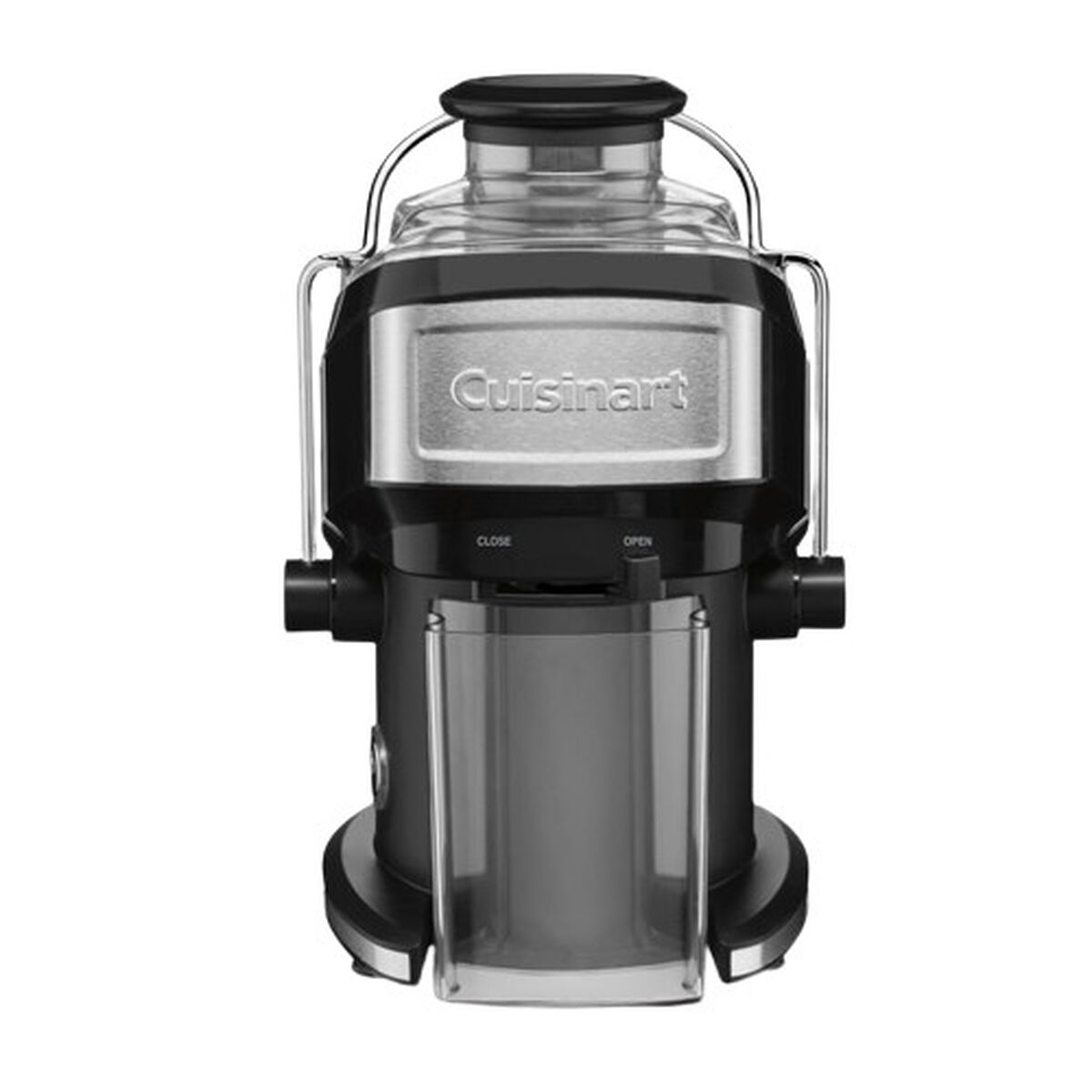
Explore this need in the finder →The Cuisinart CJE-500 is an earlier compact centrifugal extractor built around a small 16-ounce juice pitcher, a 40-ounce pulp collector, and a single on/off control. Cuisinart also publishes a separate exact code, CJE-500P1. The two U.S. product pages show the same black finish, dimensions, listed features, official image, and CJE-500 Series booklet link. I keep both codes visible in this review, but the evidence does not establish a functional difference between them or universal parts interchangeability.
Best for a modest glass at a time
The supplied pitcher holds 16 fluid ounces. That is a sensible scale if the routine is one small serving, not a promise that any particular load of apples, carrots, or leafy greens will fill it. Ingredient size, water content, trimming, and how often the pulp bin is cleared affect the result; the container is a receiving limit, not a yield measurement. Cuisinart says the pitcher can be replaced for continued juicing, so a second vessel can let you collect more, but a 16-ounce setup is still a poor match if you require a single supplied jug of 32 ounces or more.
The separate pulp container is listed at 40 ounces. That leaves room to collect pulp apart from the juice, but does not mean the machine extracts 40 ounces of juice or can run indefinitely. The manual says excess pulp on the mesh can slow flow. It also describes a resettable thermal device: after an extreme overload trip, unplug the machine and let it rest for 30 minutes before continuing. Plan for an occasional stop to clear the basket or empty the pulp container rather than judging capacity from one number.
One switch keeps the control simple
This is not a variable-speed extractor. The product pages and booklet describe a one-touch on/off button with a blue light, a locking safety bar, and a removable mesh filter-and-blade assembly. The basket grinds and spins produce against the mesh; juice travels through the adjustable outlet to the pitcher while pulp collects separately. The manual gives ingredient-specific tips and says softer ingredients can go before harder ones and that leafy greens are easier to feed between other ingredients. Because there is no selectable speed, you cannot choose a gentler speed for delicate produce.
The manufacturer calls the machine “quietly powerful,” but that is descriptive copy, not a named Quiet mode or a sound-level measurement. If a noise limit is essential, this page does not document a setting or decibel figure that would establish it. Likewise, the booklet’s maximum 400-watt appliance rating is not a measured juicing load or evidence of extraction performance.
Preparation and counter fit still matter
Cuisinart publishes body dimensions of 11 inches long by 9 inches wide by 13 inches high. Treat the listed length as a first estimate of front-to-back depth and leave space for the feed tube, locking handle, pitcher, pulp-container removal, and hand access. A body that fits between cabinets can still be awkward to assemble or clean if the working clearance is tight.
The booklet says ingredients wider than 2 3/4 inches need cutting. That is a useful prep threshold; it is not a measured feed-tube width, so the finder does not call the tube exactly 2.75 inches. Some produce will need more preparation for reasons other than width, including skins, pits, and hard seeds. If you want the least cutting or a larger receiving jug, compare a different centrifugal model rather than treating “large feed tube” as permission to load every item whole.
Cleaning is straightforward only if it is prompt
Cuisinart identifies the cover, pusher, pulp container, pitcher, and mesh basket/blade among the removable cleaning pieces. The series booklet says those parts can be hand-washed or placed on the dishwasher’s top rack; keep the motor housing out of water and wipe it with a damp cloth. The mesh has sharp cutting edges, and pulp is harder to remove after it dries. Rinse and brush the basket soon after a session, then close the adjustable spout before lifting the pitcher to help limit drips. A safety bar must lock over the cover and the pulp bin must be present for operation, so setup is not just a plug-and-go base.
Choose by the exact code and seller package
Cuisinart’s manuals index lists CJE-500 and CJE-500P1 separately, while both exact product pages link the same CJE-500 Series booklet and publish matching operating details. That supports treating them as a shared function family for this assessment, not erasing either model code. The P1 detail page identifies it as discontinued and out of stock, although the Juicers & Blenders page still showed a sale/cart tile that led to that discontinued page when checked. Availability labels therefore are not a reliable assurance that a specific seller has a new unit. For an older listing, check the model marking, condition, included pitcher and pulp bin, and the exact replacement pieces before relying on the shared series description.
In the finder, enabling earlier offers is necessary to see this model. A centrifugal-process choice and the one-speed control option fit the documented setup; asking for a 32-ounce minimum pitcher excludes it. If you want more volume and multiple control positions, compare the Cuisinart CJE-1000P1: its one-liter jug is a different scale and its five-position dial changes how you set up a batch. For halved citrus alone, a Cuisinart CCJ press is a narrower tool; for a model that combines juicing and blending, look at a verified hybrid instead. The CJE-500 is most compelling when a compact footprint, straightforward on/off operation, and a small receiving pitcher line up with your actual serving size.
For exact manufacturer details, see the CJE-500 page, the separate CJE-500P1 page, and the linked CJE-500 Series booklet. No extraction test or personal ownership claim is implied here.
Key details at a glance
| Extraction method | Centrifugal fruit-and-vegetable extractor |
|---|---|
| Included juice receiver capacity | 16 fl oz |
| Pulp bin placement | Behind the base |
| Speed control | Single-speed on/off |
| Motor electrical rating | 400 W |
| Listed width | 9 in |
| Listed depth | 11 in |
| Listed height | 13 in |
| Dedicated Quiet selector label | No |
| Juice jug and lid dishwasher-safe | Yes |
| Filter basket dishwasher-safe | Yes |
| Controls and use | The exact pages and booklet document a single on/off button with a blue light, not selectable speed settings. |
| Cleanup note | Rinse and brush the fine mesh promptly; the cutting edges are sharp. Close the adjustable flow spout before removing the pitcher to help limit drips. The manual says a thermal overload requires unplugging and a 30-minute rest. |
| Manufacturer jug label | 16 ounces |
| Body/base construction | Black-and-stainless appearance in the official image; exact base material is not specified in the inspected U.S. product page or booklet. |
| Supplied cup nozzle | No |
| Blender mode on the same base | No |
| Pulp container capacity | 40 oz |
| Body-fit measurement note | Both exact pages list 11 in L x 9 in W x 13 in H. Leave clearance for the feed tube, locking bar, pitcher and pulp-container removal. |
| Electrical-rating caveat | The series booklet states a maximum 400-watt rating. It does not give a measured juicing load or comparative extraction test. |
| Removable parts dishwasher-safe per manual | Yes |
| Manufacturer-listed voltage | 120 V |
Use the exact model’s instructions for operating limits, supplied equipment and version differences.
Sources for this assessment
- Cuisinart U.S. exact discontinued CJE-500 compact extractor page; rendered observation transcript
- Cuisinart U.S. exact discontinued CJE-500P1 compact extractor page; rendered observation transcript
- Cuisinart U.S. Juicers & Blenders rendered page showing the P1 tile linked to its discontinued page
- Cuisinart CJE-500 Series instruction and recipe booklet linked from both exact product pages
- Cuisinart one-page CJE-500 Compact Juice Extractor FAQ linked from both exact pages
- Cuisinart U.S. Juicer Manuals directory, 9 of 9 results, listing CJE-500 and CJE-500P1 separately
- Official Cuisinart CJE-500 image endpoint linked from both exact product pages

Now check the model against your kitchen.
Use the finder for extraction style, batch, cleanup, control, and counter-fit requirements.