
Your needs, this model
Does it fit your priorities?
Do you want a slow-compression route rather than a spinning disc or citrus cone?
The BJS700 is a masticating slow-compression juicer with a screw and strainer. It is discontinued in the U.S. and appears only when earlier models are included.
Explore this need in the finder →Do you require speed selection or a quiet-labelled mode?
The BJS700 rocker selects Forward, Off, or Reverse; reverse is for clearing jams. It has no documented speed selector or quiet-labelled speed, even though Breville calls the motor ultra quiet.
Explore this need in the finder →Will the listed body dimensions fit while leaving room for the feeder and two collection vessels?
Breville lists 8.9 inches wide, 8.1 deep, and 17.5 high. The working envelope is larger when feeding produce and removing the upper assembly; body dimensions alone are not a clearance guarantee.
Explore this need in the finder →Is a known jug volume or measured chute width essential?
Breville names a juicing jug and calls the feed chute the largest on-market for slow juicers, but its U.S. page provides no capacity or numeric chute width. Unknown values do not satisfy a hard minimum.
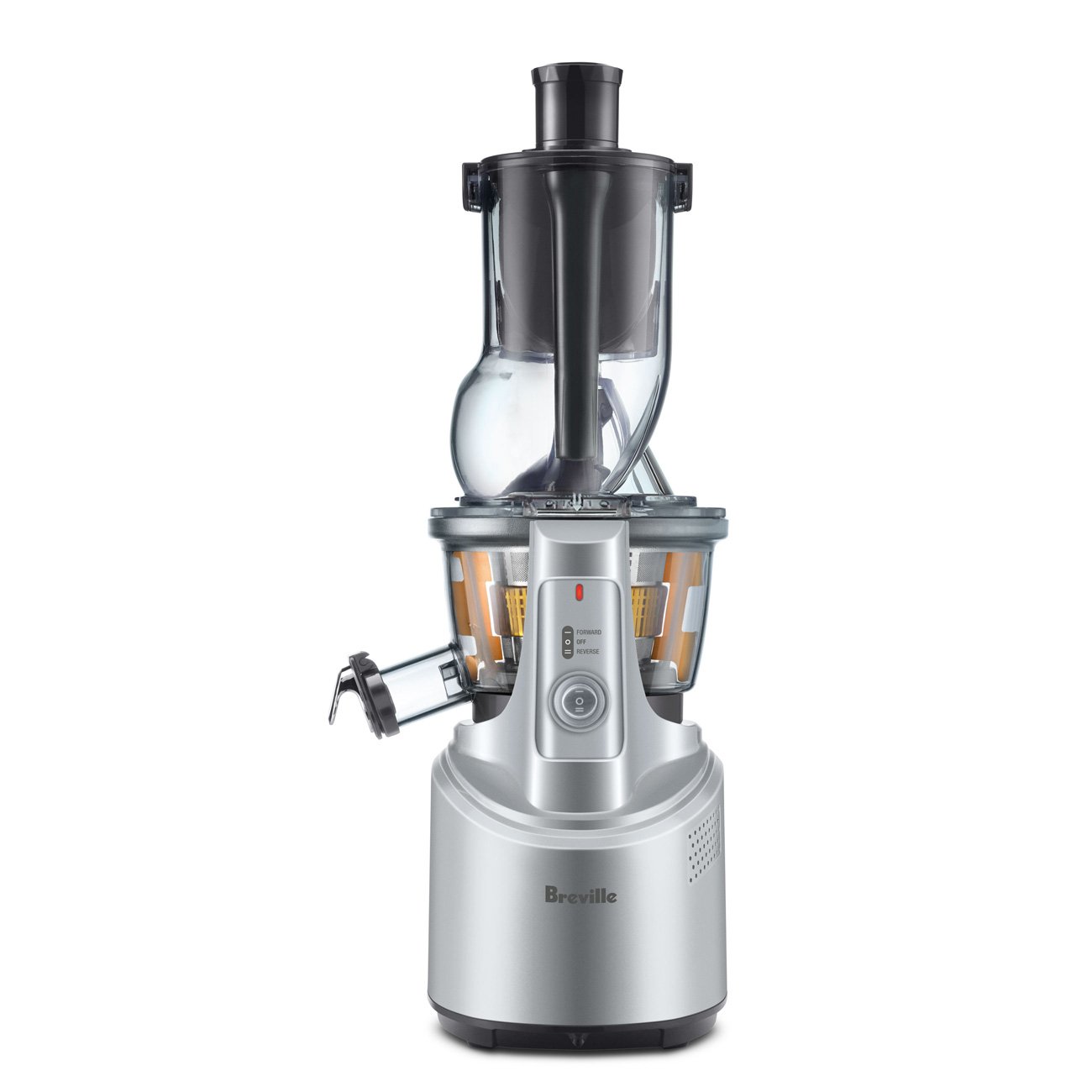
Explore this need in the finder →The Big Squeeze BJS700 is a slow-compression juicer rather than another spinning-disc Juice Fountain. Its U.S. silver configuration is SKU BJS700SIL1BUS1, and Breville now labels the U.S. product page discontinued. Treat this as an earlier model for a specific, fully described offer—not a current-stock promise. The distinctive case is the screw-and-strainer routine, a cap that can hold juice for mixing or a quick rinse, and maker-listed compact body dimensions. The missing jug and feed-chute measurements are just as important: the page names a juicing jug but does not state its volume or chute width.
A different extraction route
The manual’s parts diagram shows a feeding tube and basket, juicing bowl, rotation wiper, strainer, juicing screw, pulp cup, juice jug, and a spout with a detachable smart cap. In forward operation, the screw draws and presses prepared ingredients against the strainer; the pulp and juice leave through separate outlets. That is not the same workflow as a centrifugal disc throwing juice through a fast-spinning mesh basket. A slow-compression method may better suit someone who wants to feed a variety of produce gradually, but no independent yield or nutrient test is available here. The wattage and the words “slow” or “high yield” do not prove how much juice your recipe will produce.
Plan to prepare ingredients
The manual still asks for cutting. It directs users to shorten tough, fibrous ingredients such as carrots, beets, and spinach before feeding; leafy greens such as celery, kale, and collards need to be cut and bundled. Softer fruits and vegetables go into the separate feeding basket. Remove hard seeds, pits, and stones, peel ingredients where the manual directs, and do not feed frozen fruit or ice. The book also cautions against items such as coconut, sugarcane, and whole grains. The page’s “largest on-market” chute language is a marketing superlative, not a published width that can be checked against a cabinet or a numeric fit requirement.
Forward, off, and reverse are not speed settings
Breville lists the control as Off/On–Forward/Reverse. Forward extracts; reverse is a clearing direction for a jam, not another speed or a continuous reverse mode. The manual says the machine will not start unless assembled correctly, and it warns against running empty. Do not operate it for more than 20 seconds before adding ingredients. It also says not to run continuously for more than 30 minutes, then to let the motor cool for at least 30 minutes before another session. That makes this an unsuitable match for a user who needs a documented variable-speed dial or a high-speed centrifugal routine.
The listed body is 8.9 inches wide, 8.1 deep, and 17.5 high. Those are body dimensions, not the full clearance needed to feed the top tube, place the jug and pulp cup, and remove the upper set for washing. Breville lists a 240-watt motor and 110–120-volt supply. Neither figure tells you the machine’s tested yield, noise level, or time per batch. The product page does not publish the supplied jug or pulp cup capacities, so do not use this model to meet a hard minimum-volume request.
The smart cap helps between ingredients, not instead of cleaning
Closing the detachable cap keeps liquid in the bowl while the manual describes mixing a juice combination; opening it lets juice flow into a waiting vessel. The cap also makes it possible to rinse the bowl between different juices. Breville’s “quick rinse” description is useful for switching flavors, but it is not the full after-use wash. The manual still instructs you to disassemble the top set, remove pulp, brush the strainer, clean the screw and silicone pieces, and dry parts before reassembly. If you leave pulp in the fine strainer, the next session is harder to clean and the machine may perform less well.
Ownership, condition, and warranty
Breville describes the motor as “ultra quiet,” but does not give a decibel figure; the manual also warns that running without ingredients can make noise and damage the screw. Consider the quieter description a maker claim, not a guarantee for a sound-sensitive room. The U.S. product page lists a ten-year limited product warranty, but also states that this model is discontinued. A used or open-box machine may be incomplete or have a different warranty situation, so check the seller’s exact SKU, condition, included strainer and cleaning parts, and coverage before deciding. The page and manual provide no verified current stock or price.
Who should compare another setup?
Consider the BJS700 if you specifically want a slow-compression process and can tolerate cutting fibrous produce, a multi-part rinse routine, and an earlier-model search. Its body is fairly narrow, but that alone does not make it a compact working setup: the feeder, two collection vessels, and removable top set need space. If a large known jug, measurable chute, or selectable extraction speeds matter more, compare a current-reference centrifugal model such as the BJE830 Cold XL or CJE830 XL Pro; their documented capacities and controls do not imply a better yield. For citrus alone, the BCP600 press is a more focused tool. Each uses a different operating plan, not an interchangeable attachment.
Bottom line
The BJS700’s real distinctions are its slow-compression screw, forward/reverse clearing control, separate pulp and juice outlets, and mix/rinse cap. Its exact U.S. configuration is documented and it remains useful as an earlier-model reference, but the page marks it discontinued. Unknown jug capacity and chute width, the absence of a speed dial, ingredient preparation, and thorough cleanup should shape the decision more than untested “quiet” or “high yield” language. Read the U.S. product page and its linked instruction manual before evaluating an individual offer.
Key details at a glance
| Extraction method | Slow-compression masticating extractor |
|---|---|
| Pulp bin placement | External side bin |
| Speed control | Single-speed on/off |
| Motor electrical rating | 240 W |
| Listed width | 8.9 in |
| Listed depth | 8.1 in |
| Listed height | 17.5 in |
| Dedicated Quiet selector label | No |
| Controls and use | The rocker is Off/On–Forward/Reverse. Forward is the extraction direction; reverse is a jam-clearing direction, not a selectable speed. The maker lists 240 W and describes the motor as ultra quiet but publishes no decibel measurement. |
| Cleanup note | Clean promptly after each use. Disassemble the top set, remove pulp, brush the strainer, rinse the screw and silicone parts, and dry before reassembly. The manual's quick rinse is for switching juices, not a replacement for full cleaning. |
| Fast/firm juicing guidance | The manual says not to run the machine longer than 20 seconds before inserting ingredients and not to operate continuously for more than 30 minutes; after a continuous session, let the motor cool for at least 30 minutes. |
| Supplied cup nozzle | No |
| Manual-described lower-noise juicing range | No |
Use the exact model’s instructions for operating limits, supplied equipment and version differences.
Sources for this assessment
Now check the model against your kitchen.
Use the finder for extraction style, batch, cleanup, control, and counter-fit requirements.