
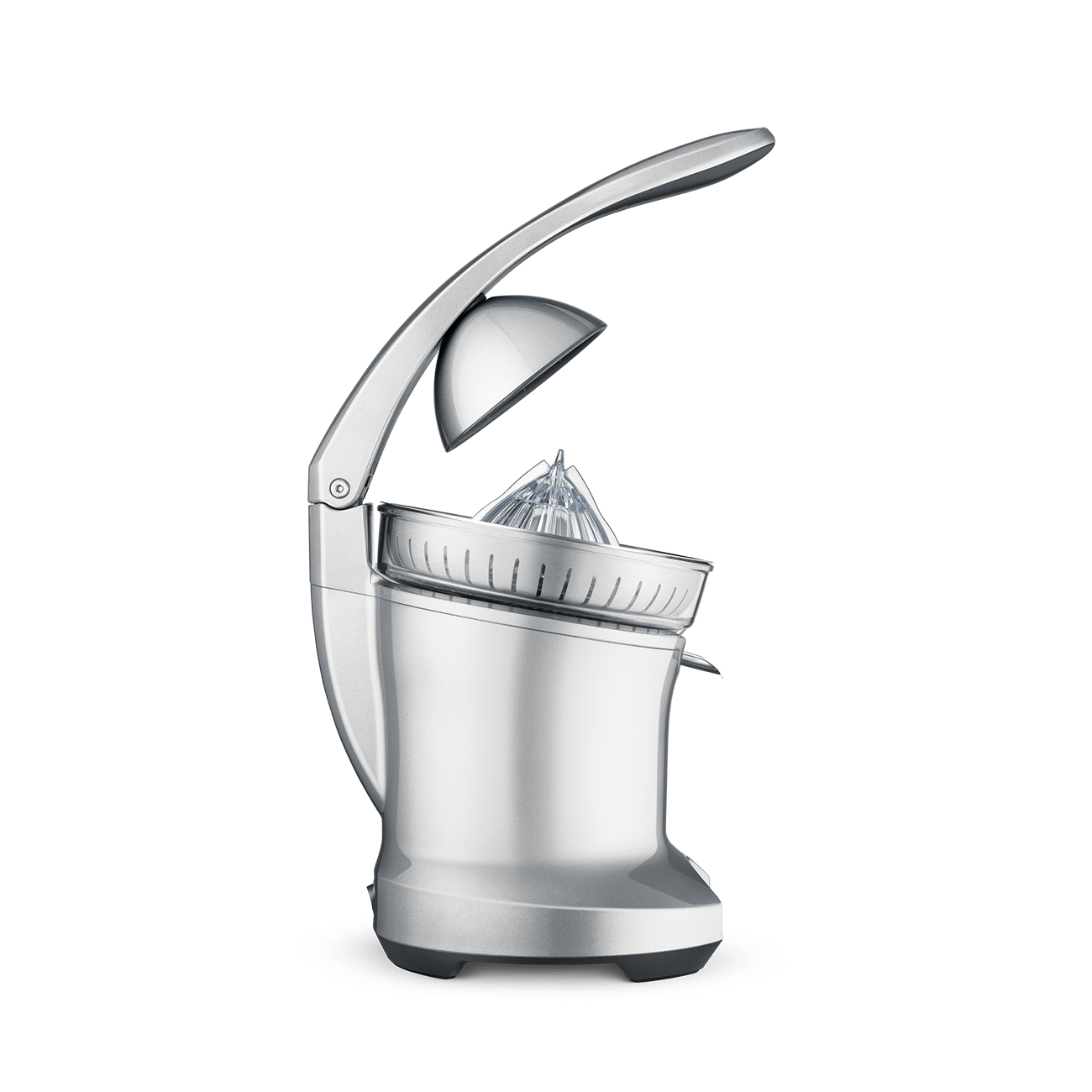
Your needs, this model
Does it fit your priorities?
Is a dedicated citrus press essential, rather than a fruit-and-vegetable extractor?
The BCP600 presses halved citrus fruit on a cone; it does not feed apples, carrots or greens through an extractor chute.
Explore this need in the finder →Do you prefer a simple one-handed lever over a triple-hinged active arm?
Breville describes the BCP600 as a simple one-handed press; its manual identifies a juice press arm, while the Pro manual specifically identifies a triple-hinged arm.
Explore this need in the finder →Is a magnetic fruit-dome attachment an essential cleanup detail?
The BCP600 manual says its fruit dome attaches magnetically and can be lifted off for cleaning.
Explore this need in the finder →The Breville Citrus Press BCP600 is a dedicated citrus appliance, not a substitute for a centrifugal or slow juicer. You halve oranges, lemons, limes or grapefruit, place a half cut-side-down on one cone, lower the arm, and catch juice from the spout. If citrus is the regular job and you would rather press fruit than prepare a mix of produce for a feed chute, that simple routine is its reason to exist. If you want juice from apples, carrots, leafy greens or other non-citrus produce, choose a different machine.
A lever press with an automatic start
Breville describes a simple one-handed operation and a one-size cone for citrus fruit. The manual explains the actual sequence: switch the appliance on, seat a cut half on the cone, then lower the press arm until the dome contacts the peel. The motor starts as pressure is applied and stops when the arm is raised. Its dual-switch safeguard requires the arm to be lowered and sufficient pressure on the cone before it turns. That is a practical control arrangement, not a claim that the user can skip proper assembly or keep hands away from moving parts.
The cone and arm suit repeated halves better than squeezing each one by hand, but this remains a single-fruit-at-a-time workflow. The manual recommends cutting across the citrus segments; lemons and tangelos with knobbly tips may need trimming so the fruit dome sits properly. A glass or jug goes beneath the spout. The upward-flipping drip-stop spout helps hold back juice between pours, and the magnetic dome lifts off for washing. The filter catches pulp and seeds; it is not a promise of a pulp-free drink.
Check the measurements before claiming a fit
Breville's current U.S. product page lists 8 by 12.8 by 18 inches in width-by-depth-by-height order. Its linked BCP600 instruction book instead gives outside dimensions as 9.5 inches long, 7.5 wide and 18.10 high. The maker's own published figures therefore do not agree on the footprint and differ slightly in height. We preserve both labels rather than choosing the more convenient set. The page dimensions are not used as a hard-fit promise in the finder; if a cabinet or counter limit is tight, confirm the current booklet and measure the exact unit. Either listing indicates a tall arm that needs headroom to lower and raise, and a jug needs room at the front spout.
The U.S. listing describes a heavy-grade polymer body and stainless-steel filter basket. Neither that page nor the manual identifies the cone as stainless steel, so do not assume the metal-cone specification of the pricier Citrus Press Pro transfers to this model. This distinction matters if material construction is a deciding point: for the BCP600, the documented body is polymer, while the cone material remains unspecified in the sources reviewed.
Cleaning is straightforward only if you rinse promptly
The product page says the cone, juice collector, filter and fruit dome are dishwasher-safe; the manual identifies the cone, filter and collector as dishwasher-safe and shows the magnetic dome as a removable part. The motor base and press arm are wiped with a soft damp cloth, not immersed. The booklet recommends rinsing removable parts soon after use because dried citrus pulp is difficult to remove and can stain. The filter also needs to be emptied when full; overfilling can prevent correct operation or damage the unit. So it is easier to clear than a fine-mesh vegetable juicer, but it is not a rinse-free appliance.
Pay attention to the booklet's load guidance. If the motor stalls or strains under load, Breville says not to operate continuously for more than 10 seconds at a time; its overload protection may require switching off, unplugging and cooling the unit for up to 30 minutes. That advice is not a universal duty-cycle rating, nor does the 110-watt label establish how much juice any particular fruit will produce. Use firm but gentle pressure and empty the filter as needed rather than forcing a struggling motor.
Who should compare it with the Pro?
The BCP600 makes sense for someone who wants a direct, one-hand lever routine, a magnetic fruit dome and a removable set of dishwasher-safe juice-contact components, without needing an all-metal body. Its U.S. manual specifies 120 V, 60 Hz and 110 W. There is no separate speed selection; the cone rotates as pressure is applied. Breville's page describes a one-size cone spanning citrus sizes, but very large or unusual fruit may still need to be halved and positioned carefully.
Compare the Citrus Press Pro 800CPXL if you specifically want the manufacturer's triple-hinged active arm, soft-grip handle, die-cast body and acid-resistant die-cast stainless-steel cone. Its linked manual identifies a keyed, eject-button fruit dome rather than this model's magnetic attachment. The Pro is listed at 7.6 by 10.3 by 14 inches, so the published body is shorter and shallower, although you should still allow working clearance around the arm. If you want to juice produce beyond citrus, a Breville centrifugal model such as the BJE430 or JE98XL serves a fundamentally different role: it feeds prepared produce through a cutting disc and filter rather than pressing citrus halves. The BJE430's published chute width is itself unresolved in its sources, so do not select it on a hard chute measurement.
Bottom line
Choose BCP600 when citrus-only extraction and a straightforward lever matter more than variable controls or broader produce use. Its helpful details are the pressure-activated start, drip-stop spout, magnetic dome and dishwasher-safe removable parts. Its limits are equally clear: it handles citrus halves rather than general produce, its own page and manual disagree on dimensions, and its cone material is not identified in the sources used here. If those uncertainties affect your counter fit or buying decision, compare the Pro's separately documented construction and measurements, or confirm the exact BCP600 booklet before ordering.
Key details at a glance
| Extraction method | Dedicated citrus reamer or cone press |
|---|---|
| Speed control | On/off with pressure-activated cone |
| Motor electrical rating | 110 W |
| Dedicated Quiet selector label | No |
| Filter basket dishwasher-safe | Yes |
| Controls and use | The manual lists an ON/OFF switch on the back. The cone begins rotating when the press arm is lowered and sufficient pressure is applied; lifting the arm stops it. No variable-speed or produce-feed control is documented. |
| Cleanup note | The page lists the cone, collector, filter and dome as dishwasher-safe. The manual says to rinse removable parts promptly, wipe the base and arm with a damp cloth, empty a full filter, and avoid immersing the base. If the motor stalls or strains, the manual limits continuous operation to 10 seconds under that condition; an overload trip may require switching off, unplugging and cooling for up to 30 minutes. |
| Manufacturer jug label | No supplied collection jug capacity is stated on the U.S. product page or in the reviewed English manual; use a separate glass or jug under the spout. |
| Press-arm design | Simple one-handed lever |
| Fruit-dome attachment | Magnetic dome |
| Body/base construction | Heavy-grade polymer body, per the U.S. product page. |
| Product-page listed width; check source note | 8 in |
| Product-page listed depth; check source note | 12.8 in |
| Product-page listed height; check source note | 18 in |
| Manual-listed length; BCP600 source conflict | 9.5 in |
| Manual-listed width; BCP600 source conflict | 7.5 in |
| Manual-listed height; BCP600 source conflict | 18.1 in |
| Cone design | One-size cone for citrus fruit; cone material not identified in the reviewed sources. |
Use the exact model’s instructions for operating limits, supplied equipment and version differences.
Sources for this assessment
Now check the model against your kitchen.
Use the finder for extraction style, batch, cleanup, control, and counter-fit requirements.