
Your needs, this model
Does it fit your priorities?
Is auger-style masticating extraction essential rather than a fast centrifugal disc?
The JC151 uses a low-speed auger and interchangeable mesh filters; it is not a centrifugal cutter-and-spinner. Choose the masticating option only if that mechanism is the routine you want.
Explore this need in the finder →Do you need a documented minimum juice-jug capacity?
Do not treat the JC151 jug as a confirmed minimum-capacity fit: the U.S. page says 24 oz in its feature copy and 30 oz in the box list, while the replacement-jug page says up to 24 oz. If a measured batch minimum is essential, this conflict is unresolved.
Explore this need in the finder →Can your counter accept the listed body dimensions without counting the cord or work clearance?
Ninja lists 12.11 in L x 7.15 in W x 15.93 in H. For a 12.2-inch front-to-back and 16-inch height allowance, the listed body dimensions fit; the pusher, cord, jug access, and cleaning space still need separate room.
Explore this need in the finder →Do you want to switch between less-pulp and lots-of-pulp filter options?
The black filter is labeled Less Pulp and the orange filter Lots of Pulp. Ninja recommends Lots of Pulp for soft fibrous produce such as pears, berries, seeded melons, and pineapple; this is a filter choice, not a guaranteed texture measurement.
Explore this need in the finder →Is dishwasher-safe removable juicer hardware an essential cleanup condition?
The JC150 Series manual says all parts apart from the motor base are top-rack dishwasher-safe and cautions against heated dry. This does not make the motor base washable in a dishwasher.
Explore this need in the finder →The Ninja NeverClog JC151 is a compact-looking household slow juicer built around an auger and two interchangeable pulp filters. Its useful distinction is not a promise that it can never block; the manual includes a Reverse control for a stalled feed and an overload reset procedure. This is a better fit for someone who wants an auger-style extraction path and can adapt to that routine than for a buyer whose first requirement is a verified large-batch jug.
What the exact U.S. model includes
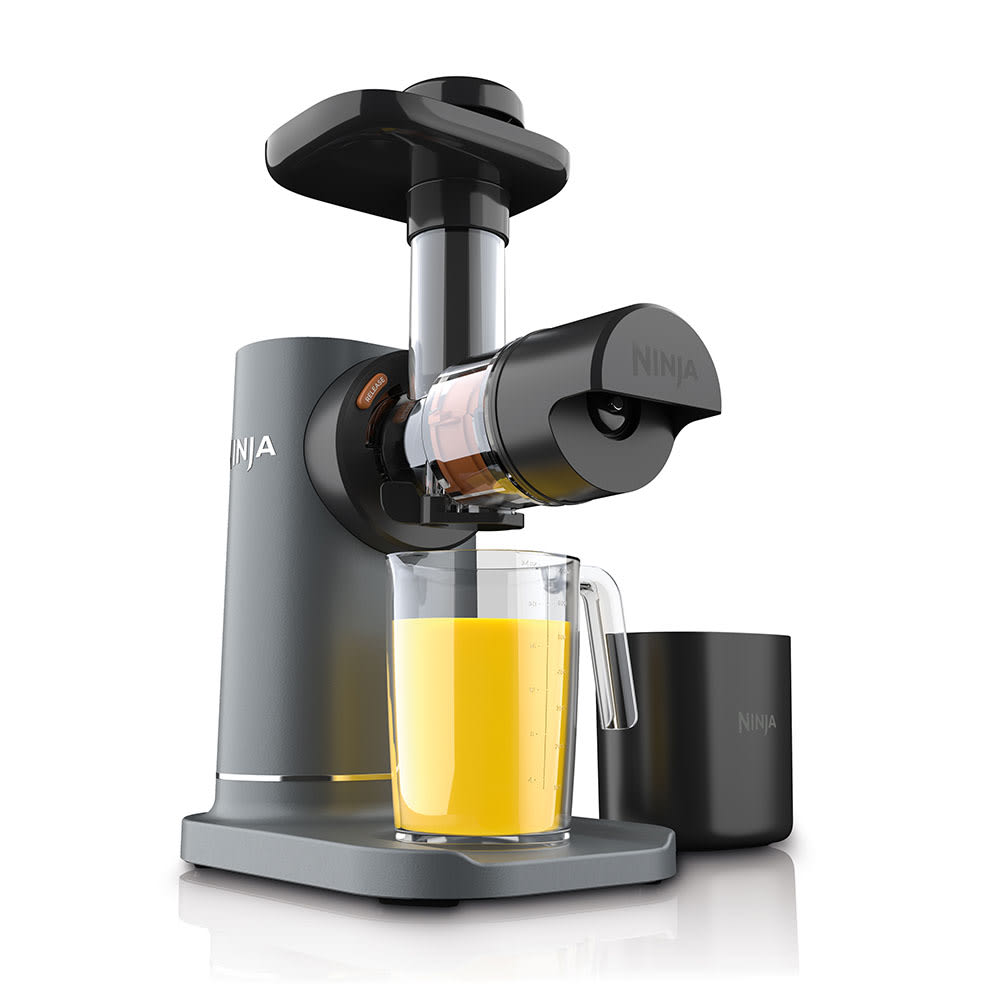
The U.S. product page identifies JC151 in Machine Gray, while the manufacturer directory lists the Spanish Moss JC151SD and its dedicated detail page. Both configurations are described with the same two programs, interchangeable filters, dimensions, included items, and one-year limited warranty; the finish difference is covered here rather than treated as a second juicer design. The image on this review shows the Gray configuration, not Spanish Moss.
Ninja lists a 150-watt, 120-volt base, a 31.5-inch cord, and a body measuring 12.11 inches long by 7.15 inches wide by 15.93 inches high. Those are manufacturer specifications, not a countertop test; the length is treated as front-to-back depth in fit comparisons. Reserve space for the tall pusher, jug access, pulp container, cord, and room to take the parts to a sink. The page does not publish a chute diameter, so this is not a model to select on a quantified chute-width requirement.
Two filters make pulp a real choice
The box list includes a black, finer-mesh Less Pulp filter and a larger-mesh orange Lots of Pulp filter. Ninja recommends the orange filter for soft, fibrous produce such as pears, berries, seeded melons, and pineapple. That is a maker instruction, not a promise of a particular mouthfeel or a measured extraction result. A filter swap also means taking the juicing assembly apart; if you will change preferences often, count the extra setup and cleaning step rather than assuming a dial changes the screen.
The controls are similarly straightforward but limited. Start/Stop runs continuously for up to 12 minutes according to the manual. Reverse is a press-and-hold action: after a beep and short pause the auger turns in the opposite direction, then releasing the control stops it. It is there to help clear a blocked chamber or restart ingredients that are not processing. It is not a variable-speed setting, and the product name should not be read as a guarantee that blockages are impossible.
Follow the feed and prep sequence
Assemble the auger, the chosen filter, and pulp spout, then lock the feed chamber onto the base. Put the pulp container below its outlet and the juice jug beneath the anti-drip lever; open that lever before juicing. Start the motor before gradually adding produce, let each addition process, and use the supplied tamper as needed. The manual tells users to remove pits and seeds and tough citrus peels, and it rules out hot ingredients, frozen fruit or vegetables, and ice. Reverse and the tamper are troubleshooting tools, not a reason to force an unsuitable ingredient through the chute.
The 36-ounce pulp container is consistently listed. The jug is not: the U.S. page calls it 24 ounces in feature copy but 30 ounces in the in-box list, and the separate Ninja replacement-jar page says the compatible jug collects up to 24 ounces. Because those manufacturer statements conflict, the included jug's usable capacity is left unknown for matching. If your essential condition is a specified 34-ounce-or-larger container, the JC151 should not pass it on the strength of the contradictory copy. Verify the exact package with Ninja before relying on a capacity label.
Plan for cleanup and limits
The JC150 Series owner's guide says all attachments except the motor base are top-rack dishwasher-safe and warns against a heated-dry cycle. That is helpful for frequent juicing, but it does not make cleanup hands-off: rinse the auger and chamber, clear pulp buildup on the metal filter mesh with a cleaning utensil or toothpick, and wipe the unplugged base with a damp cloth. The manual specifically says not to pour water into the installed feed chamber as a cleaning shortcut. After use, the jug nests inside the pulp container for storage.
The same guide says an overload can temporarily disable the motor and recommends waiting about two minutes before trying again. It also notes that fibrous ingredients may make a squeak and calls that normal. The one-year limited warranty is for normal household use and the original owner of the original product. Those details make the machine's ordinary maintenance and stop-and-reset behavior more useful buying checks than marketing language about non-stop operation.
Who should compare it with something else?
Choose the JC151 if its masticating mechanism, two pulp-filter choices, top-rack-cleanable attachments, and modest body width line up with your routine. Compare it with the earlier Breville BJS700 if you want another slow-compression design with Forward/Off/Reverse control and a detachable pulp outlet; its manual and stated dimensions differ, and its jug capacity and chute width remain unconfirmed as well. If you would rather use a centrifugal cutting disc, the Breville Cold Plus BJE530 offers a documented 3.5-inch feed chute, a two-speed Low/High control, and a 70-ounce sealed jug, but it is a different mechanism and still needs its mesh basket brushed promptly. Read those exact-model assessments before prioritizing “slow” or “fast” as a label.
Bottom line
The JC151 earns consideration for a useful filter choice, clear Reverse procedure, and dishwasher-safe removable parts. It is not a quantified-capacity pick: the maker's two jug labels conflict, and no feed-chute width is published. Use the maker's preparation and 12-minute run instructions, keep the motor base out of the dishwasher, and verify that a seller is offering JC151 Machine Gray or the JC151SD Spanish Moss variant you actually want.
Key details at a glance
| Extraction method | Slow-compression masticating extractor |
|---|---|
| Motor electrical rating | 150 W |
| Listed width | 7.15 in |
| Listed depth | 12.11 in |
| Listed height | 15.93 in |
| Dedicated Quiet selector label | No |
| Juice jug and lid dishwasher-safe | Yes |
| Filter basket dishwasher-safe | Yes |
| Controls and use | Start/Stop operates continuously up to 12 minutes; Reverse is a hold-to-run blockage-clearing control after a beep and pause, not a speed setting. The manual gives no feed-chute width. |
| Cleanup note | All removable attachments except the motor base are top-rack dishwasher-safe without heated dry. Rinse parts after use; clear pulp on the metal filter mesh with a cleaning utensil or toothpick, and wipe the unplugged motor base with a damp cloth. The manual says not to add water to the installed feed chamber as a cleaning shortcut. |
| Manufacturer jug label | Unknown for matching: product-page feature copy says 24 fl oz, its in-box list says 30 fl oz, and the separate maker replacement jug page says up to 24 oz. |
| Supplied cup nozzle | No |
| Blender mode on the same base | No |
| Pulp container capacity | 36 oz |
| Maximum continuous run listed by maker | 12 min |
| Filter configuration | Two interchangeable Less Pulp / Lots of Pulp filters |
| Removable parts dishwasher-safe per manual | Yes |
| Manufacturer-listed voltage | 120 V |
Use the exact model’s instructions for operating limits, supplied equipment and version differences.
Sources for this assessment
- Ninja U.S. NeverClog JC151 product page observation transcript; direct HTML fetch blocked
- Ninja U.S. JC151SD Spanish Moss detail-page observation, finish-only sibling evidence
- SharkNinja JC150 Series Owner's Guide, 13-page third-party-hosted manual copy; checked against official manual index title
- Individually inspected JC150 Series Owner's Guide text extraction and notes
- Ninja support manual index observation; JC150 Series quick start, inspirational, and owner guides listed
- Ninja U.S. accessory compatibility and replacement-juice-jug capacity observations
- Official Ninja JC151 Machine Gray image from SharkNinja asset host; rendering status not identified
Now check the model against your kitchen.
Use the finder for extraction style, batch, cleanup, control, and counter-fit requirements.