
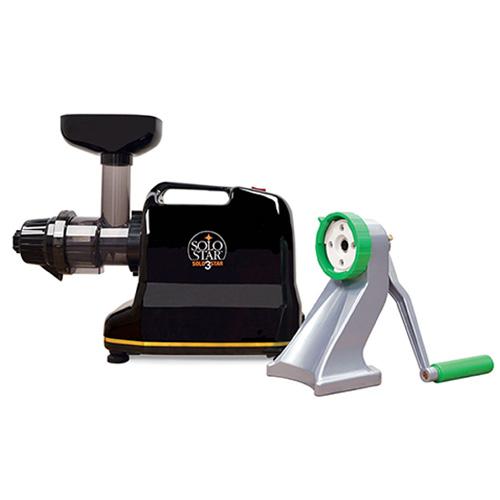
Your needs, this model
Does it fit your priorities?
Will you use the separate pasta/homogenizing setup along with the juice configuration?
The grouped SoloStar 3 manual lists a homogenizing screen with spaghetti and fettuccini nozzles, but these require a stopped configuration change and an actual used package must be checked.
Explore this need in the finder →Are dishwasher-safe removable parts essential for this earlier model?
No. Tribest’s grouped Solostar FAQ says removable Solostar parts are not dishwasher-safe; the manual directs hand-washing.
Explore this need in the finder →Must the manual document a continuous session of at least 20 minutes?
No. The grouped manual warns that more than 30 minutes straight may overheat the motor and describes cooling after automatic shutdown; it does not specify a guaranteed session or routine rest interval.
Explore this need in the finder →Tribest's support pages identify the horizontal, single-auger SoloStar 3C as SS-9113C. Its older manual also documents a separate homogenizing screen and noodle nozzles. But the manual is headed SS-9113, not SS-9113C: the FAQ groups the C suffix with that manual, a support bridge rather than a C-specific specification sheet or a promise about the parts in a used unit.
What the model identity does—and does not—establish
The official selector prints SS-9113C. Tribest's grouped FAQ names SS-4200, SS-4250, SS-9113 and SS-9113C together and points to one manual. Its cover and specification page name SoloStar 3 / SS-9113; the U.S. rating is 120 volts, 60 Hz and 180 watts, and its introduction gives 80 RPM. The grouped FAQ is the maker's bridge for using this manual, not evidence that the two suffixes are identical.
The current U.S. juicer collection lists 14 items, including SoloStar 4 but not 3C. That supports treating the 3C as an earlier model; it does not prove no used or old-stock offer exists. Separate 3C parts pages still list accessories under a collection headed SS-9113C-B. That is parts support, not an offer for a complete machine or proof of an individual seller's contents.
A juicing configuration and a separate food-processing configuration
The SS-9113 manual describes a horizontal single auger with one juicing screen and a separate homogenizing screen. The normal juice path uses the juicing screen and juicing nozzle; the manual directs the user to choose the homogenizing screen and a task-specific nozzle for pasta and other food-processing jobs. It lists spaghetti and fettuccini nozzles among the parts and describes noodles, rice cakes, breadsticks, tofu and selected grinding or homogenizing tasks. This is a changed screen/nozzle setup, not a second function running at the same time as juice extraction. Some tasks have narrow ingredient instructions: for example, the manual warns against using the homogenizing nozzle for dried pepper or coffee beans.
The attachments are the clearest reason to consider it. For juice alone, extra screens, nozzles and cleanup mean storage and setup overhead. If pasta making is already part of your routine, this configuration is more relevant than a juicer with only a large hopper. Before buying secondhand, ask the seller to show the screens, locking cap and nozzles actually present; an original manual's parts list does not prove a used unit still has them.
Preparation, feeding and cleanup are not hands-off
For juice, cut fruits and vegetables into smaller lengthwise pieces and feed in small amounts. The parts list shows a plastic plunger; never put fingers or utensils into the chute. The manual gives no numeric opening or receiver capacity, so this cannot meet a strict counter-opening or minimum-pitcher-volume requirement. It identifies separate juice and pulp containers but states neither volume.
Clean the screen promptly: the manual says dry residue can block its holes. Use lukewarm water and mild detergent, not hot water or harsh cleaners such as bleach; Tribest's grouped FAQ says removable Solostar parts are not dishwasher-safe. Do not submerge the motor. If your essential cleanup rule is a dishwasher, this is the wrong setup; otherwise, budget time for hand-washing after feeding.
Read the overheating warning literally
The manual warns that more than 30 minutes of straight use may overheat the motor. It says automatic thermal or overload shutdown can occur and advises switching off and letting the motor cool for about 30 minutes before resuming. This is a caution and recovery step, not a promise that every batch can run continuously for 30 minutes, and not a normal use/rest schedule. The manual does not establish a guaranteed continuous-session minimum or routine rest interval. If your routine depends on a documented long batch, do not turn the warning into a rated session; choose a model whose manual expressly gives the interval you need.
Who should consider an earlier SoloStar 3C?
Consider a carefully checked used or old-stock unit if you want a horizontal auger juicer with the original homogenizing and pasta setups, accept preparation and hand-cleaning, and can verify parts and condition. Look elsewhere if you need a current new-unit offer, dishwasher-safe parts, a documented receiver capacity, measured chute width or guaranteed session schedule. Do not infer those facts from a SoloStar 4, photo or seller's parts bundle.
Compare the current-reference SoloStar 4 for a similar two-screen/pasta path; it has its own current U.S. offer and unresolved specification conflicts. The vertical Shine Easy is instead a hopper-led juicing workflow. These are configuration differences, not comparative yield, noise, durability or cleaning tests. For a used 3C, verify its suffix, parts, condition and seller terms, and check current product-safety information.
The assessment is based on Tribest's product selector and grouped Solostar FAQ, user-manual index and linked SoloStar 3 manual, plus its current U.S. juicer collection and paginated SoloStar 3C parts listings. Tribest does not identify whether its product-selector image is a photograph or a rendering. No ownership, yield test, price, current complete-unit offer, individual-unit condition, or transferable warranty is claimed.
Key details at a glance
| Extraction method | Slow-compression masticating extractor |
|---|---|
| Speed control | Single-speed on/off |
| Motor electrical rating | 180 W |
| Blender mode on the same base | No |
| Body-fit measurement note | The manual lists size without assigning width/depth/height axes. Do not map its order to physical axes or use it for strict counter fit. |
| Pasta-making attachments included | Yes |
| Removable parts dishwasher-safe per manual | No |
| Manufacturer-listed voltage | 120 V |
| Maker-listed rotational speed | 80 rpm |
| Dimensions as listed (axes unspecified) | 17.3 x 13.8 x 7.5 inches; manual gives no axis assignment |
Use the exact model’s instructions for operating limits, supplied equipment and version differences.
Sources for this assessment
- Tribest U.S. product FAQ selector and grouped SoloStar support FAQ
- Tribest U.S. user-manual index
- Tribest English SoloStar 3 operation manual (24 pages)
- Tribest current U.S. Juicers collection
- Tribest SoloStar 3C parts and accessories, page 1
- Tribest SoloStar 3C parts and accessories, page 2
- Tribest official SoloStar 3C product-selector image

Now check the model against your kitchen.
Use the finder for extraction style, batch, cleanup, control, and counter-fit requirements.