
Your needs, this model
Does it fit your priorities?
Do you want a hand-powered press rather than a motorized citrus reamer or an auger?
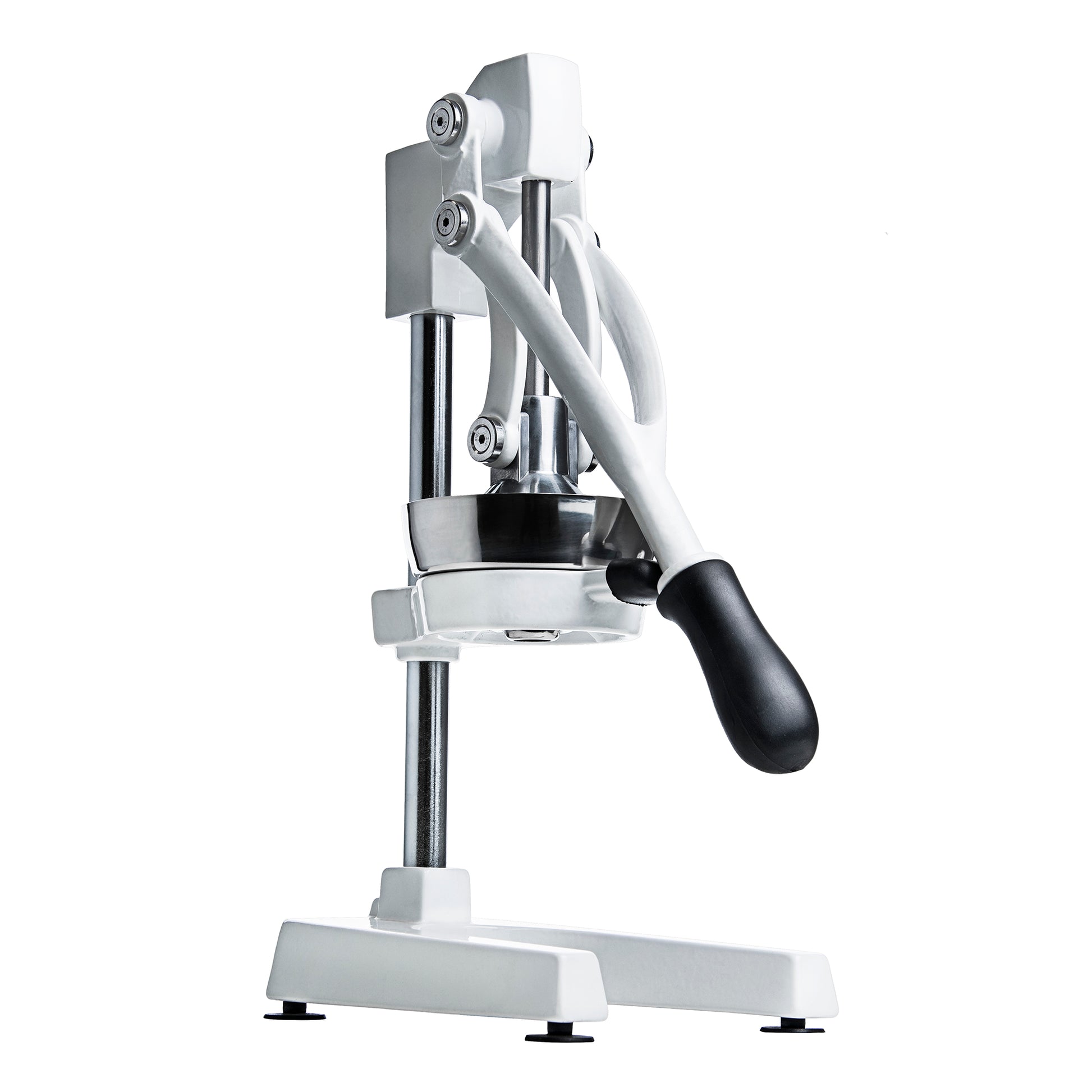
Sana calls the Citrus Press a mechanical press: halve the fruit, place it on the stainless cone and pull the lever. No powered motor is listed.
Explore this need in the finder →Must the maker explicitly name pomegranate as a supported fruit?
Both Sana's exact U.S. listing and the global Citrus Press page list pomegranate; each describes pressing a cut half rather than juicing loose seeds.
Explore this need in the finder →Does the press need to include a measured juice vessel?
Sana tells the operator to place a glass below the press but does not confirm whether it is supplied or state a receiver capacity for this U.S. SKU. A required included vessel or minimum volume is not verified, so this model does not satisfy that evidence-based constraint.
Explore this need in the finder →Do you need to juice greens, carrots or apples through an extractor chute?
This model is a dedicated mechanical press for citrus and pomegranate halves, not a whole-produce extractor. Choose a centrifugal or auger model if vegetables, greens or apples are central to the job.
Explore this need in the finder →The Sana Citrus Press is a manual lever appliance for halved citrus and pomegranate, not a slow juicer with an auger. The exact U.S. white offer is SKU SCITRUS-WHT; Sana USA's saved product data showed that color available on October 24, 2026, while the black finish was unavailable. Its attraction is a direct, cord-free press-and-glass routine. Its limitations are just as direct: you cut and position each half, place a suitable glass beneath it, and still need another machine for leafy greens or whole-produce recipes.
A press, not an extractor
Sana describes a heavy cast-iron body with stainless-steel juice-contact pieces. The global product page labels the process mechanical pressing; the U.S. page describes a stainless cone, a lever and a bowl. This is a simpler job than an auger machine: the page tells you to halve the fruit, place that half on the cone, position a glass underneath and pull the handle. No wall outlet, motor switch, feed chute, juice screen or pulp bin is part of this routine. That also means no automatic feeding: if you want a pitcher for a larger round of citrus, you prepare and press the fruit one half at a time.
The company lists oranges, grapefruit, lemons and limes, as well as pomegranates. Its pomegranate instruction is to slice the fruit in half and press; it is not a recipe for feeding loose seeds into a separate juicer. Sana says the design presses without peeling and claims that less peel bitterness reaches the juice. That is the maker's description, not a result from a comparative taste or yield test. The product page does not publish a bowl diameter, pomegranate size limit, usable receiver volume or measured extraction rate, so don't assume every fruit half or drinking glass will fit without checking your intended vessel.
Plan around a vessel the source does not quantify
The U.S. listing says to place a glass below the press but does not establish whether one is included. It gives no usable collection capacity, so an included-carafe requirement or a hard 32-ounce minimum is not verified. Treat the pressing bowl as the path to a vessel, not as a quantified storage container. If you want to juice several people at once, check whether your glass fits beneath the lever and plan for repeated pressing. Sana's image shows the white press itself rather than a receiving glass.
The operation is tactile but does ask for repeated arm motion. That may be a welcome trade if your aim is a few fresh citrus halves without powering, assembling and rinsing a motorized unit. It is a poor match if hand strain is a concern or you expect the machine to halve fruit, separate pulp or empty peel for you.
Two official pages, one unresolved weight
There is a material specification discrepancy to resolve before selecting a storage location. Sana USA's current product copy says the press weighs 10 kilograms; Sana Products' global specification table says 6.5 kilograms and lists 230 × 180 × 460 mm without labeling which number is width, depth or height. The U.S. product data also contains a variant shipping-weight field, but that does not settle the installed machine's mass. These are official sources that do not agree, not numbers to average. I leave the U.S. unit weight and all three fit dimensions unknown in the finder. If you need a firm lifting or cabinet-clearance limit, ask Sana USA to confirm the SCITRUS-WHT specifications in writing.
The regional warranty and care evidence has a similar boundary. The global page states a two-year warranty, but the U.S. product page does not set out the U.S. coverage terms, so the global duration is not assigned to this SKU. The global page says to wipe the stainless pressing cap and rinse the bowl and cone; it also identifies the stainless bowl and cone as dishwasher safe. It does not establish that the cast-iron body or every part should go in the dishwasher. No separate U.S. manual or complete care schedule was located. Use those narrow care statements cautiously and confirm whether they apply to your current U.S. package rather than extrapolating them to the entire press.
When to choose a different citrus routine
Compared with a small hand reamer, this press uses a longer lever and a substantial base, rather than asking you to twist each half directly over a bowl. Compared with a powered citrus press such as the Breville 800CPXL, it has no powered cone or motorized arm; the electric option may be preferable if repeated hand effort is the bottleneck. The Tribest MJP-105 is another hand-powered press, with its own published bowl diameter, package and instruction book. Choose among those formats by the exact vessel, handle mechanism and cleanup routine—not by a generic claim that one press extracts more juice.
For greens, celery, carrots or apples, compare a centrifugal or auger juicer instead. This Sana press does not have the feed path for those jobs. Sana mentions an optional tomato attachment on the global page, but that is not established as part of the white U.S. package and should not turn this citrus offer into a general-purpose extractor match. If tomato processing is essential, verify the attachment SKU, fit and U.S. availability separately.
What the exact offer does—and does not—confirm
The U.S. page and product data identify white SCITRUS-WHT and showed it available on the check date; black SCITRUS-BLK was unavailable then. Recheck the exact SKU before ordering. This is source-based research, not a hands-on test: no yield, force, sound, speed or durability was measured. Read the exact Sana USA Citrus Press listing and Sana Products' global page alongside the manual-versus-electric citrus guide; the conflicting weight statements remain unresolved.
Key details at a glance
| Extraction method | Hand-operated bowl-and-arm fruit press |
|---|---|
| Body-fit measurement note | Global dimensional text is retained only as a reference. The exact white U.S. offer has no labeled width/depth/height, so strict-fit matching is not supported. |
| Hand-powered operation | Yes |
| Pomegranate use listed for this exact model | Yes |
| Dimensions as listed (axes unspecified) | Sana Products global page: 230 × 180 × 460 mm (axes not labeled); Sana USA's current listing gives no dimension values. |
Use the exact model’s instructions for operating limits, supplied equipment and version differences.
Sources for this assessment

Now check the model against your kitchen.
Use the finder for extraction style, batch, cleanup, control, and counter-fit requirements.