
Your needs, this model
Does it fit your priorities?
Is a dedicated citrus press essential, rather than a fruit-and-vegetable extractor?
The 800CPXL presses halved citrus fruit on a cone; it does not feed apples, carrots or greens through an extractor chute.
Explore this need in the finder →Do you specifically need a triple-hinged active press arm?
The current U.S. product page describes an active arm and the linked 800CPXL instruction book calls the juice press arm triple hinged.
Explore this need in the finder →Must the fruit dome use a keyed EJECT release?
The linked 800CPXL manual describes a keyed fruit-dome insert and instructs pressing the EJECT button to remove it during disassembly.
Explore this need in the finder →The Breville Citrus Press Pro 800CPXL is a counter-top citrus press with a different arm and material specification from the less elaborate BCP600. It is for people who expect to make juice from halved citrus repeatedly and want the arm to guide pressure onto the fruit. It is not a centrifugal or slow juicer: there is no feed chute for apples, carrots or greens. If you want a single machine for those foods too, changing to a produce extractor is more important than choosing between the two Breville citrus presses.
The triple hinge is the meaningful operating distinction
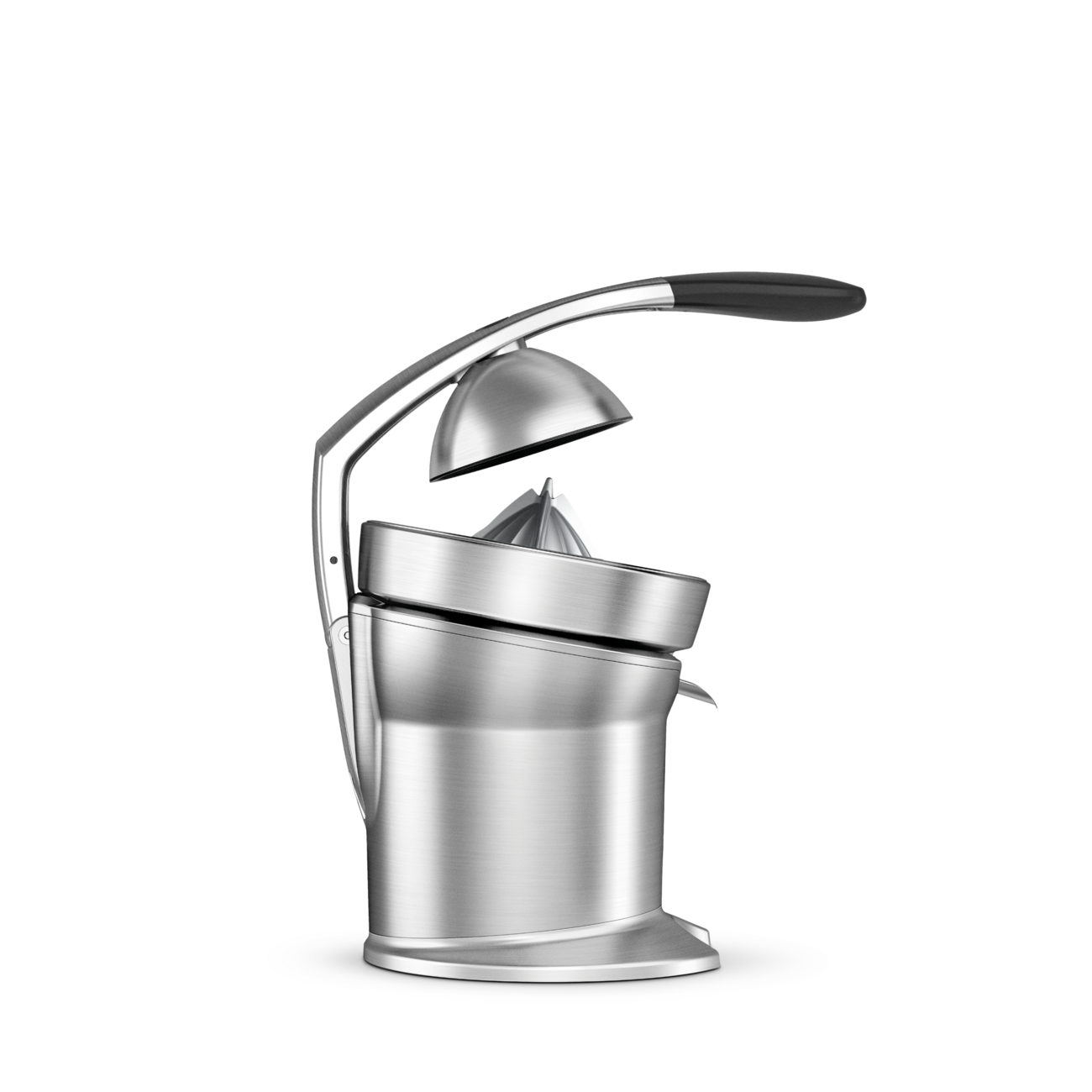
The press arm uses a triple-hinged active design and soft-grip handle. The maker says the linkage maintains downward pressure through the press; the manual's practical steps are to place a cut-side-down citrus half on the cone, lower the arm, and press firmly until the fruit dome touches the peel. The motor starts automatically under pressure. A double-stage switching system prevents the unit operating unless it is properly assembled, and Breville's product page says the arm must be lowered and sufficient pressure applied before the cone spins. This describes how its safety interlock behaves; it does not remove the need to keep fingers clear of the rotating cone and hinged parts.
Breville's Quadra-Fin cone is described as finned and undulating, and the maker identifies it as acid-resistant die-cast stainless steel. The product page also lists a solid die-cast base, stainless-steel filter basket and soft-grip handle. These are more specific construction claims than the BCP600 page makes: its listed body is heavy-grade polymer and it does not identify the cone material. The maker's durability language is not independent testing, so the useful comparison is what is documented rather than a guaranteed service life.
One cone handles the citrus sizes Breville lists, but the manual still describes halving the fruit and trimming some knobbly lemon or tangelo tips for better dome contact. A spout with a flip-up drip stop drains to a glass or jug; pulp and seeds stay in the stainless filter. The filter has to be emptied when full. The instruction book cautions not to let it overfill because that may stop correct operation or damage the appliance.
Space and cleanup are part of the purchase
The U.S. product page lists the body at 7.6 inches wide, 10.3 deep and 14 high. It is shorter than the BCP600's listed 18-inch height and shallower than its listed 12.8-inch depth, but the height is only the published appliance measurement. Leave room to raise and lower the press arm, place a vessel at the spout and remove the collector, cone and filter for washing. Check your counter and overhead clearance with the exact machine rather than treating a compact-looking product image as a fit test.
The manual says all removable parts can be washed in hot soapy water or on the top dishwasher shelf. It names the stainless filter, fruit dome, cone and juice collector as dishwasher-safe. The motor base and press arm are wiped with a soft, damp cloth. Rinse the parts immediately after use: the booklet says dried citrus pulp is hard to remove and may stain. It also advises against bleach soaking, immersion of the base and harsh abrasives. The keyed fruit dome is removed with the marked EJECT button during disassembly, then drops onto the cone; that is a more deliberate attachment than the BCP600's magnetic dome but keeps the dome from rotating during use.
Choose by routine, not the Pro label
This model suits someone who wants a guided lever action, a specified metal cone and die-cast body, and a dedicated citrus station that can live on the counter. Its 110-watt, 120-volt rating is an electrical specification, not a juice-yield measure. The manual calls for fruit to be cut across its segments, placed cut-side-down, and pressed until the dome reaches the peel; it does not promise a fixed yield from a fruit or a particular batch size. If you usually make just a half lemon for cooking, a hand reamer or compact manual squeezer may be simpler to store. If you regularly press a bowl of citrus for drinks or recipes, an electric arm press avoids the repeated hand-twisting motion, but it still processes one half per cycle and leaves pulp to clear.
Choose the BCP600 instead if its one-handed lever and magnetic dome better fit your routine and you do not require a documented die-cast cone or body. The BCP600 page/manual dimension disagreement is a reason not to use its page numbers as a strict clearance match. Choose a centrifugal unit such as Breville's JE98XL or BJE430 if your normal ingredients include apples, vegetables or greens; those machines cut and strain produce and have different preparation, cleanup and counter requirements. They are not better or worse versions of this press; they solve another task.
Bottom line
The 800CPXL earns consideration when a household wants an electric press specifically for citrus and values a triple-hinged arm plus maker-documented die-cast stainless cone. Its removable parts are dishwasher-safe, but prompt rinsing and filter emptying still matter. It does not broaden the menu beyond citrus, and it should not be chosen solely for claims like “maximum juice” or “effortless” without recognizing that the maker's use still involves cutting and positioning every half. For citrus-only kitchens, the real choice is between the Pro's specified metal construction and active arm and the BCP600's simpler lever/magnetic dome—then whether either fits the space and cleanup routine you can actually maintain.
Key details at a glance
| Extraction method | Dedicated citrus reamer or cone press |
|---|---|
| Speed control | On/off with pressure-activated cone |
| Motor electrical rating | 110 W |
| Listed width | 7.6 in |
| Listed depth | 10.3 in |
| Listed height | 14 in |
| Dedicated Quiet selector label | No |
| Filter basket dishwasher-safe | Yes |
| Controls and use | The manual lists an ON/OFF button. The cone starts when pressure is applied and stops when the arm is raised; no variable-speed control or produce-feed system is documented. |
| Cleanup note | The manual permits removable parts on the top dishwasher shelf or in hot soapy water; it instructs the user to wipe the motor base and press arm with a damp cloth, promptly rinse the removable parts, and empty the filter before it overfills. The keyed dome is removed by pressing the EJECT button during disassembly. |
| Manufacturer jug label | No supplied collection jug capacity is stated on the U.S. product page or in the reviewed English manual; use a separate glass or jug under the spout. |
| Press-arm design | Triple-hinged active arm |
| Fruit-dome attachment | Keyed dome with EJECT release |
| Cone material stated by manufacturer | Die-cast stainless steel (maker-described as acid-resistant) |
| Body/base construction | Solid die-cast base, per the U.S. product page. |
| Cone design | Finned and undulating Quadra-Fin cone; specified for citrus sizes by Breville. |
Use the exact model’s instructions for operating limits, supplied equipment and version differences.
Sources for this assessment
Now check the model against your kitchen.
Use the finder for extraction style, batch, cleanup, control, and counter-fit requirements.