
Your needs, this model
Does it fit your priorities?
Is a two-speed centrifugal extractor the right style for your regular fruit-and-vegetable juice?
The NBJ50100ID guide shows a spinning sieve and Low/High controls, not an auger or citrus-only cone.
Explore this need in the finder →Would a 27 oz pitcher cover your collection batch?
The exact guide lists a 27 oz pitcher; capacity is not a yield promise.
Explore this need in the finder →Do you require three speeds rather than Low and High?
This exact guide lists two settings, so a three-speed requirement is not established.
Explore this need in the finder →Must every removable juicing part be dishwasher-safe?
The guide excludes the food pusher and no-drip spout, as well as the base, from dishwasher-safe parts.
Explore this need in the finder →Do you need a ten-minute uninterrupted session to be documented?
The 15-minute instruction is an overheat cooldown; ordinary continuous-use time is not stated.
Explore this need in the finder →The nutribullet Juicer is a straightforward centrifugal extractor whose exact NBJ50100ID package pairs two speeds with a 27-ounce pitcher and an integrated pulp basin. It is a sensible starting point if you want fruit-and-vegetable juice without stepping up to a more accessory-heavy bundle. Its useful limitations are equally concrete: the maker does not publish a normal session timer, the listed body dimensions have no named axes, and several removable parts stay out of the dishwasher.
A spinning sieve for prepared produce
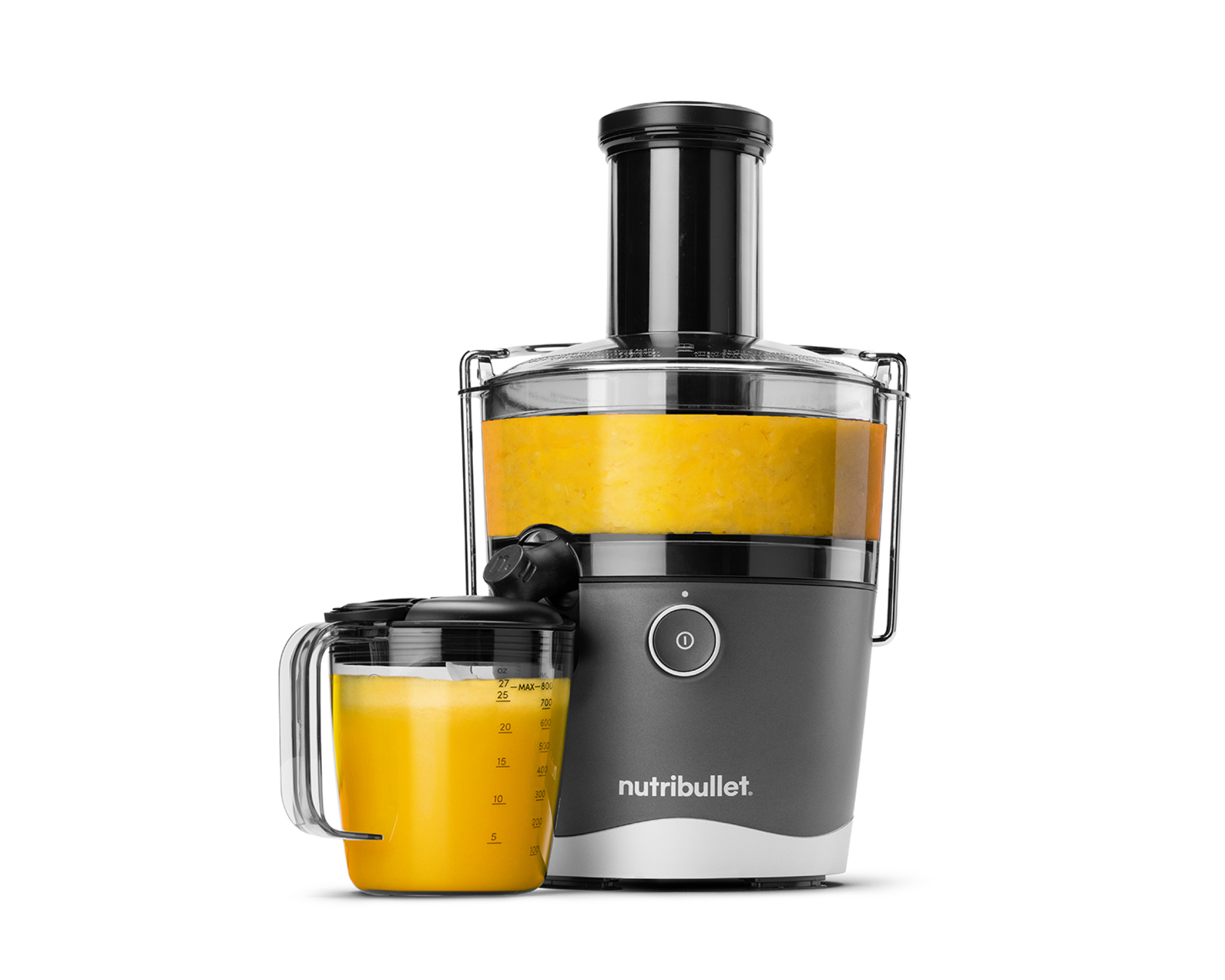
The U.S. product page and NBJ50100ID guide describe an 800-watt centrifugal juicer. A spinning stainless-steel sieve separates juice from pulp, with the pulp falling into an integrated 1.5-liter basin. This is different from an auger pressing produce through a screen, and it is not a citrus cone that handles only halved oranges or lemons. The two labeled speeds are Low and High. Those controls give you an option for ingredient choice, but the power rating and speed labels do not establish measured yield, smoothness, noise, or extraction efficiency.
The 3-inch feed chute can reduce cutting for some produce, but the manual still asks you to remove citrus rind and hard pits and not to process frozen produce. It instructs you to start the machine before feeding and to use the pusher gently. That is a better fit for someone willing to follow those steps than for a shopper who equates a wide opening with “everything goes in whole.” The product page presents an integrated pulp basin, so there is not a separate collector sitting beside the base. The pitcher still occupies space below the outlet, and the assembly needs disassembly and handling after use.
What the 27-ounce pitcher tells you
The supplied pitcher is labeled 27 ounces and includes a lid with froth separator. That is the rated container size, not a promise of how much juice a basket of produce will yield. It does not make the NBJ50100ID a larger-batch machine than the Juicer Pro: both exact guides list a 27-ounce pitcher. The useful difference in this pair is that the Pro adds Turbo, a dual-size pusher, a 2 L basin and storage accessories. Choose the standard model if those features are not essential and the 27-ounce vessel is enough.
The product page lists three body measures as 17.95 × 11.02 × 10.47 inches, but does not attach width, depth and height labels to them. Do not use one as a hard cabinet-clearance promise. Measure the assembled machine, overhead clearance for feeding, and room to position the pitcher and remove the pulp basin. The 6.9-pound listed weight may help estimate lifting effort, but it says nothing about vibration or stability.
Cleaning and run limits
The manual identifies dishwasher-safe removable components but expressly excludes the food pusher, motor base and no-drip spout. It also says not to use the dishwasher's Sterilize cycle. If your essential rule is that every removable juicing part goes through the dishwasher, this is not a clean match even though many pieces can be loaded. Wipe the base rather than immersing it, rinse the sieve promptly and follow the manual's disassembly order. Small openings in a centrifugal sieve can hold pulp that dries, so “dishwasher-safe components” should not be read as a no-cleanup promise.
There is no ordinary continuous-use duration in the guide. The 15-minute cooling instruction applies when the motor stops from overheating: unplug it and let it cool before trying again. It is not a recommended 15-minute juicing session and does not support a hard minimum-run-time requirement. If a timed uninterrupted batch is essential, leave the answer unknown rather than borrowing the Pro's limit or a number from another nutribullet model.
Where it sits beside the Pro and Cold Press
The Juicer suits a kitchen that wants a two-speed centrifugal mechanism, a known 27-ounce receiver and an integrated pulp basin. The Pro is the more control-rich centrifugal choice with Low, High and Turbo, a larger basin and storage pieces—but its pitcher remains 27 ounces and the manual sets a ten-minute run/rest boundary. If slower auger extraction is the priority, the current Cold Press Batch uses a 1.5 qt hopper and 35-ounce cup. That is a different workflow; its Reverse control clears a jam rather than supplying a second speed.
Do not choose by wattage alone or expect a particular yield, foam level or sound advantage. NBJ50100ID's evidence-backed match is a two-speed centrifugal setup with a 27-ounce vessel. It does not meet an all-removable-parts dishwasher requirement or a request for a documented ten-minute continuous session. A hard cabinet-fit need should also wait until you measure the actual product orientation instead of guessing which listed dimension is height.
Sources: nutribullet's U.S. NBJ50100ID product page and linked User Guide. Compare the Juicer Pro and Cold Press Batch Juicer. No personal ownership, lab measurements or customer-review evidence is claimed.
Key details at a glance
| Extraction method | Centrifugal fruit-and-vegetable extractor |
|---|---|
| Included juice receiver capacity | 27 fl oz |
| Pulp bin placement | Integrated within footprint |
| Published feed-chute width | 3 in |
| Speed control | Two speeds |
| Motor electrical rating | 800 W |
| Dedicated Quiet selector label | No |
| Manufacturer jug label | The exact model guide lists a 27 oz juice receiver; this is container capacity, not yield. |
| Fast/firm juicing guidance | The manual gives no ordinary continuous-run time; its 15-minute direction is an overheat cooldown only. |
| Body-fit measurement note | The maker lists 17.95 × 11.02 × 10.47 in without named axes; the values are not assigned to width/depth/height. |
| Electrical-rating caveat | Manufacturer-listed electrical rating; it is not a yield, noise or durability test. |
| Removable parts dishwasher-safe per manual | No |
| Automatic ingredient-sensing mode | No |
Use the exact model’s instructions for operating limits, supplied equipment and version differences.
Sources for this assessment
Now check the model against your kitchen.
Use the finder for extraction style, batch, cleanup, control, and counter-fit requirements.