
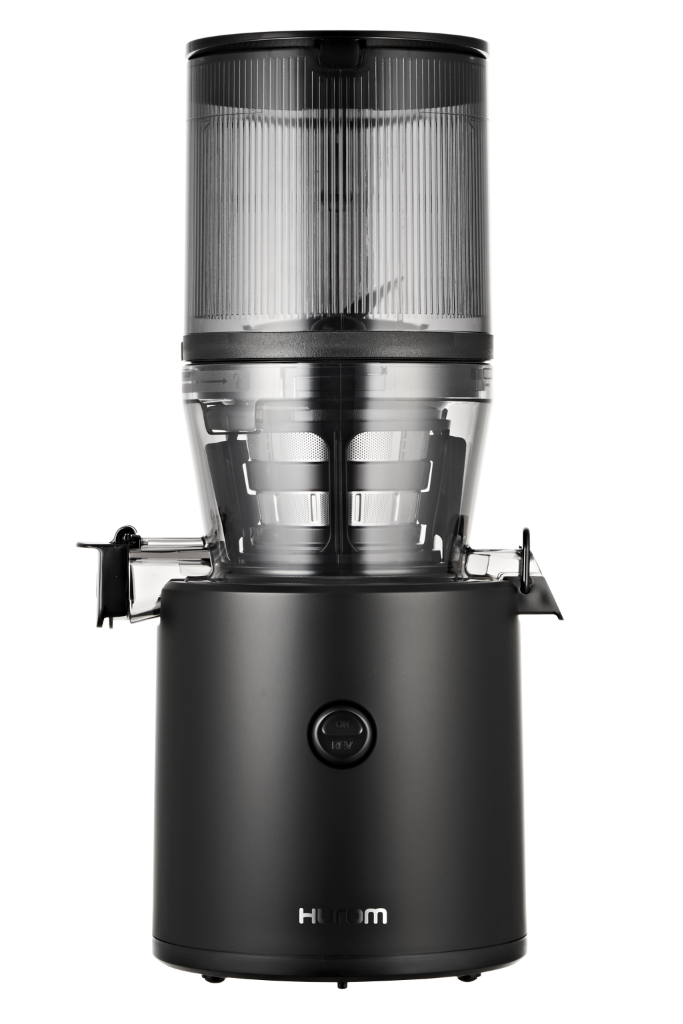
Your needs, this model
Does it fit your priorities?
Do you want the H320 package's coarse strainer for thicker soft-fruit or smoothie-style preparations?
The exact U.S. package lists fine and coarse strainers; the H320N manual directs the coarse screen for thicker soft-fruit juice and smoothie-style uses. It is not a homogenizing blank or blender.
Explore this need in the finder →Is a 2 L produce hopper sufficient for the batch size you want to stage?
Hurom lists a 2 L / about 67.6 fl oz hopper; that is produce-hopper volume, not juice output or juice-container size.
Explore this need in the finder →Can you accept the H320N manual's approximately five-minute stop-and-restart interval?
The manual says a safety timer stops the machine after about five minutes; a separate 30-minute limit does not establish an uninterrupted half-hour run.
Explore this need in the finder →Is the maker-listed 136 mm inlet large enough for your numeric feed-opening minimum?
The page lists 136 mm / about 5.4 inches. The manual still requires ingredient preparation; width alone does not establish whole-fruit fit.
Explore this need in the finder →The Hurom H320 is a powered, vertical auger juicer for people who want a large hopper and two screen choices, but are willing to cut ingredients and wash the assembly by hand. Its headline 2-liter capacity is the feed hopper, not a pitcher of finished juice; Hurom separately lists a 500 ml internal chamber and does not state the supplied juice container’s volume.
Who should consider the H320?
The exact U.S. listing maps the H320 to three finish codes—H320N-BBS01MB in Matte Black, H320N-BBS01MW in White, and H320N-BBS01DG in Kale. The H320N manual is linked from that U.S. page, which lists 120 V, 60 Hz and 150 W. It is a household slow juicer, not an all-purpose food processor. Consider it if you want to load a batch into a self-feeding hopper, choose between fine and coarse straining, and can work within the manual’s preparation and stop-start routine.
It is a less convincing fit if “batch” means collecting several liters of finished juice in one vessel, if you require an uninterrupted run longer than five minutes, or if dishwasher cleaning is essential. Hurom lists a juice container in the box but gives no container volume. The 500 ml number belongs to the internal chamber, and neither capacity promises a particular amount of juice from a given load.
The two screens change the job
The U.S. box list names a fine strainer, coarse strainer and spinning brush. The linked H320N manual describes the fine screen for ordinary fruit and vegetable juice. It describes the coarse screen for thicker soft-fruit juice and smoothie-, latte- or soup-style preparations. That is a useful choice of extraction setup, not evidence that the unit blends ingredients or produces a tested texture. If you specifically need a homogenizing blank for a separate food-processing task, do not treat the H320’s coarse juice strainer as equivalent.
This also matters when comparing the H320 with the newer-looking H330. Hurom’s H330 sales page calls its coarse strainer an added feature versus H320, but the exact current U.S. H320 page itself lists both fine and coarse strainers, and its H320N manual explains how to use the coarse one. The two page-level package records do not establish an exclusive coarse-screen advantage for the H330. Check the exact purchase package rather than deciding on that sentence alone. The H320-versus-H330 guide documents the conflict; our H330 review covers its own manual and setup.
A big feed hopper still needs preparation
Hurom lists a 2-liter hopper and a 136 mm (about 5.4-inch) inlet, alongside the 500 ml chamber. The inch figure is rounded; 136 mm converts to about 5.354 inches, so a hard 5.4-inch clearance is not established. A wide opening can reduce the need to stage each piece, but the manual still says to prepare ingredients small enough to enter and stay below the hopper’s limit mark. It asks you to remove hard, unchewable seeds, peel and cut thick-skinned fruit, and cut leafy or stem vegetables to three centimeters or shorter. It recommends mixing very soft or dry, viscous ingredients with other produce instead of feeding them alone. Frozen ice and grain-pulverizing are explicitly out of bounds. Use the supplied pusher only and keep the juice cap open during extraction.
The manual’s switch is not a speed dial: ON starts juicing, the center position stops, and REV works only while pressed. If the screw stalls, the instructions say to use short reverse pulses, let the screw stop fully, then resume forward operation. The H320 listing gives 50 RPM for the auger and 17 RPM for the spinning brush; those are manufacturer specifications, not user-selectable speeds or independent performance measurements.
Read the timer and care instructions literally
Hurom’s product page states up to 30 minutes of continuous use. The linked H320N troubleshooting page also says a safety timer stops operation after about five minutes and that pressing the switch briefly restarts it. The safety page separately warns against more than 30 minutes of continuous use and advises a break of over five minutes before another use. So a five-minute uninterrupted need is supported; a 15-minute single-session need is not. The separate 30-minute ceiling is not permission to ignore the automatic stop.
After the motor has stopped, unplug the unit and remove the chamber set. The manual calls for brushing and washing food-contact pieces under running water, opening the juice cap and discharge cover to clean the chamber, washing the silicone packings, and wiping the motor body with a damp cloth. It says not to put the parts in a dishwasher or dish dryer and not to use boiling or high-temperature water. This is not the minimal-parts, dishwasher-cleanup choice.
Bottom line
The H320 is most compelling when you want the documented 2-liter hopper and coarse-screen option, and the household’s juice routine can include ingredient prep, short timer-driven runs and prompt hand cleaning. It is a poor match for anyone who needs a known pitcher volume, long uninterrupted extraction or appliance-safe cleaning. Hurom’s U.S. page advertises 15-year motor-and-parts coverage while the linked manual cover says “Warranty not included”; read the current written purchase terms rather than assuming the headline settles eligibility or exclusions. For a similar hopper-first alternative, compare exact H330 documentation; for a strainer-free two-part chamber and different care routine, compare Hurom’s H70 or H400. None of these maker specifications substitutes for independent yield, pulp, noise or durability testing.
Primary sources: Hurom H320 U.S. product page, linked H320N Series manual and the maker’s H320 product data. Exact images are manufacturer-supplied; Hurom does not identify the pictured studio asset as a photograph or render.
Key details at a glance
| Extraction method | Slow-compression masticating extractor |
|---|---|
| Published feed-chute width | 5.35 in |
| Speed control | Single-speed on/off |
| Motor electrical rating | 150 W |
| Controls and use | REV must be pressed and held for a short reverse pulse to clear stopped/overloaded ingredients; it is not automatic reverse. |
| Published feed-chute width (metric) | 136 mm |
| Maximum continuous run listed by maker | 30 min |
| Body-fit measurement note | Hurom provides 243 × 223 × 463 mm (9.7 × 8.8 × 18.2 in) but does not name the axes; keep the published sequence and do not call individual values width, depth or height. |
| Filter configuration | Separate fine and coarse strainers |
| Continuous operation before rest | 5 min |
| Removable parts dishwasher-safe per manual | No |
| Produce hopper capacity | 2 L |
| Automatic ingredient-sensing mode | No |
| Internal juicing chamber capacity | 16.9 fl oz |
| Produce hopper capacity (not juice yield) | 67.6 fl oz |
| Batch-loading hopper | Yes |
| Separate smoothie strainer included | Yes |
| Manufacturer-listed voltage | 120 V |
Use the exact model’s instructions for operating limits, supplied equipment and version differences.
Sources for this assessment
Now check the model against your kitchen.
Use the finder for extraction style, batch, cleanup, control, and counter-fit requirements.