
Your needs, this model
Does it fit your priorities?
Do you specifically want a slow auger-and-screen juicing path rather than a spinning centrifugal basket?
Yes. The exact 67951 page and linked manual identify an auger-driven masticating slow juicer; the Reverse button clears food and is not another speed.
Explore this need in the finder →Is an exact-manual pomegranate recipe important, while wheatgrass remains an unconfirmed requirement?
The 67951 Type CJ16 guide includes a pomegranate-seed juice recipe, but neither the exact page nor inspected manual documents wheatgrass. A must-have wheatgrass answer must not be inferred.
Explore this need in the finder →Will an included 24 oz receiver work, or do you require a larger batch vessel?
The maker lists a 24 oz juice cup with froth separator. It is a container-volume fact, not a yield promise; a 32 oz minimum excludes this model.
Explore this need in the finder →Can you accept a 30-minute automatic continuous-use cutoff rather than needing a longer run?
The manual says the machine automatically shuts off after 30 minutes continuous operation or overload. A 30-minute need fits; a 31-minute minimum does not.
Explore this need in the finder →Do you need dishwasher-safe removable parts but reject high-heat SANI cycles?
Hamilton Beach marks the removable assembly dishwasher-safe and explicitly prohibits SANI; the motor base is kept out of water and the dishwasher.
Explore this need in the finder →The Hamilton Beach 67951 is a current U.S. slow juicer with a powered auger, one fine-mesh strainer and a supplied 24-ounce juice cup. It makes more sense for someone who wants an auger-based routine than for someone expecting a wide chute, variable speeds or a quantified yield advantage. Its most useful exact-model distinctions are the pomegranate recipe in its manual, its 30-minute automatic stop, and the work required to clean a separate screen.
A single slow-compression path, not a multi-mode machine
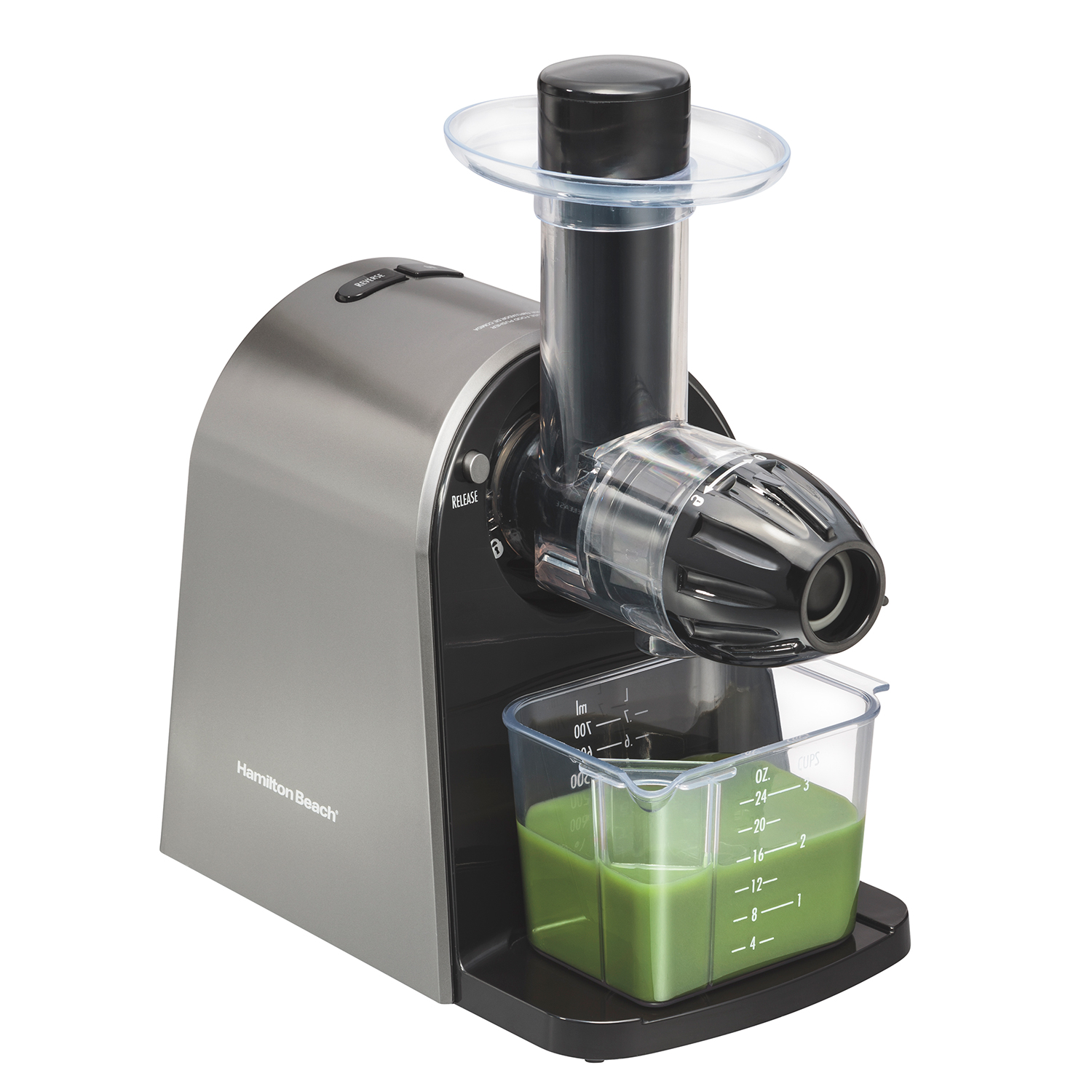
The exact U.S. product page calls model 67951 a masticating slow juicer. The linked 840243103 Use & Care guide identifies the unit as model 67951, Type CJ16, rated 120 V, 60 Hz and 150 W. The manual's parts drawing shows a motor base driving an auger in a juicer chute against a micro-mesh strainer. Juice flows into a separate container while pulp goes to a second bin. This is not a centrifugal basket with a selectable fast/slow dial, and it does not add a blender or citrus-press attachment.
There is one powered extraction direction: ON/OFF starts and stops the slow auger. A separate REVERSE button is there to help move food when the chute is blocked; it is not a second speed. The practical routine is gradual feeding with the included pusher. The manual says most produce needs cutting and advises peeling some fruit such as oranges, melons or mangoes. It also requires large pits and seeds to be removed. No numeric chute-width measurement is published, so a “slow juicer” label or funnel shape should not be used to assume whole produce will fit.
The 24-ounce cup is a small receiver, not an output claim
Hamilton Beach lists a 24-ounce BPA-free juice cup with a froth separator. The cup can sit under the spout, and its separator keeps froth from pouring into the glass as directed. That gives the maker a usable vessel-size match at 24 ounces, but capacity is not how much juice a particular shopping basket will produce. The pulp collector is a separate part, and its volume is not stated; do not count it as a large juice pitcher.
The listed body is 13.46 inches high, 12.6 inches wide and 7.44 inches deep. It is relatively wide across the counter, so check the width as well as front-to-back depth. Leave extra room for the feed pusher, the cup under the outlet, the external pulp bin and the twist-off parts needed for assembly and cleanup. The manual includes a pomegranate-and-blueberry recipe using seeds. That is exact-model evidence for pomegranate use; it does not establish that every hard seed or membrane should be fed into the machine. Wheatgrass is not named for this exact model and remains an unknown requirement rather than a promised capability.
Feed patiently and know the automatic stop
The manual's method is to run the machine, guide produce slowly with the pusher, and let juice and pulp fall into their separate containers. A gradual feed is not a test result or a guarantee of dry pulp: the troubleshooting section says to slow the pusher if the motor stalls or pulp is too wet, and to brush buildup from the screen. The manufacturer page claims a particular leafy-green yield compared with centrifugal juicers, but supplies no test protocol here. Treat that as a maker claim, not as measured comparative performance. The 150-watt electrical rating also says nothing by itself about juice volume, texture, sound level or durability.
The guide says the juicer automatically shuts off after 30 minutes of continuous operation or if overloaded; pressing ON resets it. That is a real use boundary, not a promise that a produce load takes a certain time or yields a certain batch. The product page markets minimal noise but gives no decibel reading or named quiet setting. If low sound is essential, this documentation does not verify a quiet mode.
Cleaning is helped by the dishwasher, not replaced by it
The page names the pulp bin, juice bowl, lid and pusher as dishwasher-safe and includes a strainer brush. The manual also pictures the removable assembly as dishwasher-safe while expressly keeping the motor base out of water and out of the dishwasher. It forbids the high-heat SANI cycle. The strainer remains a delicate micro-mesh screen: unplug before taking the unit apart, let it stop, remove the auger and chute components, and brush the screen promptly before fibers dry. Several pieces must be twisted or slid apart before they can be cleaned. So this may be manageable for an owner who rinses immediately, but it is not a one-button clean-and-store setup.
How it differs from the other shortlists
Choose 67951 over Hamilton Beach's centrifugal 67870 if the slower auger mechanism and manual-documented pomegranate recipe matter more than quick feeding or a three-inch opening. The 67870 page lists two speeds, an 800-watt motor and three-inch chute, but its supplied juice cup is 16 ounces; the 80-ounce figure belongs to its separate pulp bin. These capacity and mechanism distinctions are useful; they do not prove that either product yields more juice.
Ninja's JC151 is another current auger-style option, but it includes two maker-labeled pulp filters and its manual sets a shorter 12-minute maximum continuous run. Ninja's published juice-jug capacity is inconsistent, so it cannot be used for a hard receiver-size minimum. The 67951 instead has a single micro-mesh strainer, a confirmed 24-ounce cup and a 30-minute automatic shutoff. If named pulp-filter choices matter, compare the Ninja; if a known cup volume and the exact pomegranate recipe matter, the Hamilton Beach has the clearer documented match.
Who should consider it?
The 67951 suits a household that wants an auger-and-screen extractor, accepts cutting and slow feeding, finds a 24-ounce receiver adequate, and will brush the mesh after use. In the finder, the masticating requirement, a supplied receiver, an exact-model pomegranate need, dishwasher-safe removable parts without SANI, and a 30-minute continuous-session minimum can all fit this one assembly. A 32-ounce included receiver, a required SANI cycle, a requirement for more than 30 uninterrupted minutes, a confirmed wheatgrass capability, or a maker-labeled quiet mode does not fit its evidence. For a larger juice container, published chute width, or faster centrifugal approach, choose a different model and verify its own manual rather than transferring specifications across the Hamilton Beach range.
Sources: Hamilton Beach's exact 67951 product page and its linked 840243103 Use & Care guide. Compare the Ninja JC151 and Hamilton Beach 67870. No personal ownership, lab measurement or customer-review evidence is claimed.
Key details at a glance
| Extraction method | Slow-compression masticating extractor |
|---|---|
| Included juice receiver capacity | 24 fl oz |
| Pulp bin placement | External side bin |
| Speed control | Single-speed on/off |
| Motor electrical rating | 150 W |
| Listed width | 12.6 in |
| Listed depth | 7.44 in |
| Listed height | 13.46 in |
| Dedicated Quiet selector label | No |
| Juice jug and lid dishwasher-safe | Yes |
| Filter basket dishwasher-safe | Yes |
| Controls and use | The manual depicts ON/OFF and a separate REVERSE button to help clear stuck food. Reverse is not a second extraction speed; no variable-speed selector or speed dial is documented. |
| Cleanup note | Brush the micro-mesh strainer promptly under running water before fiber dries; the exact page includes a strainer-cleaning brush. Turn off, unplug and allow the auger to stop before disassembly. The guide marks removable parts dishwasher-safe but forbids SANI and excludes the motor base from water/dishwasher cleaning. |
| Manufacturer jug label | The exact product page lists an included 24 oz BPA-free juice cup with froth separator. This is vessel capacity, not a measured juice yield or large-batch promise. |
| Fast/firm juicing guidance | The manual states automatic shutoff after 30 minutes continuous operation or overload, with ON to reset. This is a stated cutoff, not a juice batch duration or performance measurement. |
| Supplied cup nozzle | No |
| Blender mode on the same base | No |
| Manual-described lower-noise juicing range | No |
| Maximum continuous run listed by maker | 30 min |
| Body-fit measurement note | The exact U.S. page lists 13.46 H × 12.6 W × 7.44 D inches. Measure counter width as well as depth and leave room for the cup, separate pulp bin and food pusher. |
| Electrical-rating caveat | The final 840243103 model/type panel lists 120 V, 60 Hz and 150 W for 67951 Type CJ16. This is an electrical rating, not a yield, speed, noise or durability test. |
| Filter configuration | Single micro mesh screen |
| Hand-powered operation | No |
| Pomegranate use listed for this exact model | Yes |
| Continuous operation before rest | 30 min |
| Removable parts dishwasher-safe per manual | Yes |
| Automatic ingredient-sensing mode | No |
| Manufacturer-listed voltage | 120 V |
Use the exact model’s instructions for operating limits, supplied equipment and version differences.
Sources for this assessment
- Hamilton Beach exact U.S. Masticating Slow Juicer model 67951 page
- Hamilton Beach 840243103 Use & Care guide directly linked from exact 67951 page; 67951 / Type CJ16 / 120 V / 60 Hz / 150 W
- Exact 67951 hero image linked from Hamilton Beach U.S. product page
- Hamilton Beach posted 2001 juice-extractor recall notice; limited model list, not complete exact-67951 clearance
- Archived official CPSC 2001 Hamilton Beach juice-extractor recall notice (02-041); exact model lookup is limited to this notice

Now check the model against your kitchen.
Use the finder for extraction style, batch, cleanup, control, and counter-fit requirements.