
Your needs, this model
Does it fit your priorities?
Do you want a centrifugal basket extractor rather than a slow auger or citrus-only press?
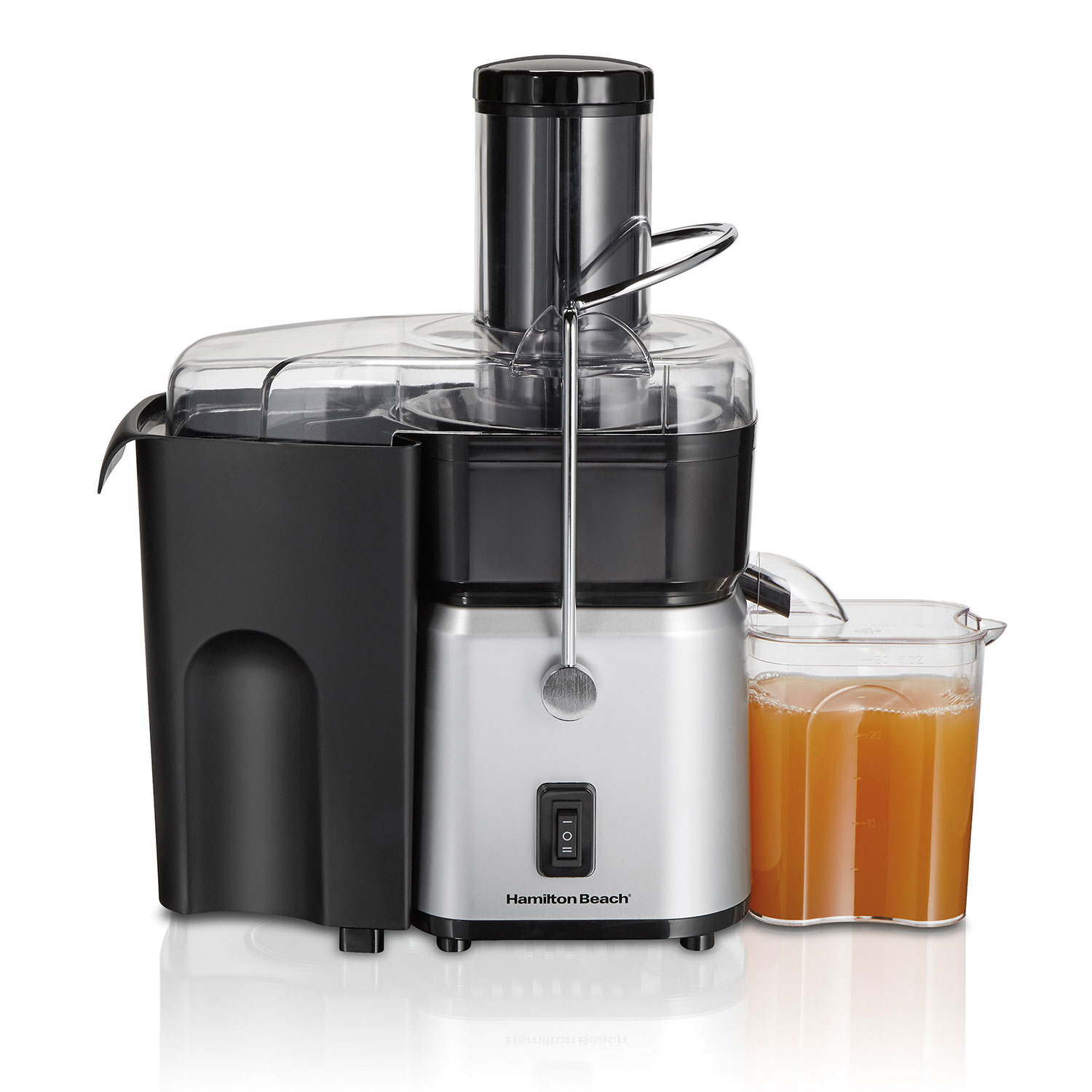
The 67840 Type CJ25 guide shows a motor-driven stainless micro-mesh basket and separate side pulp container.
Explore this need in the finder →Would the manual's two-speed HI/LO control fit your produce routine?
The CJ25 chart assigns firmer produce to HI and softer produce and leafy greens to LO; this is not a variable-speed dial.
Explore this need in the finder →Is a listed 3-inch opening useful while you still prepare produce as directed?
Hamilton Beach lists a 3-inch feed chute, but the guide still says to peel some items, pit stone fruit, feed slowly and use the pusher.
Explore this need in the finder →Must a juice receiver be included, even if its 30-ounce volume is below your larger-batch minimum?
The exact page lists a 30-ounce BPA-free pitcher with froth separator; this is receiver capacity, not expected yield.
Explore this need in the finder →Do dishwasher-safe removable parts work if you avoid the SANI cycle and keep the base out?
The CJ25 guide allows dishwasher cleaning for removable parts but prohibits SANI and washing the motor base in the dishwasher.
Explore this need in the finder →Is documented pomegranate-seed use essential, rather than use of the whole fruit intact?
The manual provides a recipe for seeds and says to omit the membranes; it does not establish that a whole pomegranate goes through the chute.
Explore this need in the finder →Can an 8-inch listed body width fit your counter if you also allow for the deeper body and separate bin?
The page lists a 7.92-inch body width; the matching question uses an 8-inch ceiling, and the full operating footprint is larger.
Explore this need in the finder →Does the older 67840 suit you only when its exact earlier-model offer is the one you are checking?
Hamilton Beach marks the exact U.S. model no longer available; include it only when you opt in to earlier models.
Explore this need in the finder →The Hamilton Beach 67840 is an earlier centrifugal extractor with a 3-inch chute, two produce-matched speeds and a 30 fl oz pitcher. Its slim listed body is only 7.92 inches wide, but it is 17.07 inches deep before you allow room for its separate pulp bin, pitcher, cord or feeding access. Hamilton Beach marks this U.S. model no longer available, so this review is most useful when checking a specific older offer or identifying a machine you already have.
Start with the exact 67840, not a nearby model name
The U.S. page identifies the silver Whole Fruit Juice Extractor as model 67840. Its directly linked 840343200 guide lists Type CJ25, 120 V, 60 Hz and 700 W. A motor-driven micro-mesh basket separates juice into a supplied container while pulp falls into a side container. “Whole Fruit” does not mean every item goes in whole.
The page lists a 3-inch opening, two speeds, BPA-free 30-ounce pitcher, froth separator, dishwasher-safe parts, brush and three-year limited warranty. It also says “NO LONGER AVAILABLE.” Check the model label, parts, condition and seller terms for any used or old-stock offer; secondhand ownership does not automatically carry an original-purchase warranty.
What the two-speed routine changes
The Type CJ25 manual shows HI/LO/OFF rather than a variable dial. Its chart assigns firm items such as apples, carrots and beets to HI, and softer fruits, tomatoes and leafy greens to LO. Many apples, carrots and cucumbers often fit whole, but it still recommends peeling some produce for flavor and pitting stone fruit. Feed slowly with the supplied pusher and cut anything that does not pass comfortably. A wide opening reduces some prep, not safe-use instructions.
The page’s “8 ounce glass in 9 seconds” is a promotional claim, not a measured or guaranteed result; 700 W is an electrical rating, not an extraction score. Yield, noise and routine continuous-use duration are not established. If overload protection stops an overheated motor, unplug it and wait 15 minutes. That recovery instruction is not a normal run-time limit.
Thirty ounces is receiver capacity, not juice output
The supplied pitcher is listed at 30 fl oz and has a froth separator. That capacity tells you how much the vessel can hold, not how much juice a batch of produce will make. A separate pulp container is pictured and called large in the manual, but neither source gives its volume. Keep those two jobs distinct when sizing a routine: the pitcher receives juice and the side container collects discarded pulp. The maker does not confirm that the pictured glass is lidded, so do not count on a storage lid unless the exact package you are considering includes one.
Published body dimensions are 15.91 inches high, 7.92 wide and 17.07 deep. The 67840 is much narrower but deeper than the listed 14.5-inch-wide 67850. Its 30-ounce pitcher is smaller than the 67850’s documented 40-ounce lidded pitcher and larger than the 16-ounce cup supplied with the 67870. Similar product names do not transfer dimensions or accessories.
Budget for the mesh-basket cleanup
The manufacturer confirms a strainer-cleaning brush with the exact 67840 offer, and the manual recommends prompt mesh cleaning or soaking before pulp dries and clogs the fine pores. Removable parts are dishwasher-safe, but the guide expressly prohibits the SANI cycle and putting the motor base in a dishwasher; do not immerse the base. It also warns that unusually high dishwasher temperatures or placement near a heating element may distort parts. The center blades in the stainless basket are sharp, and a bent, cracked or damaged basket should not be used. These are real ownership constraints even though the page uses an easy-clean message.
Who should consider it
The 67840 may suit someone evaluating a specific earlier machine who wants a two-speed centrifugal routine, an included 30-ounce receiver, a documented 3-inch chute and a relatively narrow body. It is a poor fit if you need a current-reference-only recommendation, at least a 32-ounce supplied pitcher, an integrated pulp bin, a quiet-mode promise, SANI-cycle permission, or a verified session duration. The manual includes a pomegranate-seed recipe and says to use the seeds without the membranes; it does not establish wheatgrass use. A hard requirement for an unknown feature should rule it out rather than be treated as a match.
For a new comparison, the 67850 changes the receiving capacity and counter layout; the current-reference 67906 widens the listed chute to 3.5 inches and documents a 34-ounce pitcher, while taking a different body footprint. Those measurements and capacities still do not predict yield or prove an in-stock offer. This is a source-based assessment, not a hands-on test. A limited CPSC recall notice names six older extractor codes but not 67840; that one notice is not a complete recall-history clearance for this model.
Sources: Hamilton Beach’s exact U.S. 67840 product page, its directly linked 840343200 Type CJ25 Use & Care guide, and the limited CPSC historical notice. Also compare the exact 67850, 67870, and 67906 assessments.
Key details at a glance
| Extraction method | Centrifugal fruit-and-vegetable extractor |
|---|---|
| Included juice receiver capacity | 30 fl oz |
| Pulp bin placement | External side bin |
| Published feed-chute width | 3 in |
| Speed control | Two speeds |
| Motor electrical rating | 700 W |
| Listed width | 7.92 in |
| Listed depth | 17.07 in |
| Listed height | 15.91 in |
| Dedicated Quiet selector label | No |
| Filter basket dishwasher-safe | Yes |
| Controls and use | The exact manual shows HI/LO/OFF and a produce chart: firmer examples use HI; soft fruits, tomatoes and leafy greens use LO. It does not identify a variable dial or a lower-noise mode. |
| Cleanup note | The exact U.S. page lists a strainer-cleaning brush. The manual says promptly brush/soak the fine mesh before pulp dries; the basket blades are sharp and a damaged basket must not be used. |
| Manufacturer jug label | The exact U.S. page identifies a BPA-free 30-ounce pitcher and froth separator. This is vessel capacity, not measured yield; a lid is not confirmed in the consulted U.S. package wording. |
| Fast/firm juicing guidance | No ordinary continuous-run duration is published. The guide says to unplug and cool for 15 minutes only if overload protection stops the motor because of overheating; this is not a normal rated session limit. |
| Supplied cup nozzle | No |
| Blender mode on the same base | No |
| Manual-described lower-noise juicing range | No |
| Body-fit measurement note | The maker lists a narrow 7.92-inch body width and a deep 17.07-inch body depth. Allow additional working room for the external side pulp container, receiver below the spout, raised pusher, cord and safe disassembly. |
| Electrical-rating caveat | The final Type CJ25 manual panel lists 120 V / 60 Hz / 700 W. This is the electrical rating, not a measured extraction output or comparative performance score. |
| Filter configuration | Stainless steel micro mesh strainer basket |
| Hand-powered operation | No |
| Pomegranate use listed for this exact model | Yes |
| Removable parts dishwasher-safe per manual | Yes |
| Automatic ingredient-sensing mode | No |
| Manufacturer-listed voltage | 120 V |
Use the exact model’s instructions for operating limits, supplied equipment and version differences.
Sources for this assessment
- Hamilton Beach exact U.S. Whole Fruit Juice Extractor Silver model 67840 page
- Exact-page-linked 840343200 Use & Care guide; model 67840 / Type CJ25
- Original 1500 x 1500 Open Graph image from the exact U.S. 67840 product page
- Hamilton Beach U.S. Juicers Product Archive, exact 67840 link
- CPSC/Hamilton Beach 2001 juice-extractor recall notice; limited six-model code list, not a complete 67840 search

Now check the model against your kitchen.
Use the finder for extraction style, batch, cleanup, control, and counter-fit requirements.