
Your needs, this model
Does it fit your priorities?
Is a centrifugal fruit-and-vegetable extractor essential rather than a citrus press or auger?
Exact product page and linked manual describe a powered extractor with a rotating stainless strainer basket.
Explore this need in the finder →Would a published 3.5-inch feed chute fit the produce routine you repeat?
The exact U.S. page states a 3.5-inch chute. Preparation and pusher rules still apply; the opening is not a promise that all produce fits whole.
Explore this need in the finder →Do you need both a HI and LO setting, or would a single switch be enough?
The manual documents HI for higher-fiber foods and LO for high-water foods. It does not describe variable or quiet-labeled speed control.
Explore this need in the finder →Is a 34-ounce included collection pitcher a hard minimum?
The exact page specifies a 34-ounce pitcher. That establishes receiver size, not the juice yield of any produce batch.
Explore this need in the finder →Will the 16.7-inch listed depth fit your counter before allowing for working room?
The exact maker dimensions list 16.7 inches deep. Leave additional room for loading, the pitcher, pulp container, cord and cleaning access.
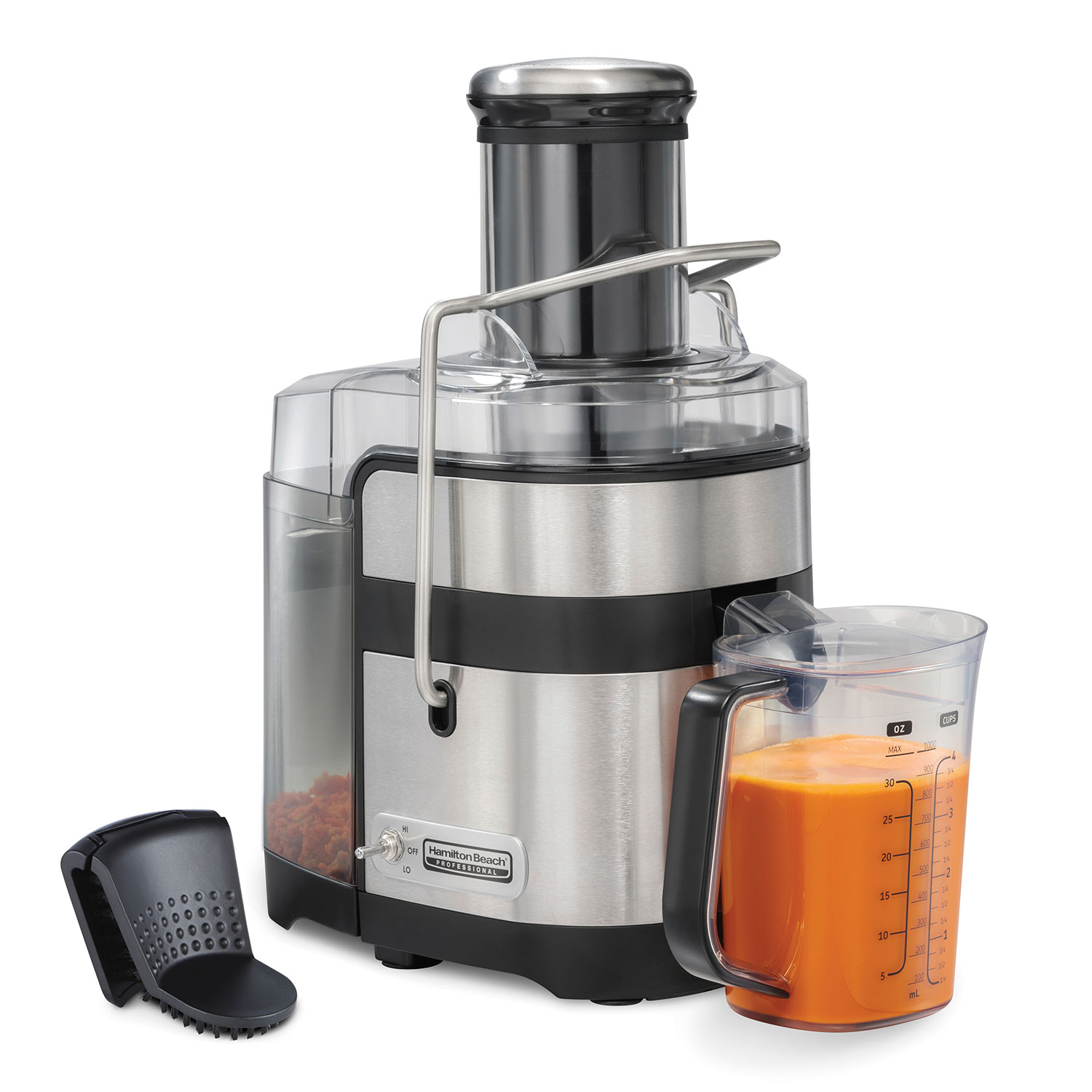
Explore this need in the finder →The Hamilton Beach Professional Super Chute Easy Clean Juice Extractor 67906 is a large centrifugal machine with a 3.5-inch feed opening, HI/LO control and a specified 34-ounce pitcher with froth separator. Its tradeoff is the footprint: 17.2 inches tall and 16.7 deep before allowing room for loading, pitcher, cord, or washing.
A wider opening helps with preparation, not every ingredient
The exact U.S. listing calls the chute 3.5 inches and says many whole foods fit. That can reduce cutting for apples, carrots, cucumbers, and similar produce. It does not make every beet, long vegetable, or large piece a safe whole-food load. The manual still calls for washing produce, using the pusher rather than fingers, peeling some fruit for flavor, and removing large pits. “Virtually eliminates pre-cutting” is maker copy, not a guarantee. Feed slowly: the manual says vigorous pushing can make the motor seem to stall or leave wetter pulp.
This is a powered centrifugal extractor: a motor turns a stainless-steel strainer basket, juice drains to a pitcher, and a separate container collects pulp. It is not a slow auger, citrus cone, or blender. If you mainly want a straightforward fruit-and-vegetable extractor, that is the right distinction to make. A wide chute and wattage label do not substitute for a different extraction style.
Two useful speeds, but no quiet or variable mode
The switch is labeled HI/OFF/LO. The manual assigns HI to higher-fiber produce such as carrots, cabbage, and apples, and LO to high-water ingredients such as tomatoes, watermelon, and oranges. This gives you a real setting choice compared with a one-switch machine, but it is only two fixed speeds—not a variable dial or automatic sensing. Hamilton Beach does not call LO quiet, so it does not meet a hard requirement for a manufacturer-labeled lower-noise mode.
The page claims the 1,100-watt motor makes 16 ounces in 10 seconds. Treat that as marketing, not a measured yield or promise for a mixed produce load. Wattage also does not establish noise, nutrient retention, durability, or how dry the pulp will be.
The 34-ounce pitcher is useful—but not a yield promise
Hamilton Beach specifies a 34-ounce pitcher with lid and froth separator. That is a defined collection vessel, unlike the 67650 Big Mouth Pro listing, whose FAQ confirms a cup but gives no capacity. If a documented receiver of at least 34 ounces is essential, 67906 meets that vessel threshold; it does not promise that any batch of ingredients will produce 34 ounces. The froth separator sits in the lid. It is not an adjustable foam setting, and the model has no documented low-foam dial.
The separate pulp bin has no published volume. The maker calls it large, but that adjective is not a capacity figure; the manual warns not to let it overfill.
Cleaning is designed in, but the mesh still needs care
The page promotes its patented Easy Sweep tool as reducing strainer-cleaning time; we did not test that claim. The manual's practical directions matter more for everyday ownership: unplug before disassembly, handle the sharp center of the basket carefully, and brush the fine mesh promptly before pulp dries. Soak it if needed. The manual lists the feed chute, cover, basket, pusher, pitcher and lid as dishwasher-safe, but prohibits the SANI cycle and says to keep the motor base out of water and the dishwasher.
A 15-minute cool-down applies only if overload protection stops the motor. It is recovery advice, not a normal run-time limit; the manual publishes no routine continuous-use interval. Inspect the basket before use and do not run a cracked, bent or damaged screen.
Measure the footprint and read the warranty as a household term
Published dimensions are 17.2 high by 9.5 wide by 16.7 deep. Compared with the smaller 67650, listed at 14.4 by 7.8 by 11.5 inches, 67906 needs more height and depth. Measure cabinet clearance and counter depth, then add room to insert the pusher, position the pitcher, reach the switch, remove the side pulp bin, and wash the parts. A width under ten inches does not make it a compact juicer.
The manual gives a five-year limited warranty for products purchased and used in the U.S. or Canada; it requires proof of purchase and limits coverage to single-family household use. “Professional” is the line name, not evidence of commercial warranty coverage. The U.S. page showed an add-to-cart path when checked, but availability can change.
Who should shortlist exact model 67906?
Consider it when the 3.5-inch opening, two produce-specific speeds, 34-ounce pitcher, and longer stated household warranty matter more than a compact body. It is a poor fit if your counter cannot take 16.7 inches of depth, you need a quiet-labeled setting, or an auger is essential. Compared with the 67650, it adds a defined larger pitcher and second speed but takes substantially more room; the 67650's cup capacity is unknown, so it cannot be treated as a documented 34-ounce substitute.
CPSC's 2001 Hamilton Beach juice-extractor recall names six older models—67150, 67180, 67180W, 395WS, 67199, and 3920JS—not 67906. This describes that notice only, not a blanket safety assurance for every used appliance. Check the rating label and inspect the basket on any secondhand machine.
Sources: Hamilton Beach's exact 67906 U.S. product page and linked 840280104 Use & Care guide, plus the CPSC Hamilton Beach juice-extractor recall notice. This is a source-based assessment, not hands-on yield, noise, or durability testing.
Key details at a glance
| Extraction method | Centrifugal fruit-and-vegetable extractor |
|---|---|
| Included juice receiver capacity | 34 fl oz |
| Pulp bin placement | External side bin |
| Published feed-chute width | 3.5 in |
| Speed control | Two speeds |
| Motor electrical rating | 1100 W |
| Listed width | 9.5 in |
| Listed depth | 16.7 in |
| Listed height | 17.2 in |
| Dedicated Quiet selector label | No |
| Filter basket dishwasher-safe | Yes |
| Cleanup note | Unplug and allow the basket to stop before disassembly. The manual warns that the central strainer blades are sharp and the screen is delicate; brush the fine mesh promptly before pulp dries, and soak if needed. Do not use a cracked, bent or damaged basket. No SANI cycle; motor base stays out of water and dishwasher. |
| Manufacturer jug label | Exact U.S. product page specifies a 34 oz pitcher with lid and froth separator. This is vessel capacity, not guaranteed output from any load. |
| Fast/firm juicing guidance | The manual gives an approximately 15-minute unplug/cool-down if overload protection stops the motor. That is fault recovery, not a normal continuous-run allowance. |
| Supplied cup nozzle | No |
| Blender mode on the same base | No |
| Manual-described lower-noise juicing range | No |
| Manual foam-management setup | A supplied pitcher lid has a froth separator; the manual does not document an adjustable low/more-foam selection, so it does not satisfy the questionnaire's adjustable-foam choice. |
| Body-fit measurement note | Exact page lists 17.2 H × 9.5 W × 16.7 D inches. Allow extra overhead clearance for pusher, depth for feeding, and room for the separate pulp bin, pitcher, cord, and washing access. |
| Electrical-rating caveat | The product page states 1100 W; the exact page-linked manual model panel identifies model 67906/type CJ18 at 120 V, 60 Hz, 1100 W. This is an electrical rating, not a comparative extraction measurement. |
| Filter configuration | Stainless steel micro mesh strainer basket |
| Hand-powered operation | No |
| Removable parts dishwasher-safe per manual | Yes |
| Automatic ingredient-sensing mode | No |
| Manufacturer-listed voltage | 120 V |
Use the exact model’s instructions for operating limits, supplied equipment and version differences.
Sources for this assessment
- Hamilton Beach U.S. Professional Super Chute Easy Clean Juice Extractor exact model 67906
- Hamilton Beach Professional Juice Extractor Use & Care guide 840280104; 36 pages; exact page-linked manual
- Hamilton Beach product image linked by the exact 67906 U.S. page
- CPSC, Hamilton Beach Announce Recall of Juice Extractors (02-041)
- Hamilton Beach recall information page

Now check the model against your kitchen.
Use the finder for extraction style, batch, cleanup, control, and counter-fit requirements.