
Your needs, this model
Does it fit your priorities?
Is an included nozzle for juicing directly into a cup essential?
The ANZ BJE420 page lists a juicing nozzle and the instruction book says it directs juice into a cup. That accessory is confirmed for this ANZ package, not for the U.S. support entry.
Explore this need in the finder →Would a 1.4 L jug be large enough for your usual batch?
Breville labels the ANZ jug 1.4 L (about 47.3 U.S. fl oz). That is more than the 34 fl oz threshold, but it is not a 70 fl oz batch jug.
Explore this need in the finder →Would an 84 mm chute meet your preparation preference?
The page publishes 84 mm, equivalent to about 3.31 inches. This conversion does not mean every ingredient fits whole; the manual still requires preparation such as peeling citrus and pitting stone fruit.
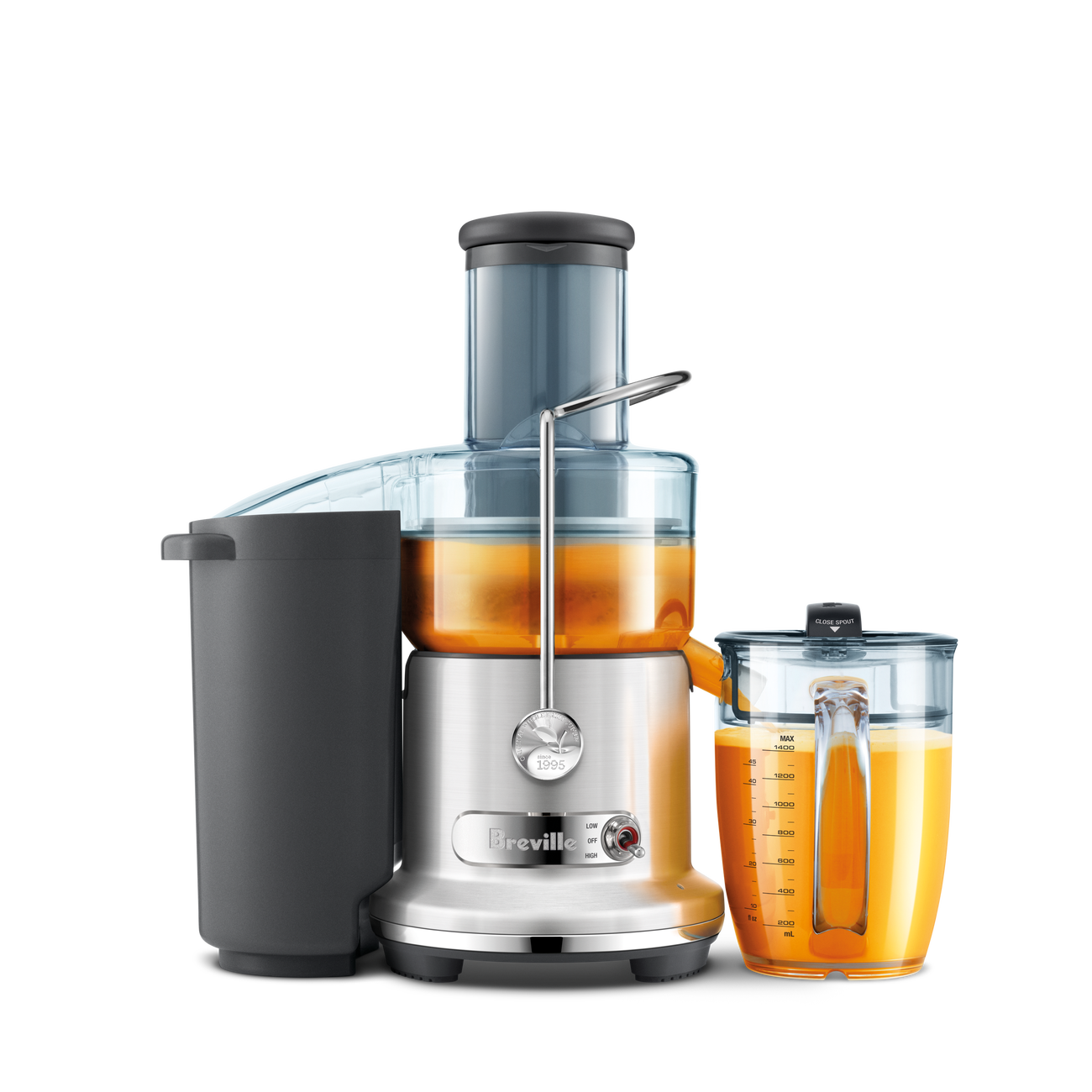
Explore this need in the finder →The Juice Fountain Fresh 95 is the middle member of Breville’s ANZ Fresh centrifugal range: a 1.4 L jug and 3 L pulp bin, with an 84 mm chute and a supplied nozzle for directing juice into a cup. That mix is genuinely different from the larger Fresh BJE440 and the integrated-bin Fresh Compact BJE220. This assessment is for the Australian-market SKU BJE420BSS4IAN1 and its ANZ instruction book, not a U.S. electrical edition.
A familiar fast-juicer layout with a wide opening
The BJE420 uses a spinning cutting-and-mesh basket to separate liquid from produce. Breville lists an 84 mm feed chute and two speed settings, with the slower speed intended for softer ingredients and the faster one for firmer produce. The ANZ manual identifies a 1,050 W motor, a stainless-steel micro-mesh basket and a side-mounted 3 L pulp container. Breville’s Fresh Spin and speed claims describe its design; they are not a comparative yield or nutrient test for the produce in your kitchen.
An 84 mm opening can reduce some cutting, but it is not a promise that every apple, beet, or vegetable fits whole. The manual still says to remove citrus peel and pit stone fruit, and directs users to trim hard stems and prepare ingredients as its guide specifies. Switch the motor on before feeding, use only the supplied pusher, and apply gentle pressure. A wide chute changes prep for some foods, not all of it.
Moderate batches, a side bin, and a cup nozzle
The included 1.4 L jug has a sealing lid and froth separator. Breville says the sealed jug can be refrigerated for up to three days; treat that as its maker’s storage guidance, not a guarantee for every ingredient or kitchen. The 3 L pulp container sits to the side rather than inside the motor body. The package also lists a juicing nozzle that fits over the outlet for collecting into a cup. That nozzle is a distinct supplied accessory, unlike simply placing a glass under a spout.
If you usually make a larger batch, the ANZ BJE440 Fresh increases the jug to 2 L and the external pulp bin to 3.4 L while keeping the 84 mm chute, two speeds, and nozzle. The BJE420 is the lighter-batch choice between those two editions, not a compact footprint machine: Breville lists it at 45.5 × 19.2 × 41.8 cm (W × D × H). Check clearance above the pusher and room beside the base for the pulp container. Its listed dimensions are body measurements, not the complete working envelope.
The Fresh Compact BJE220 takes another route. Its chute is 75 mm and its pulp collector is integrated within the machine footprint; it keeps a 1.4 L jug but has no separate juice nozzle listed in its included accessories. The Compact’s bin arrangement may reduce loose parts beside the juicer, while the BJE420 has the broader chute and verified direct-cup nozzle. They are different packages, not just alternate colors.
Respect the batch and rest instructions
The BJE420 manual advises allowing the motor to rest for one minute between uses. It says not to process more than 3 kg of carrots at a time and gives 5 kg of beetroot juiced over two minutes as an anticipated heavy-load example. That guidance matters if “large jug” sounds like an invitation to run uninterrupted. Choose the manual’s speed for the ingredient, let the basket reach full speed before feeding, and slow down rather than pressing hard when pulp or wet produce begins to build up.
After a session, stop and unplug before taking the lid off. The manual lists the cover, filter-bowl surround, jug and lid, pulp container, nozzle, and pusher pieces as dishwasher-safe; the micro-mesh basket is top-rack only. Rinsing and brushing the basket promptly is still the dependable routine, because dried fiber clogs the fine mesh. Wipe the motor base with a damp cloth and keep it out of the sink. The basket’s cutting edges are sharp, so handle it by the rim.
Why this is not the U.S. BJE420 recommendation
Breville’s U.S. support record identifies the BJE420 Fresh 95 and lists finish-coded item numbers, including BJE420BSS1ANA1 (Brushed Stainless Steel), BJE420BTR1ANA1 (Black Truffle), BJE420SST1ANA1 (Sea Salt), BJE420DBL1ANA1 (Damson Blue) and BJE420ALM1ANA1 (Almond Nougat). It does not supply a U.S. product specification sheet or instruction book, and its product-image field is a generic unavailable placeholder. The specifications above come from the ANZ BJE420BSS4IAN1 page and ANZ manual; the shared BJE420 code does not prove that this SKU, accessory package or regional supply details apply to a U.S. unit. This review remains an ANZ reference, not a U.S. purchase recommendation.
For a U.S. shopper wanting a supplied direct-cup nozzle, the current BJE530 Cold Plus and BJE830 Cold XL are documented U.S. comparisons; the BJE530 adds a 70 fl oz jug, two-speed switch and rear bin, while the BJE830 offers variable control and a named Quiet setting. If a one-piece footprint matters more, review the U.S. BJE200XL Compact, but its one-speed control and smaller page-labeled jug are a different package. The finder will use only verified U.S. facts rather than treating the ANZ BJE420 as equivalent.
Bottom line
The ANZ Fresh 95 combines a wide 84 mm chute, 1.4 L jug, 3 L external pulp bin, two speeds, and a direct-cup nozzle. Those details make it a useful regional reference and distinguish it from both Fresh neighbors. Breville’s U.S. support data supplies several item numbers for BJE420 finishes, but not the local manual, electrical rating, accessory set or model specifications needed to assess a U.S. configuration. Use this review for the ANZ edition; for a U.S. shortlist, compare models with local manuals and documented packages.
Key details at a glance
| Extraction method | Centrifugal fruit-and-vegetable extractor |
|---|---|
| Included juice receiver capacity | 47.3 fl oz |
| Pulp bin placement | External side bin |
| Published feed-chute width | 3.31 in |
| Speed control | Two speeds |
| Motor electrical rating | 1050 W |
| Listed width | 17.91 in |
| Listed depth | 7.56 in |
| Listed height | 16.46 in |
| Juice jug and lid dishwasher-safe | Yes |
| Filter basket dishwasher-safe | Yes |
| Cleanup note | The ANZ manual lists removable parts as dishwasher-safe, with the filter basket restricted to the top shelf. Rinse and brush the mesh promptly; wipe the motor base with a damp cloth. |
| Supplied cup nozzle | Yes |
| Published feed-chute width (metric) | 84 mm |
| Jug capacity (metric label) | 1.4 L |
| Pulp collector capacity | 3 L |
Use the exact model’s instructions for operating limits, supplied equipment and version differences.
Sources for this assessment
Now check the model against your kitchen.
Use the finder for extraction style, batch, cleanup, control, and counter-fit requirements.