
Your needs, this model
Does it fit your priorities?
Is a documented 3-inch chute enough, without requiring more than 3 inches?
Breville's product page identifies the feed chute as 3 inches. That does not mean every item fits whole; use the manual's preparation and pusher guidance.
Explore this need in the finder →Does a listed depth of 9.8 inches fit your counter limit?
Breville lists 9.8 inches for the appliance depth. Also leave room for the jug, pusher, power cord and safe access.
Explore this need in the finder →Do you want one on/off speed rather than a two-speed or variable dial?
The manual identifies an ON/OFF button and does not document a speed selector. Its one-minute run/rest instruction for rapid-rate or firm-pressure juicing still applies.
Explore this need in the finder →Must the pulp collector stay within the juicer footprint?
The U.S. BJE200XL manual identifies an integrated pulp collector within the unit footprint. This avoids a separate side bin, but the height, chute clearance and jug still need their own space check.
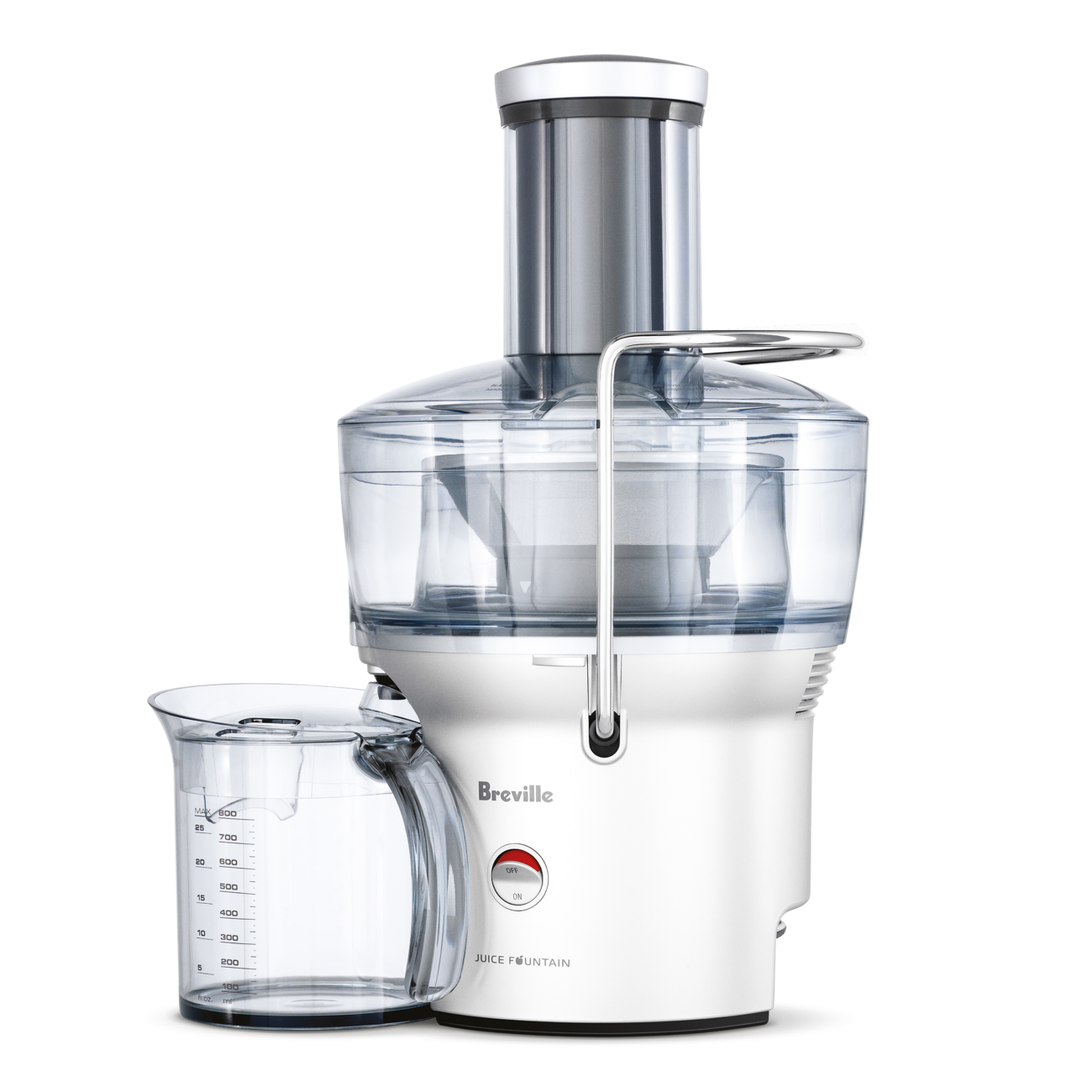
Explore this need in the finder →The U.S. Breville Juice Fountain Compact offer listed as BJE200XL is relatively narrow among these reviewed Breville models: the maker lists it 9.1 inches wide and 9.8 inches deep, and says pulp is collected within the unit's footprint. It has a single on/off control, a published 3-inch feed chute and a small supplied jug. That combination suits a kitchen with limited counter area and a routine centered on modest servings, provided the single-speed operation and manual's pacing directions work for you. “Compact” describes the listed dimensions, not an automatic pass for every cupboard or a promise of quick cleanup.
Small footprint, one operating speed
Breville lists the body's dimensions as 9.1 inches wide by 9.8 inches deep by 15.7 inches high. Those are useful comparison points, not the whole working envelope: leave room for the pusher above the chute, to position the jug at the spout, to lift the locking arm and removable assembly, and to reach the outlet. The pulp container collects within the unit's footprint rather than projecting from the side or behind it, which saves counter width. The manual's assembly steps still require you to lift out the pulp container and carry it to the sink when it needs emptying.
The 700-watt motor has an easy on/off button; neither the page nor the manual specifies multiple speeds. If you want a low setting for softer produce, a variable dial, or a separately named Quiet control, this is not the documented configuration. Its electrical rating is not a measurement of juice output, speed under load, or sound. The manual gives a less obvious operating limit worth respecting: when juicing at a rapid rate or with firm pressure, do not run the appliance for more than one minute at a time, then allow a one-minute rest. If your routine means processing successive large loads, those pauses matter.
A wide opening still needs safe preparation
Breville calls the feed chute 3 inches wide. The manual notes that small apples, carrots and cucumbers may fit without cutting, but the chute's diameter does not mean that every piece of produce fits whole or can be fed safely without preparation. Peel citrus, remove pits or stones from stone fruit, and follow the booklet's other preparation guidance. Use the supplied food pusher and never reach into the chute with fingers or utensils; turn off, unplug and wait for the filter basket to stop before taking the machine apart.
The machine uses a stainless-steel cutting disc and micro-mesh filter basket, which makes it a centrifugal juicer rather than a slow auger press. The manual says leafy greens processed alone tend to produce less juice in this kind of mechanism and recommends combining them with other ingredients. That is a practical limit for someone whose main goal is pressing a large amount of greens, not a lab comparison of this model with another juicer.
Check the jug label and plan the cleanup
Breville's U.S. product page describes the supplied jug as 25 ounces; the BJE200-series manual labels its dishwasher-safe jug as 800 ml. Those are not identical published figures, so do not treat them as a verified precise fill-to-the-brim conversion. This review preserves both source labels; the finder uses the product-page's 25-ounce value only for the available 70-ounce threshold, which the Compact does not meet either way. The manual's diagram also places a built-in froth separator in the jug lid, useful if you prefer less foam in the glass, but not a larger-batch feature.
The official booklet marks the juicer cover, integrated pulp container, filter basket and jug as top-rack dishwasher-safe; the food pusher is not. Rinse parts promptly after use so damp pulp does not dry into the fine mesh. The supplied nylon brush is intended for that basket, which has sharp cutting teeth and needs careful handling. The machine's pulp container and motor base are separate in the manual's assembly; wipe the motor base with a damp cloth rather than immersing it. Several parts can go on the top rack, but the pusher and mesh still make this a hands-on cleanup rather than a no-touch one.
Where it sits beside other Breville models
Choose the BJE200XL when the 9.8-inch listed depth, footprint-contained pulp collection and simple on/off control address a real constraint, and a smaller jug is adequate. Compare the Juice Fountain Plus JE98XL if you want two speeds, a larger manufacturer-labeled jug and an external side pulp bin; its listed depth is much longer at 14.1 inches. Compare the BJE430 Cold if you need a 70 fl oz jug and a particularly shallow listed body, but its published chute measurements conflict. The Cold Plus adds a rear bin and a published 3.5-inch chute, while the Cold XL has a variable dial with a Quiet-labeled range. Both also have 70 fl oz jugs and require a larger listed footprint than the Compact.
Those are differences in the maker's documented configuration, not a ranking from yield testing. Measure the installed counter and overhead space, check the exact suffix on the seller's listing, and read the matching manual before deciding. In particular, do not select this one-speed model on the assumption that a compact footprint also means a large-batch or uninterrupted high-volume setup.
Bottom line
The Juice Fountain Compact is a reasonable fit for a small counter, one-speed preference and moderate servings, with an integrated pulp arrangement that keeps the listed body footprint narrow. Its main compromises are the smaller and inconsistently labeled jug, no speed choices, care needed at the mesh, and a one-minute rest rule after rapid-rate or firm-pressure runs. If your essential need is a 70-ounce batch, variable control, a quiet-labeled selector, or extended processing without those rests, choose a documented alternative instead.
Key details at a glance
| Extraction method | Centrifugal fruit-and-vegetable extractor |
|---|---|
| Included juice receiver capacity | 25 fl oz |
| Pulp bin placement | Integrated within footprint |
| Published feed-chute width | 3 in |
| Speed control | Single-speed on/off |
| Motor electrical rating | 700 W |
| Listed width | 9.1 in |
| Listed depth | 9.8 in |
| Listed height | 15.7 in |
| Dedicated Quiet selector label | No |
| Juice jug and lid dishwasher-safe | Yes |
| Filter basket dishwasher-safe | Yes |
| Controls and use | Easy ON/OFF button only; the manual provides no speed selector. For juicing at a rapid rate or with firm pressure, the instruction book limits operation to one minute followed by a one-minute rest. |
| Cleanup note | Manual specifies the cover, integrated pulp container, Nutri Disc and jug as top-shelf dishwasher-safe; the food pusher is not. Rinse removable parts promptly and use the supplied nylon brush carefully on the fine mesh; wipe the motor base with a damp cloth. |
| Manufacturer jug label | Breville U.S. product page: 25 oz; BJE200-series manual component diagram: 800 ml. Preserve both source labels; the published figures differ. |
Use the exact model’s instructions for operating limits, supplied equipment and version differences.
Sources for this assessment
Now check the model against your kitchen.
Use the finder for extraction style, batch, cleanup, control, and counter-fit requirements.