
Your needs, this model
Does it fit your priorities?
Must the pulp collector stay within the juicer footprint?
The ANZ BJE220's page and manual describe an integrated collector. It avoids a separate bin beside the machine, but the body still measures 35.5 by 28.5 by 40.5 cm and needs the usual chute, jug, and cleaning clearance.
Explore this need in the finder →Do two speed options matter for your mix of soft and firm produce?
The ANZ manual labels the two settings SOFT and HARD and includes produce-specific speed guidance. It also says to rest the motor between uses and not to push with fingers or utensils.
Explore this need in the finder →Is a 75 mm chute wide enough for your preparation habits?
The maker-published 75 mm opening converts to about 2.95 inches, just under a strict 3-inch floor. This does not establish that a whole piece will fit, and the manual still requires produce-specific preparation.
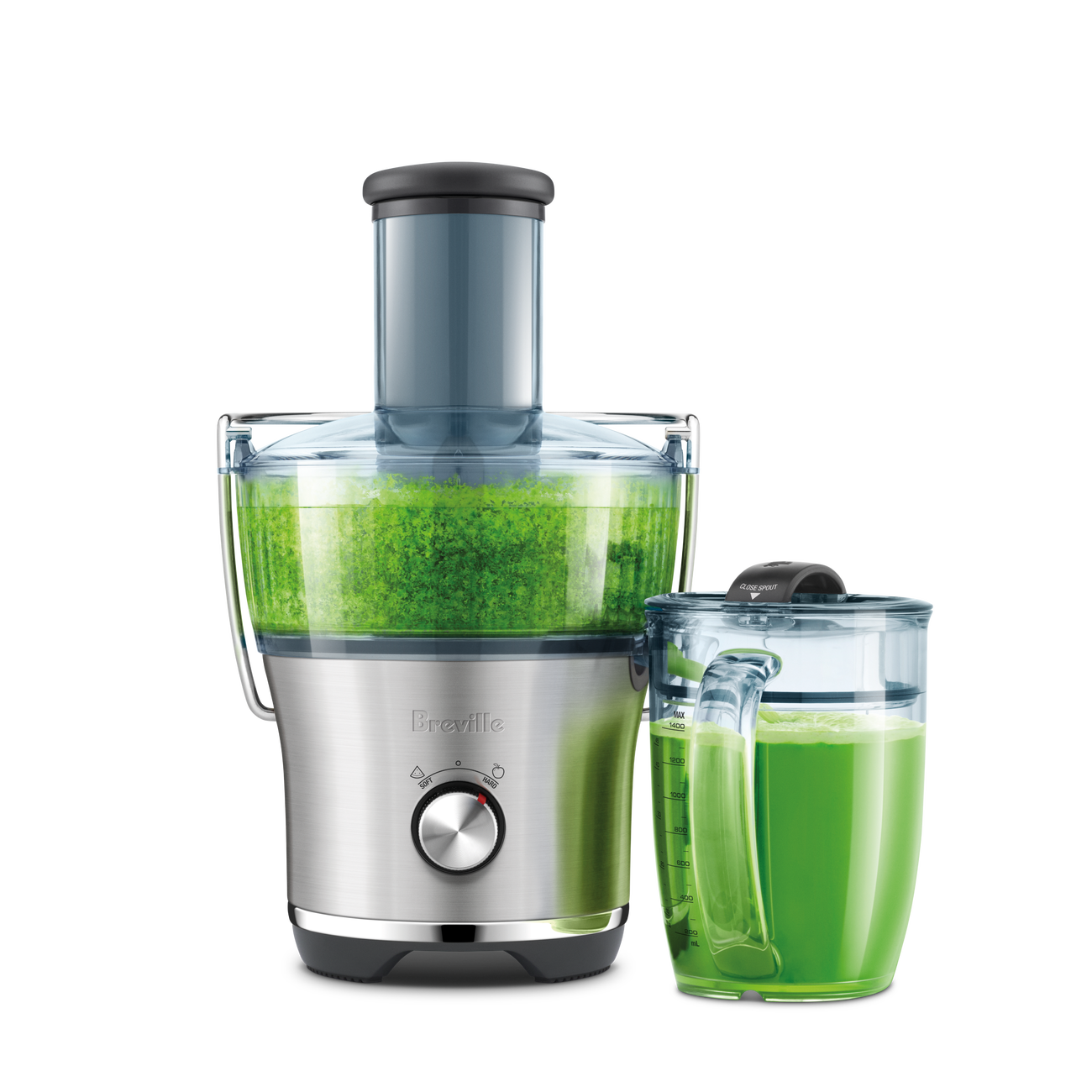
Explore this need in the finder →The Fresh Compact BJE220 is defined less by a small overall footprint than by where it puts the pulp: Breville describes an integrated collector inside the unit’s footprint, so there is no separate side bin to park. The ANZ version also has a 1.4 L sealing jug, a 75 mm feed chute and two speed settings. This review is for the brushed-stainless BJE220BSS4IAN1 and ANZ instruction book, not for the separate U.S. support-directory configuration.
Compact means integrated pulp collection
The integrated collector is the meaningful layout choice. The manual describes the collector as part of the juicer assembly and instructs you to lift the combined piece away for emptying. Compared with the BJE420 Fresh 95 or BJE440 Fresh, that removes an external bin from the counter and reduces a separate container to manage. Breville’s product page does not publish a collector volume, so this assessment does not assign one.
“Compact” does not mean shallow. Breville lists the BJE220 at 35.5 × 28.5 × 40.5 cm (W × D × H). It is narrower than the Fresh 95’s 45.5 cm width but 28.5 cm deep, because the collector sits within the base assembly. Measure the full counter, the opening above the chute and the space needed to remove the integrated pulp collector. The jug must also sit below the outlet, and the detachable parts need space at the sink.
The chute measures 75 mm, compared with 84 mm on the Fresh 95 and Fresh BJE440. That is about 2.95 inches, just below a strict 3-inch minimum. The manual lists a 950 W motor, a stainless-steel micro-mesh basket and SOFT/HARD speeds. The product page does not describe this basket as titanium-reinforced, unlike the Fresh 95 and Fresh descriptions, so the materials should not be silently merged across models. None of the wattage figures establishes comparative juice yield.
A moderate jug and two produce speeds
The 1.4 L jug has a sealing lid with a froth separator, and Breville’s page gives the same up-to-three-day refrigerated storage guidance found across the new family. Use the manual’s instructions for storage and refrigeration; the statement is not a universal freshness guarantee. The BJE220’s SOFT and HARD settings change how the machine handles different ingredients. Use the supplied guide and prepare fruit as directed instead of treating the chute opening as permission to feed untrimmed produce.
The manual allows a glass under the outlet but recommends the jug and lid to limit splatter. It does not list a separate juice nozzle in the product’s accessories, so an included nozzle is unconfirmed. If that accessory is essential, do not infer it from the ability to position a cup below the spout. The distinction matters when comparing it with the BJE420 and BJE440, whose pages list the nozzle as supplied equipment.
Follow the load and cleanup directions
The BJE220 manual advises resting the motor for one minute between uses, processing no more than 3 kg of carrot at a time, and cites 5 kg of beetroot over two minutes as an anticipated heavy-load example. It also cautions that the wrong speed can strain the motor. Let it reach operating speed before adding ingredients, use the food pusher, and stop if the safety or overload protection activates. These directions apply to the ANZ edition and should not be transferred to a U.S. appliance without its own book.
The manual lists the juicer cover, integrated collector, jug and lid, and pusher pieces as dishwasher-safe; it allows the micro-mesh basket on the dishwasher’s top shelf. Rinse the basket immediately and use the supplied brush so pulp does not dry in the mesh. The basket and feed chute contain sharp blades, and the motor base is wiped with a damp cloth rather than submerged. Fewer loose bins can simplify setup, but the small mesh still needs regular hands-on cleaning.
Keep the ANZ and U.S. models separate
Breville’s U.S. support record identifies the BJE220 Fresh Compact and lists finish-coded item numbers, including BJE220BTR1ANA1 (Black Truffle), BJE220BSS1ANA1 (Brushed Stainless Steel) and BJE220SST1ANA1 (Sea Salt). The support page still supplies no U.S. instruction book or product specifications; its product-image field is a generic unavailable placeholder. The Australian page reviewed here documents the separate BJE220BSS4IAN1 package and its ANZ manual, which specifies 220/240 V. The support item numbers do not bridge the ANZ feature set, accessories or electrical rating to a U.S. edition, so this remains an identification reference rather than a U.S. purchase recommendation.
The current U.S. Juice Fountain Compact BJE200XL is not interchangeable by name: its U.S. page and manual describe a different one-speed configuration and different capacity labels. Choose it only if its own U.S. facts suit you. If two speeds are essential, compare a verified U.S. JE98XL Plus or BJE530 Cold Plus. Those alternatives do not reproduce the ANZ BJE220’s integrated collector by implication; read each exact U.S. review and assess the location and clearance you need.
Bottom line
The ANZ BJE220 combines a smaller 75 mm chute, two speeds and an integrated pulp collector with a moderate 1.4 L jug. Its narrower listed width is useful only if the greater depth fits your counter; the “compact” label does not guarantee a smaller working setup. Its package does not confirm a separate cup nozzle, and its ANZ electrical documentation is not a U.S. version. Use this reference to distinguish the regional Fresh Compact from Breville’s U.S. Juice Fountain Compact rather than merging the two.
Key details at a glance
| Extraction method | Centrifugal fruit-and-vegetable extractor |
|---|---|
| Included juice receiver capacity | 47.3 fl oz |
| Pulp bin placement | Integrated within footprint |
| Published feed-chute width | 2.95 in |
| Speed control | Two speeds |
| Motor electrical rating | 950 W |
| Listed width | 13.98 in |
| Listed depth | 11.22 in |
| Listed height | 15.94 in |
| Juice jug and lid dishwasher-safe | Yes |
| Filter basket dishwasher-safe | Yes |
| Cleanup note | The ANZ manual lists the cover, integrated collector, jug and lid, and food pusher as dishwasher-safe; the filter basket is top-rack-safe. Rinse and brush the mesh promptly and wipe the motor base with a damp cloth. |
| Published feed-chute width (metric) | 75 mm |
| Jug capacity (metric label) | 1.4 L |
Use the exact model’s instructions for operating limits, supplied equipment and version differences.
Sources for this assessment
Now check the model against your kitchen.
Use the finder for extraction style, batch, cleanup, control, and counter-fit requirements.