
Your needs, this model
Does it fit your priorities?
Do you need a hand-cranked juicer that works without electricity?
The Z-710's exact product page and manual identify a hand-cranked manual juicing configuration; its optional Solostar 3C base is separate.
Explore this need in the finder →Is wheatgrass an essential ingredient?
Tribest explicitly names wheatgrass for Z-710, along with fruits, vegetables and leafy greens.
Explore this need in the finder →Does the setup need an included clamp to secure the base at a table or counter edge?
Tribest lists a table clamp; the manual says to secure it to the table/counter edge before cranking.
Explore this need in the finder →Do you need an exact manufacturer-listed maximum height to meet a hard cabinet limit?
No exact hard-fit dimension is established because the linked page and manual give conflicting body sizes.
Explore this need in the finder →Do you require a model page that documents pomegranate use?
The exact Z-710 sources do not name pomegranates; unknown fruit capability is not treated as yes.
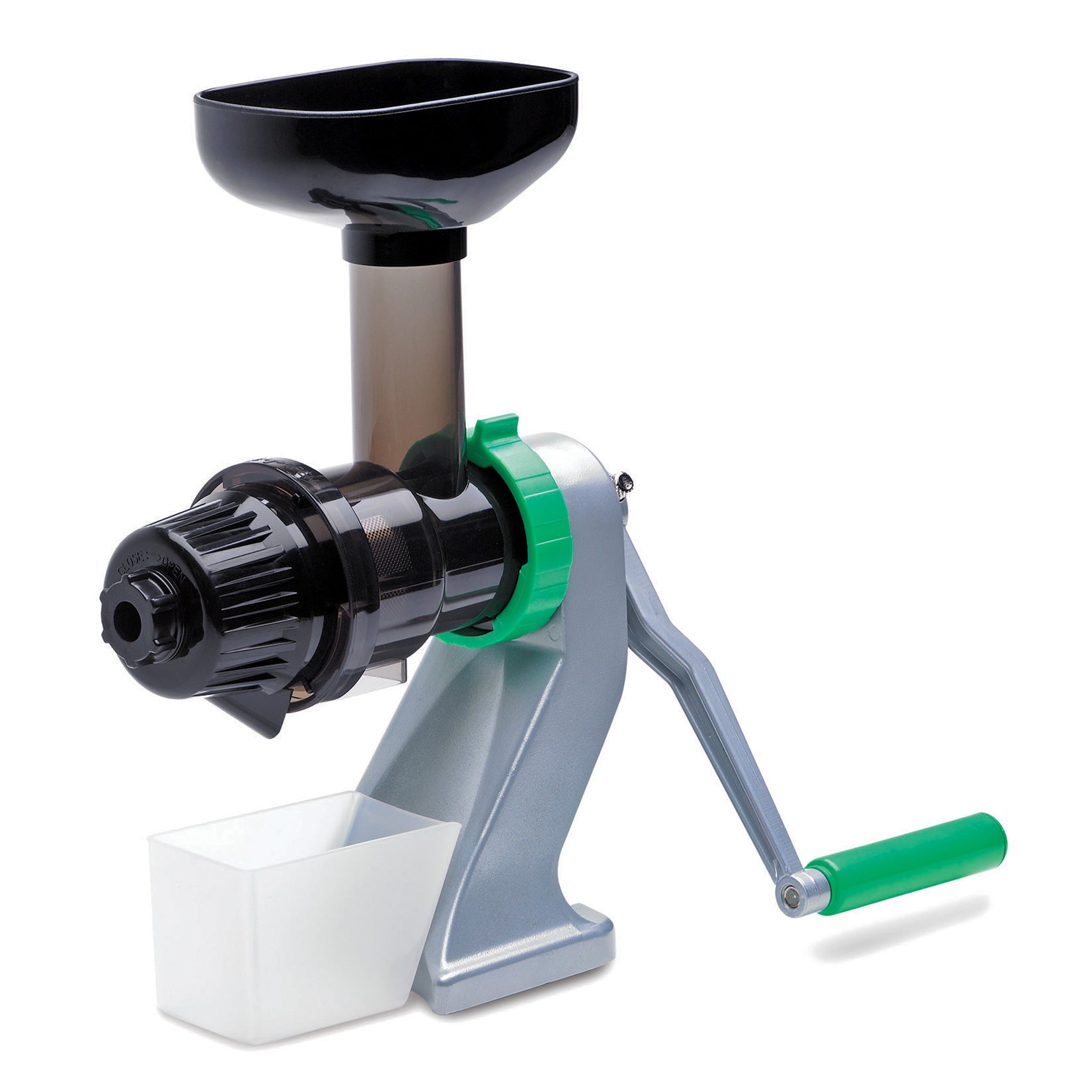
Explore this need in the finder →The Tribest Zstar Z-710 is a hand-cranked single-auger juicer, not a small electric slow juicer: you secure its base to a table or counter edge, feed prepared produce into the chute and turn the handle as the auger works it through a screen. Tribest names wheatgrass, fruits, vegetables and leafy greens. The case for it is power-free operation and a narrower task than a powered machine; the tradeoff is steady hand work, cutting produce into short lengths and cleaning the screen promptly.
Know what kind of manual juicer this is
Manual does not mean the same thing across the category. A hand reamer turns each citrus half over a cone. Tribest's Cancan MJP presses use a bowl, strainer and arm for prepared fruit. The Z-710 instead feeds produce lengthwise through an auger and screen. That difference matters if your routine includes wheatgrass or leafy greens: the Z-710 manual identifies its juicing screen for leafy greens, vegetables and fruits, while the MJP-100 and MJP-105 are fruit presses. Tribest explicitly names pomegranate use for MJP-105, not for the exact Z-710 page. If pomegranate is essential, the Z-710's silence on that fruit is not evidence of compatibility.
Tribest identifies the auger and screen as Ultem and “virtually BPA-free,” with a separate 100% BPA-free housing claim—not a blanket material claim for every accessory. The page says the Z-710 can pair with a Solostar 3C motor base, but that base is not in the listed box. This review covers the hand-cranked setup.
Plan for a clamped, gradual routine
The manual asks you to secure the base at a counter or table edge with the supplied clamp before use, attach the hand crank, assemble the auger housing and retaining ring, then fit the juicing screen, locking cap and selected nozzle. Put the supplied juice container under the appropriate outlet. Cut food into smaller lengthwise pieces, add it in small amounts while turning the crank, and use the included plastic plunger only to push produce down as directed. This is a slower, deliberately paced way to feed a small throat; the manufacturer publishes no chute width, crank-force measurement, output rate or yield test.
It may suit someone who wants a small amount of greens or wheatgrass where an outlet is inconvenient, but it needs an accessible edge for its clamp. Tribest says the clamp extends up to 3 inches; check your actual worktop and handle clearance. The manual says some pulp can remain. A separate homogenizing screen and nozzles serve other food-processing uses; they are not a second juicing setup.
Published size is not a reliable hard-fit result
The current exact U.S. product page lists a 6.8-pound unit and a body size of 14.5 × 4.3 × 13.3 inches in width × depth × height order. The linked 2013 instruction manual instead gives 13.2 × 12.6 × 4.9 inches without axes. Those figures do not reconcile, and the manual does not identify whether that size is an installed body, a different orientation or an outdated measurement. The finder therefore treats all body dimensions as unknown for a strict cabinet or counter limit. Measure an actual unit or get written clarification from the seller before relying on either version. The product is relatively light on the maker's listed weight, but lightweight does not mean clamp-free or ready for travel without a suitable edge.
Feed and cleaning instructions are practical limits
The manual warns against putting fingers or utensils into the feeding chute and says to use the included plunger. It restricts the unit to household use. For cleaning, disassemble only the parts needed for normal operation, wash and store them after every session, and rinse the screen before residue dries; the manual warns dried pulp can block the screen holes. Use lukewarm water and mild detergent, not water above 104°F (40°C), bleach or harsh chemicals. Tribest's FAQ says the Zstar is not dishwasher-safe. The manual offers a 70% white-wine-vinegar / 30% water soak for colored stains. These instructions are more specific than the general promise of an easy-to-clean screen: the practical cleanup is immediate and by hand.
For noise, feeding trouble, a housing that will not fit or rear leakage, Tribest's FAQ/manual point to a level surface, shorter pieces, checking for debris, tightening the retaining ring or reducing the load. Those are support instructions, not reported failure rates or observations from testing.
Choose by task, not by the word “manual”
The exact current Z-710 offer lists a one-year household warranty. A separate Tribest refurbished SKU, Z-710R, uses the same underlying Z-710 arrangement, but its exact product page was unavailable on 2026-10-23 and states that refurbished purchases are final sale with no refunds or returns. The current Z-710 review is for the new Z-710 SKU; see the Z-710R refurbished assessment before considering that condition-specific offer. Do not confuse the refurbished `R` suffix with a different auger model.
Choose Z-710 if no-outlet operation, wheatgrass or greens and a crank-driven screw/screen routine matter more than speed or a known hard-fit number. For pomegranate and citrus, MJP-105 is a different lever press with documented fruit scope; MJP-100 is a smaller press with narrower documented use. For less hand work, compare powered slow juicers and accept their outlet and different cleanup needs. See Tribest's Z-710 page, manual and FAQ. This is source-based, not hands-on: no yield, speed, effort, noise or durability was measured.
Key details at a glance
| Extraction method | Slow-compression masticating extractor |
|---|---|
| Controls and use | The reviewed Z-710 arrangement is hand-cranked; no motor, electrical rating, speed control or selectable speed is included in its listed box contents. The page separately says it can be paired with a Solostar 3C motor base, which is not included or assessed as this setup. |
| Cleanup note | Clean and store the parts after each operation; dried residue can block screen holes. Use lukewarm water with mild detergent. Do not use water above 104°F/40°C or harsh chemicals. For colored stains the manual gives a 70% white-wine-vinegar/30% water soak. The FAQ says the unit is not dishwasher-safe. |
| Manufacturer jug label | The manufacturer does not state the included container volume; do not infer its capacity or juice yield. |
| Body/base construction | Metal base and handle per Tribest product page; exact metal type is not stated. |
| Body-fit measurement note | Unresolved exact-source discrepancy: current product page lists 14.5 × 4.3 × 13.3 in W × D × H; the linked 2013 manual gives 13.2 × 12.6 × 4.9 in without axis labels. Do not use dimensions for hard-fit matching until clarified. |
| Hand-powered operation | No |
| Removable parts dishwasher-safe per manual | No |
Use the exact model’s instructions for operating limits, supplied equipment and version differences.
Sources for this assessment
- Tribest U.S. exact Zstar Manual Juicer product page, default model/SKU Z-710
- Tribest English Z-710 manual, 16 pages, individually inspected
- Existing archived Tribest user-manual directory; Zstar Z-710 entry
- Existing archived Tribest FAQ; Zstar Z-710 / Z-510 support section and dishwasher statement
- Tribest U.S. exact refurbished Zstar product page; SKU Z-710R, unavailable on checked date
- Tribest exact Z-710 manufacturer product image; same original bytes are used on Z-710R page
- Exact-model CPSC recall reconciliation not completed

Now check the model against your kitchen.
Use the finder for extraction style, batch, cleanup, control, and counter-fit requirements.