
Your needs, this model
Does it fit your priorities?
Do you want a hand-powered bowl-and-arm press rather than a motorized cone?
The MJP-100 is an exact manufacturer-listed manual juice press; the shared manual directs the operator to turn the arm by hand.
Explore this need in the finder →Is a manufacturer-confirmed 3.9-inch bowl enough, without requiring the wider MJP-105 bowl?
Tribest specifies a 3.9-inch bowl for the MJP-100; the MJP-105 is specified at 4.5 inches.
Explore this need in the finder →Would a press documented for pomegranates be essential?
Pomegranate is not listed on the exact MJP-100 U.S. product page, so that essential need remains unknown for this model; Tribest names it for the MJP-105.
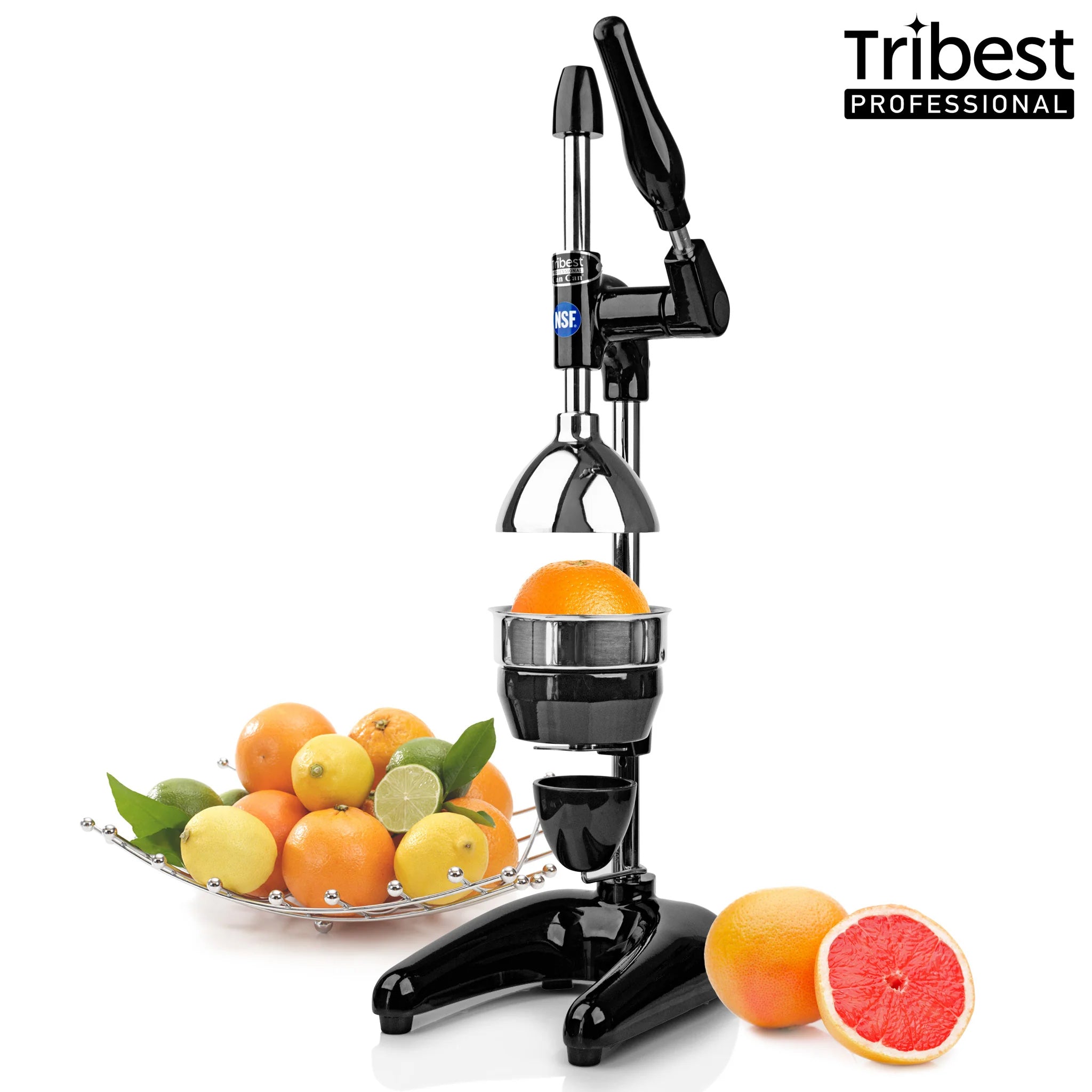
Explore this need in the finder →The Tribest Professional Cancan MJP-100 is a tall, hand-operated lever press for citrus and some tomatoes. Its 3.9-inch stainless-steel bowl and strainer sit above a built-in drip cup, but the cup is for leftover drips—not a juice pitcher. You supply a separate container under the bowl and provide each pressing stroke. Tribest lists a 12.1-pound body, 7.5 × 11.4 × 21.7-inch dimensions, and a three-year household-use warranty.
Choose this format when you want a stable manual press
The MJP-100 is a different kind of “manual juicer” from a hand reamer or a small citrus squeezer. Fruit is placed in a bowl and pressed by a tall arm; it is not a feed-chute machine and it does not have a motor. Tribest names oranges, mandarins, grapefruits and lemons, as well as some vegetables such as tomatoes. The exact U.S. product page does not say this base model is intended for pomegranates, even though the shared manual’s general introduction mentions pomegranate for the family. If that fruit is a requirement, the separately documented MJP-105 is the safer match.
The 3.9-inch bowl is listed as wide enough for a variety of citrus. That number is a bowl diameter, not an opening guarantee for every unusually large fruit. You still wash and cut fruit in half, position each half on the strainer, turn the arm, then clear the spent peel and pulp before the next pressing. This is deliberate, hands-on work. The maker advertises a 200-pound squeezing-pressure figure, but that is Tribest’s claim—not an independently measured result, juice-yield comparison, or promise that you can press without effort.
Set up your own receiving vessel
The included parts list names the press body, stainless-steel strainer, 3.9-inch stainless-steel bowl, drip cup and manual. It does not list a juice pitcher. The manual tells you to place your desired container centered under the bowl, with the drip cup moved to the side during pressing. Afterward, the small cup swings beneath the bowl to catch residual drips. If you buy this expecting its built-in cup to hold the batch, that distinction will be frustrating; choose a glass, measuring jug or other vessel of your own that fits under the bowl and is easy to lift out.
The family’s main trade is a manual mechanism for a tall, substantial body. At 21.7 inches, it may not fit upright beneath low cabinets, and at 12.1 pounds it is not the sort of compact tool that disappears in a drawer. Its weight may help the base feel planted on a suitable flat, nonslip surface, but that is not a lab-tested stability claim. Measure the actual countertop position and the space needed to center and remove your container. There is no published footprint clearance for the arm during use.
Follow the manual; do not assume dishwasher care
Tribest’s sequence is unusually specific. Wash and halve the fruit, set the press on a flat nonslippery surface, raise the arm by turning it twice, check that the strainer is fully seated in the bowl, and lock the bowl into its bracket. Put fruit on the strainer and a separate vessel under the bowl. Turn the arm to press, then reverse it to reopen the space and clear the peel and pulp. Keep hands dry; the manual cautions against wet hands and damp surroundings. It also says to lift the unit by its lower body with both hands rather than by the arm.
For care, the removable bowl and strainer need frequent washing with nonabrasive soap, and the inside of the upper press should be wiped with a damp cloth and dried. The manual says “hot water” in its routine but sets an explicit maximum of 104°F (40°C) in its cleaning caution; follow that ceiling. Neither the exact page nor manual supplies a dishwasher-safe claim, so do not choose this model on the assumption that the parts can go in a rack. No timed cleaning comparison is available.
Tribest’s own troubleshooting page is practical rather than glamorous: poor pressing can come from unsuitable fruit, a strainer that is not fully seated or an arm stroke that is not completed. Some dripping after use is described as normal. A displaced rubber foot can cause wobble, while a problem with the arm returning may need support. These notes help set expectations; they are not reports of failure rates or findings from our own use.
Who should choose it—and when the larger press makes sense
The MJP-100 is a plausible fit if you mostly press halved citrus, prefer to control the action by hand, have room for a tall, heavy tool, and do not mind supplying a collection vessel. Its stainless bowl and strainer are confirmed juice-contact parts. The manufacturer’s refurbished offer lists Gray MJP-100GYR and Black MJP-100BKR. Tribest describes these as like-new, inspected and reconditioned with a three-year warranty, but says no manual is included and all sales are final without refunds or returns. Download the shared manual before choosing that offer.
Choose the MJP-105 instead if a press documented for pomegranates matters or its 4.5-inch bowl is useful: it is 0.6 inch wider, but also 0.4 inch wider and deeper as a body, 1.1 pounds heavier, and still 21.7 inches tall. That difference does not turn either press into an electric appliance; your hand still works the arm. For occasional recipe quantities, Cuisinart’s hand reamer CTG-00-CJ collects in its own marked two-cup bowl and takes less counter commitment, while Breville’s powered citrus presses reduce repeated manual turning but remain citrus-only. For apples, greens or carrots, look to a conventional centrifugal or slow juicer rather than either Cancan press. The finder treats pomegranate as confirmed only for MJP-105 and leaves unknown capacity or space data unmatched. See Tribest’s MJP-100 product page and its shared MJP-100/MJP-105 manual. This is a source-based review, not hands-on testing: we have not measured pressing force, yield, sound, speed or durability.
Key details at a glance
| Extraction method | Hand-operated bowl-and-arm fruit press |
|---|---|
| Listed width | 7.5 in |
| Listed depth | 11.4 in |
| Listed height | 21.7 in |
| Controls and use | Hand-operated arm; the manual instructs the operator to rotate it to apply pressure and reverse to reopen the press. No motor or speed controls are listed. |
| Cleanup note | The manual says to wash the removable stainless bowl and strainer before use and frequently between uses with nonabrasive soap; wipe the inside of the upper press with a damp cloth and dry with a soft cloth. Though the routine text says hot water, the caution caps cleaning water at 104°F (40°C). |
| Manufacturer jug label | No separate juice jug or pitcher is listed. |
| Body-fit measurement note | Manufacturer-listed product body dimensions in W × D × H order; this does not include additional operating or vessel clearance. |
| Hand-powered operation | Yes |
| Manual-press bowl diameter | 3.9 in |
| Separate drip cup included | Yes |
Use the exact model’s instructions for operating limits, supplied equipment and version differences.
Sources for this assessment
- Tribest U.S. exact Manual Juice Press product page, model MJP-100
- Tribest Cancan MJP-100 / MJP-105 four-language instruction manual; English section inspected page by page
- Tribest U.S. official user-manual directory listing MJP-100 / MJP-105
- Tribest official troubleshooting FAQ; MJP press entries inspected
- Tribest U.S. Manual Juicers collection; complete 3-of-3 pagination inspected
- Tribest U.S. Citrus Juicers collection; complete 3-of-3 pagination inspected
- Tribest U.S. Vertical Juicers collection; complete 6-of-6 pagination inspected
- Tribest official black MJP-100 product image, linked from exact U.S. product page
- Exact-model CPSC recall reconciliation not completed
- Tribest exact U.S. manufacturer-refurbished offer for MJP-100
- Tribest public structured variant/availability data for refurbished MJP-100 offer
- Official gray MJP-100GY variant image linked from the exact refurbished offer


Now check the model against your kitchen.
Use the finder for extraction style, batch, cleanup, control, and counter-fit requirements.