
Your needs, this model
Does it fit your priorities?
Are you shopping for a powered citrus cone rather than a fruit-and-vegetable juicer?
The CS-1000-A presses halved citrus on a motorized ream. It has no produce feed chute for apples, carrots, greens or other vegetables.
Explore this need in the finder →Would an included spout that sends juice straight into your own glass suit your routine?
The manual directs the integrated stainless-steel spout toward a user-supplied vessel. Tribest does not publish collector capacity or a maximum glass height.
Explore this need in the finder →Do you require a named low, medium or high citrus-pulp setting?
The CS-1000-A has a stainless filter, but no maker-labeled selectable pulp position; a required labeled setting should rule it out.
Explore this need in the finder →Must your press run continuously for at least one minute before resting?
No. The manual recommends 15 seconds on followed by 15 seconds rest and sets a separate five-minute maximum before a few minutes' rest.
Explore this need in the finder →Is dishwasher cleaning of removable juicing parts essential?
The manual directs hand-washing and says not to use a dishwasher; Tribest's separate FAQ contains conflicting advice. Treat dishwasher compatibility as unconfirmed and do not require it.
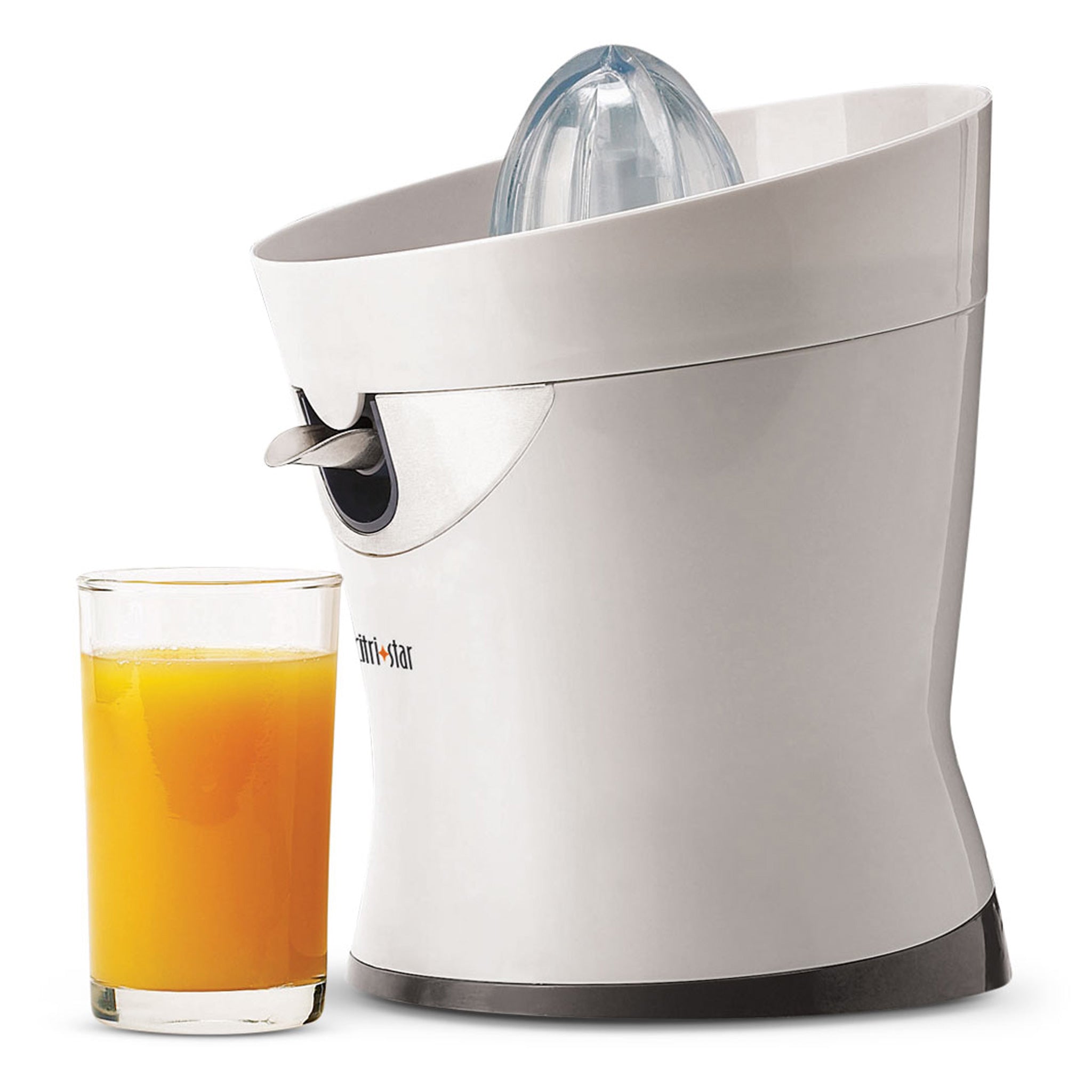
Explore this need in the finder →The Tribest Citristar CS-1000-A is a small, mains-powered citrus press for halved fruit. Press a lemon, lime, orange or grapefruit half onto the ream and its motor turns the cone; a stainless filter sits over a sloped collector with an integrated locking spout. It measures 8 × 8 × 9.5 inches and weighs 5.6 pounds on Tribest's U.S. listing. This is a dedicated citrus tool, not a route for apples, leafy greens or other produce.
A compact press for repeat citrus jobs
The CS-1000-A suits a kitchen that regularly makes citrus juice by the glass, for a recipe or for a small round of drinks. Its product page lists a 50-watt motor and describes automatic start and stop: the user still halves fruit and applies it to the ream, but does not turn a hand cone for every half. This is a narrower convenience than the word “juicer” sometimes suggests. There is no feed chute or produce pusher, and the page does not describe a multi-produce extraction assembly.
Tribest supplies a small ream and a ream cap. The manual says the cap goes on top of the small ream for larger fruit such as oranges and grapefruit; use the smaller ream for lemons and limes. A stainless filter catches pulp and pits, while the collector's sloped bowl and stainless-steel spout direct liquid toward a glass or other container. The spout flips down for pouring and up when finished. That direct-to-vessel layout keeps a second juice pitcher off the counter, but Tribest does not list a collector capacity or the maximum height of a glass that fits underneath. Measure your usual glass against the actual outlet before relying on a close fit.
What this simple control does not provide
The machine has no manufacturer-labeled low, medium or high pulp selector. Its filter is meant to keep pulp and pits out of the flow, but that is not the same as an adjustable texture setting. Nor is there a selectable speed control: the maker's described routine starts the motor when fruit is pressed down. If changing pulp level matters, the Cuisinart CCJ-500P1 documents three named settings; if a filter that lets through more pulp is essential, compare its parts and booklet rather than treating Citristar's fixed screen as equivalent. Those labels are not quantitative pulp percentages or yield promises.
The body is 8 inches wide and deep, with a listed height of 9.5 inches—shorter than the tall-arm Breville 800CPXL, though your glass and fruit need extra room. At 5.6 pounds, it is not a measured stability claim. Tribest calls the body and reams BPA-free and identifies the filter and spout as stainless steel; other component materials are not enumerated.
Follow its short-cycle operating instructions
Tribest's manual calls for a firm, level surface. Set the juice collector and filter in place, insert the small ream and, when needed, set its cap on top. Plug in and press a halved fruit onto the cone. The manual recommends 15 seconds of operation followed by 15 seconds of rest, says not to operate more than five minutes at one time, and instructs users to allow a few minutes before the next use. That guidance makes this better suited to short batches than a prolonged, uninterrupted session. I would not treat the five-minute ceiling as permission to ignore the shorter on/off cycle. It is an operating limit, not a throughput rating.
For care, the manual says to unplug, remove the ream, filter and collector, lower the spout fully, then hand-wash the removable pieces in warm soapy water. The spout cannot detach; wipe the base with a moist cloth and never immerse or rinse it. Tribest's FAQ conflicts: one answer discourages dishwasher cleaning, while another says the screen, reams and cover can go in a dishwasher but may deform under high heat. Follow the manual's explicit hand-wash direction unless Tribest clarifies which version the FAQ covers. Clean promptly so citrus residue does not dry around the filter or outlet.
Check the exact code and refurb terms
The U.S. product page and variant record name CS-1000-A; the FAQ and manual use family key CS-1000. Tribest's refurbished offer is SKU CS-1000R-A and identifies its underlying model as CS-1000-A. It claims technician inspection/reconditioning and a one-year warranty, but also says the sale is final with no refunds or returns. These are maker statements, not an assessment of a particular unit. Check the exact suffix and current terms; don't transfer them to a different marketplace listing.
One source detail remains unresolved: the current product text says CS-1000-A, but the gallery image alt text says CS-1000-B. Tribest also links that same illustration from its refurbished page. It shows the Citristar form, not a verified suffix or refurb condition. Check the actual offer/model marking rather than using the picture to prove compatibility.
Who should choose it—and what to compare
Choose the CS-1000-A for repeated citrus use if its compact powered cone, direct glass outlet and short rest cycles suit you. Compare Cuisinart's CCJ-500P1 for labeled pulp options, Breville's 800CPXL for a lever-and-dome arrangement, or Cuisinart's hand tool CTG-00-CJ for occasional recipe amounts without a motor. For apples, carrots, greens or a supplied large pitcher, choose a centrifugal or slow juicer that documents those capabilities instead.
See Tribest's CS-1000-A listing, the linked CS-1000 manual, and its CS-1000R-A refurbished offer for the exact listing and care terms. This is a source-based assessment, not a hands-on test: no extraction yield, time, noise, durability or cleaning performance was measured.
Key details at a glance
| Extraction method | Dedicated citrus reamer or cone press |
|---|---|
| Speed control | Single-speed on/off |
| Motor electrical rating | 50 W |
| Listed width | 8 in |
| Listed depth | 8 in |
| Listed height | 9.5 in |
| Dedicated Quiet selector label | No |
| Controls and use | The U.S. model page identifies 50 W and automatic start/stop when citrus is pressed onto the ream. The manual gives no user-selectable speed; no speed or yield measurement was made. |
| Manufacturer jug label | Includes a juice collector with spout; manufacturer does not list its usable capacity or a separate lidded carafe. |
| Supplied cup nozzle | Yes |
| Manufacturer-listed voltage | 120 V |
Use the exact model’s instructions for operating limits, supplied equipment and version differences.
Sources for this assessment
- Tribest exact U.S. Citristar current product page; names model CS-1000-A and links the manual
- Public Shopify product and exact current CS-1000-A variant/availability record
- Current linked Tribest Citristar CS-1000 multilingual operation manual; English text individually inspected
- Exact Tribest U.S. Citristar manufacturer-refurbished offer, model code CS-1000R-A
- Public Shopify variant/availability record for exact refurb SKU CS-1000R-A
- Tribest U.S. User Manuals directory, Citristar section CS-1000-A
- Tribest official Product FAQ selector; Citristar support key CS-1000
- Tribest U.S. Citrus Juicers directory; Citristar cross-listed with manual juice press rows
Now check the model against your kitchen.
Use the finder for extraction style, batch, cleanup, control, and counter-fit requirements.