
Your needs, this model
Does it fit your priorities?
Would a horizontal auger with four separate speed positions make the earlier 929 worth considering?
The exact U.S. 929 page and compatible 120-V manual list 40, 65, 90 and 120 rpm. This is four selector positions, not a continuously variable dial. Sana marks the exact pre-owned offer sold out, so the earlier-model choice must be enabled.
Explore this need in the finder →Is a 32-fl-oz receiver enough, or do you need at least 34 fl oz?
Sana lists a 1,000-ml pitcher, about 33.8 U.S. fl oz: enough for a 32-fl-oz vessel threshold, but below a strict 34-fl-oz minimum. Vessel capacity does not predict juice yield.
Explore this need in the finder →Is a documented preloaded batch hopper essential?
The 929 has a dual hopper with a standard opening and a deeper bowl, but Sana does not publish a numeric batch-hopper capacity or describe a self-feeding batch system for this horizontal setup. Do not treat the two openings as a measured batch-loading feature.
Explore this need in the finder →The Sana 929 Ultimate is a horizontal single-auger juicer whose U.S. pre-owned listing was unusually complete on paper: four speed positions, three removable screen setups, a one-liter pitcher, and food-contact juicing parts the manufacturer describes as solid stainless steel. The exact retail configuration is SKU SANA929SS_CPO. Sana USA currently marks this pre-owned offer sold out, and Sana Products lists the 929 among discontinued juicers, so treat this as an earlier-model reference rather than a presently available new pick.
What the stainless-steel package changes
The 929’s distinction is not just a stainless-colored housing. Sana says its drum, auger, screens, drum cap and pressure regulator are solid food-grade stainless steel, and its U.S. listing identifies a stainless-steel body and pulp container. That is a meaningful materials distinction if you specifically want metal juicing parts. It does not establish a measured yield, quietness, sanitation result or durability advantage; the page’s stronger performance language is the maker’s own claim, not an independent test. The U.S. offer pairs that horizontal auger with a dual hopper: a conventional opening for larger pieces and a deeper bowl for smaller produce and leafy greens. That is not the same thing as a measured, preloaded batch hopper. Sana provides no numeric chute width or batch capacity, so a wide-opening or load-it-once requirement cannot be verified from these sources. The manual describes a normal feed-and-push routine and cautions against overfeeding.Four speeds and three separate setups
The U.S. listing and the 120-volt Sana 929 manual agree on four selector positions—40, 65, 90 and 120 rpm—and a 150-watt motor. Use the fine screen for the manual’s general juicing setup and the coarse screen for softer fruit such as berries and pineapple. The third screen is a homogenizing blank: it mixes rather than separates juice, so it is a different installed job, not another simultaneous juice filter. Sana’s manual says to attach the juice plug for homogenizing and leave it open for ordinary juice extraction. The maker also describes adjustable pressure at the drum cap and an automatic jam-clearing reverse. The manual explains that the machine pauses, reverses briefly and resumes at the previous setting; a separate manual reverse remains available if the jam persists. This is a useful safeguard, not ingredient recognition. The optional Sana 702 oil extractor is a separate attachment, not part of the listed juicer package.Receiver size is not juice yield
The pre-owned listing names a 1,000-ml borosilicate glass pitcher and a stainless strainer—about 33.8 U.S. fluid ounces by conversion. That is vessel capacity, not the amount a particular batch will produce. It clears a 32-ounce receiver minimum but does not clear a strict 34-ounce minimum. The page calls its external steel pulp container extra large but publishes no capacity. For a larger juice batch, this is a smaller receiver than a 1,500-ml vessel; plan to empty it rather than infer output from the glass size. The manual makes the cleanup routine more concrete than the listing’s broad “nonstop” motor claim. For large batches it directs users to process about two pounds of one ingredient, disassemble and wash, then repeat. It also says not to run empty, not to force hard pits through the auger and not to overfeed. The removable drum, auger, screens, cap and containers are listed as top-rack dishwasher-safe with mild detergent; the wooden pusher is not. Wipe the motor body with a damp cloth, keep liquid out of the controls and dry the stainless parts after washing.Buying an earlier pre-owned offer
Sana USA describes the listing as “looks new” and “used only a few times,” but that is the seller’s description, not an inspection of the particular machine a buyer might receive. The same page uses “Full Warranty” and “Lifetime Warranty” headings without supplying the written CPO terms, exclusions or transfer rules. Do not infer that the standard 929 warranty automatically covers a pre-owned unit. The page now says sold out; an exact-model search may find a different offer, but it will not prove that offer is Sana-certified, complete or covered by the same terms. There is also a specification conflict worth knowing before considering a specific unit: Sana USA’s pre-owned page lists 27.5 pounds and dimensions as 8 × 15 × 15⅜ inches without assigning axes. The exact U.S. 929 manual lists 16.75 pounds and labels width 15, length 8 and height 15 inches. I leave the weight and strict height fit unresolved rather than guessing whether the listing figure includes shipping or reflects another measurement. Measure a particular machine and its working clearance.Who should look elsewhere?
Choose a different configuration if you need a current in-stock manufacturer offer, a documented hopper batch volume, a 34-ounce-or-larger included pitcher, or a known pre-owned warranty. The Sana 727 Supreme is another horizontal four-speed model, but its reviewed black CPO setup has a 500-ml cup; the 929’s one-liter vessel and explicitly all-steel juicing parts are its stronger paper distinctions. Sana’s 878 instead uses a vertical self-feeding hopper. No measured performance, actual used-unit condition or current CPO warranty is established here.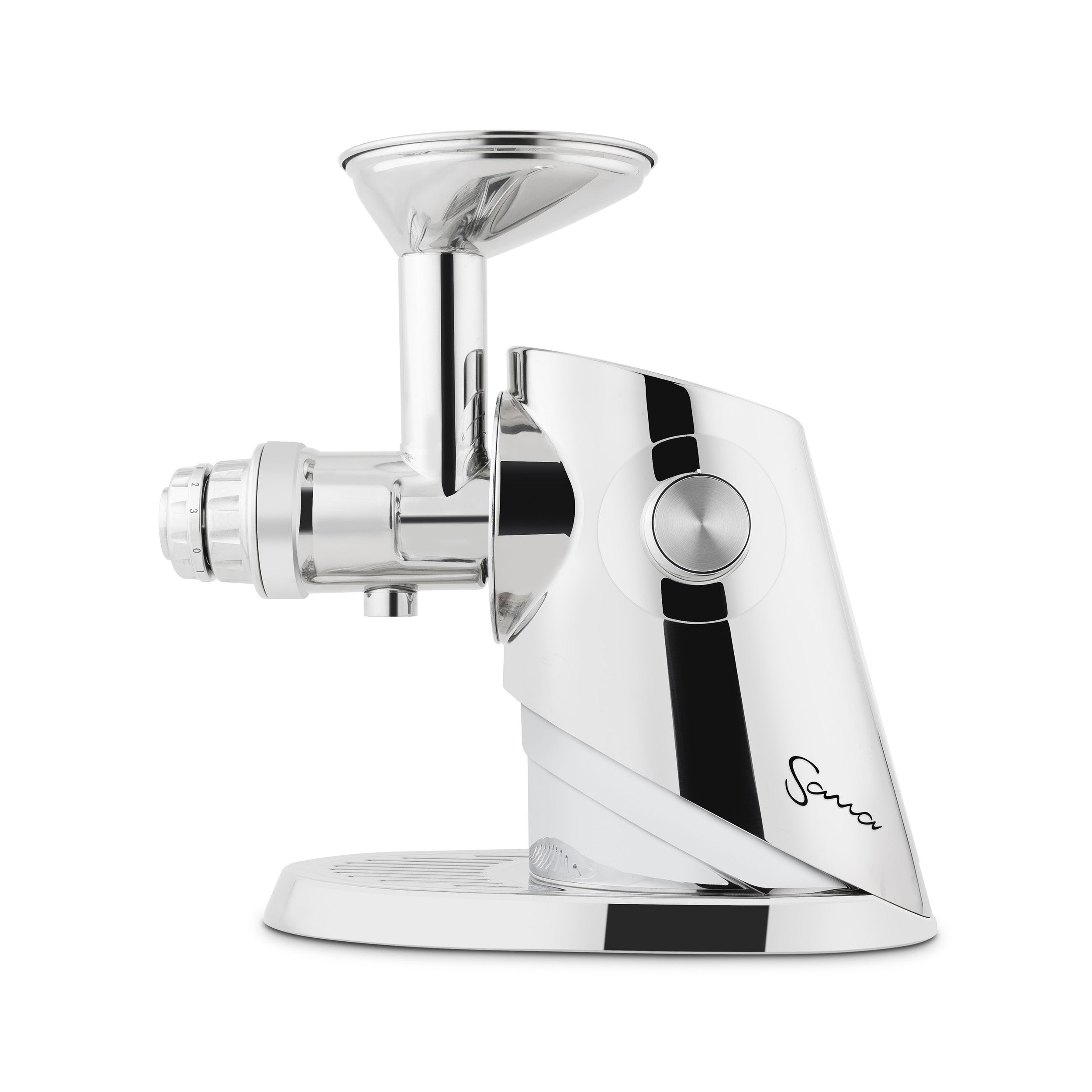
Sources: Sana USA’s exact pre-owned listing and product data; Sana Products’ 929 model page and its U.S. 120-volt instruction manual. The manufacturer’s model directory lists the 929 as discontinued. This source-based assessment is not a lab test or inspection of a used machine.
Key details at a glance
| Extraction method | Slow-compression masticating extractor |
|---|---|
| Included juice receiver capacity | 33.8 fl oz |
| Pulp bin placement | External side bin |
| Speed control | Four discrete speed settings |
| Motor electrical rating | 150 W |
| Listed width | 15 in |
| Manufacturer jug label | Sana USA lists a 1,000-ml glass pitcher (about 33.8 U.S. fl oz); capacity is vessel size, not juice yield. |
| Fast/firm juicing guidance | The pre-owned listing says the brushless motor allows nonstop operation, but gives no numeric runtime limit. The exact U.S. manual directs large batches to be processed in about 2-lb ingredient stages followed by disassembly and washing. This is a manual batch-care instruction, not an inferred minute limit. |
| Body-fit measurement note | The exact 929 U.S. manual labels width 15, length 8 and height 15 in; Sana USA’s exact CPO page lists 8 × 15 × 15 3/8 in without axis labels. The height conflicts by 3/8 in, so strict height-fit matching stays unknown. Measure the specific unit and counter clearance. |
| Electrical-rating caveat | The exact CPO page and U.S. 929 manual list 150 W; this is an electrical rating, not a yield or durability measurement. |
| Removable parts dishwasher-safe per manual | Yes |
| Batch-loading hopper | No |
| Separate smoothie strainer included | No |
| Included blank/sorbet strainer | No |
| Manufacturer-listed voltage | 120 V |
| Discrete speed settings | 40 / 65 / 90 / 120 rpm |
Use the exact model’s instructions for operating limits, supplied equipment and version differences.
Sources for this assessment
- Sana USA 929 Ultimate Stainless Steel Juicer Pre-Owned exact U.S. page
- Sana USA exact SANA929SS_CPO product data
- Sana Products Sana 929 Ultimate exact model page
- Sana Products U.S. juicer directory and discontinued section
- Sana 929 US_3 instruction manual (24 pages, 120 V)
- Sana USA main image on exact SANA929SS_CPO listing

Now check the model against your kitchen.
Use the finder for extraction style, batch, cleanup, control, and counter-fit requirements.