
Your needs, this model
Does it fit your priorities?
Does this package include the four-screen set, including a smoothie screen?
Sana USA lists fine, coarse, smoothie and sorbet screens in the exact black 868 listing; cleaning and use of the 120-V kit still require its exact U.S. manual.
Explore this need in the finder →Do you need the Sana 868 wide feed opening, while accepting that its manual hopper volume is unknown?
The exact U.S. 868 listing states an 82-mm / 3.25-inch trap-door opening. Its product name says Batch Juicer, but the maker does not list a numeric preloaded produce hopper.
Explore this need in the finder →Will the listed 50-ounce pitcher meet your batch-size threshold without confusing it with yield?
Sana USA lists a 50-ounce / 1,500-ml glass receiver; its actual extracted yield depends on produce and is not assessed here.
Explore this need in the finder →The Sana 868 is a vertical single-auger juicer with an unusually wide, maker-listed 3.25-inch opening and a trap-door feed design. Sana USA’s exact black listing identifies SKU SANA868-BLK, 50 rpm, 240 W, 120 V, four screen setups and a 50-ounce glass pitcher. Its main appeal is less cutting and more ways to change the output; the compromise is that Sana’s 868-specific manual available online is for 220–240 V, not this U.S. model.
Wide-feed does not mean a preloaded hopper
Despite “Batch Juicer” in the name, Sana’s U.S. materials describe a wide feed opening and trap door, not a measured produce-batch hopper that can be loaded and left to feed itself. The maker lists the opening at 3¼ inches (82 mm), with a narrower circular passage integrated into the door for celery stalks and smaller carrots. Its page says some whole apples and larger produce pieces can fit; that is a size example, not permission to put every apple, hard vegetable, pit or unprepared ingredient through the machine. Follow the manual packaged with the exact 120-volt U.S. unit. That distinction separates it from the 878 Self-Feeding Juicer. The 878’s U.S. page specifies a 2-liter hopper whose dual blades are described as sorting, cutting and feeding loaded ingredients. If reducing repeated hand-feeding is the priority, that is the more relevant design. The 868 instead targets a wide opening and broad screen kit, while requiring the user to stay involved in preparing and feeding produce. “Batch” in the 868 product name should not be read as automatic feeding or a 2-liter hopper.Four different screen configurations
Sana lists four supplied setups: fine and coarse juicing screens, a smoothie screen, and a frozen-dessert/sorbet screen. The fine screen is the maker’s usual choice for fruit and vegetables; the coarser openings are described for softer fruit and a pulpier style. Sana describes the smoothie screen as returning pulp into the mixture and the frozen-dessert screen for slightly thawed fruit. These are assembled setups, not simultaneous modes. The U.S. product page also describes a pulp flap for mixing or holding juice in the chamber, and a 50-ounce (1,500 ml) glass pitcher for collecting it. That versatility matters only if you will change and wash the extra parts. Someone who wants straightforward juice from mostly firm produce may not need four screens. Its four setups make more sense if you want soft-fruit, smoothie-style, or frozen-dessert options than a one-screen machine. Sana’s descriptions of juice yield, nutrient retention and quality are manufacturer claims, not measurements or tests in this assessment.Exact U.S. evidence, with a manual caveat
Sana USA’s product page and exact product-data record identify the U.S. 868 as a 120-volt, 240-watt, 50-rpm vertical single auger; the captured black SKU is SANA868-BLK, and red SANA868-RED is the same model in another finish. The 15-year warranty headline is not accompanied by established U.S. terms. Sana’s separate global 868 page links a manual whose specifications identify 220–240 V and 50–60 Hz. That is not the right electrical manual for a 120-V North American machine, so its operating, ingredient-preparation, cleaning and run-time directions are not transferred into this review. Obtain and use the exact U.S. instructions supplied with the purchased configuration. There is also a metadata discrepancy: some page metadata refers to an 848, but the visible Sana USA title and page body, exact U.S. product object, available SKU and gallery identify the 868. The review follows the exact 868 product title and SKU rather than carrying over an 848 model label or specifications. This matters because the 848 is a separate Sana model.Counter, capacity and cleanup
The exact U.S. listing gives a 50-ounce / 1,500-ml glass juice pitcher and a stainless-steel pulp collector. The juice receiver is generous for pouring a family-size batch, but its nominal capacity is not a claim about how much juice a particular recipe produces. The pulp bin’s capacity is not numerically stated. The listing gives assembled dimensions as 7 × 9 × 18 inches high, with no explicit axis labels for the first two measurements; height is named, while width and depth remain uncertain. Measure the feed door, containers, sink access and cleaning space. The maker lists three cleaning brushes and a drum-removal tool and describes an open pulp outlet and screen-cleaning brush. Those details suggest useful cleaning accessories, not a verified fast-cleaning result. Dishwasher safety and a precise cleaning sequence remain unknown for the U.S. 120-V kit because the available global manual is voltage-incompatible. If hand-washing every removable piece is a deal-breaker, request the U.S. instruction sheet before relying on the listing. Optional Sana 868 citrus and oil-extraction attachments are separate products; neither is included merely because the manufacturer discusses compatibility elsewhere.Who should shortlist it?
Shortlist the Sana 868 if your essentials are a documented wide opening, a four-screen package, a glass receiver around 50 ounces and a U.S. 120-V slow auger. Compare it with the 878 if you want a 2-liter self-feeding hopper and vacuum-storage container more than the 868’s separate smoothie screen. Compare it with the 707C or 727 if you prefer a horizontal auger. Do not choose the 868 for an exact dishwasher requirement, a quantified pulp-bin size, a verified uninterrupted-run interval, or certainty about U.S. cleanup instructions: the sources inspected do not establish those points. No yield, taste, noise, health or durability claim has been tested here.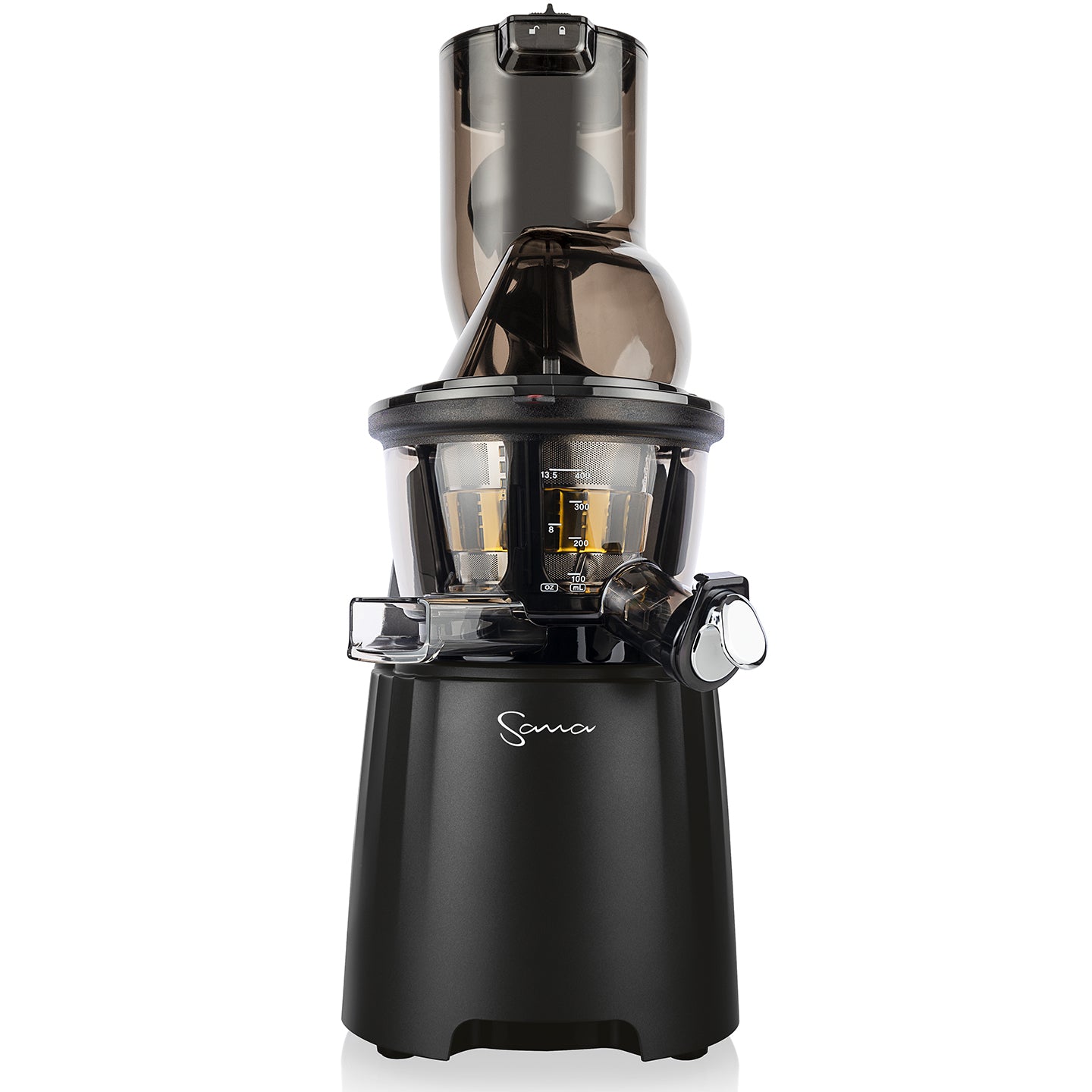
Sources: Sana USA’s 868 Batch Juicer listing and exact product data; Sana Products’ global Sana 868 product page and its linked 220–240-V manual are regional references only. This source-based review is not an ownership, yield, noise or durability test.
Key details at a glance
| Extraction method | Slow-compression masticating extractor |
|---|---|
| Included juice receiver capacity | 50 fl oz |
| Pulp bin placement | External side bin |
| Published feed-chute width | 3.25 in |
| Speed control | Single-speed on/off |
| Motor electrical rating | 240 W |
| Listed height | 18 in |
| Manufacturer jug label | Sana USA lists 50 oz / 1,500 ml for its glass pitcher; use the maker-stated 50 fl oz conservatively for numeric questionnaire thresholds. Vessel capacity is not juice yield. |
| Fast/firm juicing guidance | The exact U.S. page does not establish a run limit. A linked exact-model global manual identifies 220–240 V and is not used for the U.S. 120-V model. |
| Published feed-chute width (metric) | 82 mm |
| Body-fit measurement note | Sana USA lists assembled dimensions as 7 × 9 × 18 inches high but does not explicitly label the first two axes. The listing explicitly says 18 in high; width and depth remain unknown for strict fit. |
| Electrical-rating caveat | Maker-listed U.S. rated power, not an extraction-yield or durability test. |
| Batch-loading hopper | No |
| Separate smoothie strainer included | Yes |
| Included blank/sorbet strainer | Yes |
| Manufacturer-listed voltage | 120 V |
| Maker-listed rotational speed | 50 rpm |
Use the exact model’s instructions for operating limits, supplied equipment and version differences.
Sources for this assessment

Now check the model against your kitchen.
Use the finder for extraction style, batch, cleanup, control, and counter-fit requirements.