
Your needs, this model
Does it fit your priorities?
Would a horizontal auger and separate screen setups suit the produce and texture you want?
The U.S. 707C page identifies a horizontal single auger and fine, coarse and homogenizing screens. The coarse screen is the maker-described option for softer fruit; screen changes are separate setups.
Explore this need in the finder →Is a glass juice bowl supplied, and do you need its capacity to meet a strict batch minimum?
Sana USA lists a glass bowl with strainer top, but publishes no U.S. bowl volume. The product can meet an included-receiver requirement; a numeric minimum remains unknown.
Explore this need in the finder →Does the Sana 707C document the four-speed selection you might require?
The U.S. listing states 63 RPM but does not document a four-setting user selector or exact U.S. control manual. It should not be chosen for an essential four-speed requirement.
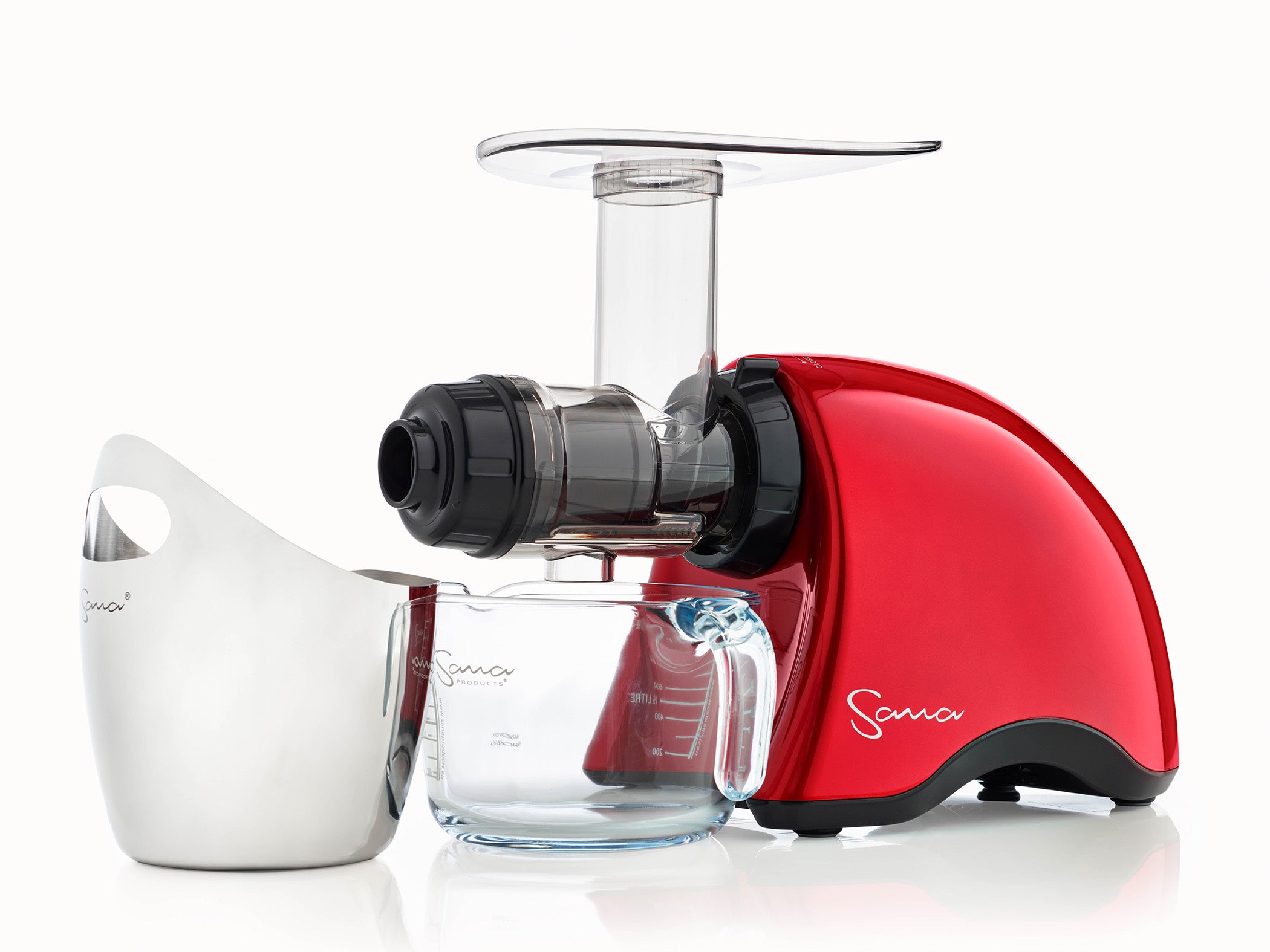
Explore this need in the finder →The Sana 707 Classic listing identifies the North American machine as model 707C. Sana’s U.S. product data identifies red S707RED alongside black and white finish SKUs; its three-screen horizontal auger and supplied glass bowl make it a multi-setup appliance rather than a one-purpose vertical juicer. The U.S. page states 110 volts and 63 rpm, but contradicts itself on motor power: the feature text says 150 watts while the specifications say 200. This assessment leaves wattage and several manual-dependent details unresolved instead of borrowing a regional 707 booklet.
A horizontal auger with three screen choices
The most useful distinction is what sits in the juicing drum. Sana lists a fine screen for a finer, clearer juice, a coarse screen for a denser result and softer fruit such as berries or pineapple, and a homogenizing blank for jobs such as nut butter, sorbet, nut milk, pasta or salsa. These are changed configurations, not a single mode that produces every result at once. If you primarily juice conventional produce and care about screen choice, this is a meaningful set of tools; if you expect a vertical batch hopper, wide-mouth whole-fruit loading or automatic feed, the 707C is a different style.
The U.S. listing also describes three pasta nozzles and a larger universal food-processing nozzle. It identifies a celery insert and a separate Sana 702 oil extractor attachment, but does not make the latter part of the ordinary juicer purchase. Do not treat optional oil extraction as an included juice function. Sana’s “up to 15%” celery-yield statement is the maker’s claim, not a result measured in this assessment.
Keep U.S. and regional 707 information separate
Sana USA labels this offer 707C, gives a U.S. voltage of 110 V and lists a 63-rpm single-auger horizontal process. The manufacturer page does not establish an exact U.S. user manual or an operating interval. A separate global Sana 707 page links a booklet whose cover names “Sana Juicer EUJ-707”; that document is not identified as the 707C package manual, so its instructions should not be assumed to govern the North American machine. Ask the seller for the exact manual and follow it for ingredient preparation, feeding, reverse use, cleaning and run limits.
There is a specific electrical-rating conflict on the U.S. page itself: a feature bullet calls the motor 150 W, while the technical table says 200 W. Neither number is adopted as a settled specification here. This does not change the clearly stated 110-V figure, but it does mean wattage-based comparisons are unreliable. The page lists a 15-year warranty without spelling out its complete scope or conditions; read the actual written warranty rather than treating the headline as unlimited coverage.
Supplied vessels and cleanup claims
The exact U.S. listing says the package includes a glass juice bowl with a strainer top and a stainless-steel pulp container. It does not give the bowl’s capacity, and a size visible in a studio image is not a capacity specification. If you require a receiver above a particular number of ounces, this listing does not establish that threshold. The stainless container is the pulp collector, not a second juice pitcher.
Sana describes the 707 as having few parts and says cleanup takes two to three minutes with rinsing and a brush for the screen. That is the manufacturer’s description, not a timed test. No exact U.S. 707C cleaning manual was found in the product materials inspected, so dishwasher eligibility and a safe detailed cleaning sequence remain unknown. The practical choice is whether you are comfortable rinsing and brushing the screen promptly and obtaining the correct U.S. instructions before operating the juicer.
Who should compare it with the 727?
Choose the 707C for its coarse-screen soft-fruit route, three screen configurations, several food-processing nozzles and a standard horizontal single-auger arrangement. Its U.S. page supplies no numeric chute width, bowl capacity, dishwasher approval or exact session limit, so do not choose it for those hard requirements. The Sana 727 Supreme is the contrasting horizontal model if selectable speeds matter: its U.S. listing gives four settings—40, 65, 90 and 120 rpm—plus automatic two-second reverse. The 727 offer currently reviewed is certified pre-owned black, and its specified crystal glass is 500 ml, a small receiver rather than a batch pitcher. Its advertised nonstop use is not a measured extraction result or an exact U.S. manual limit.
Neither “slow” nor the wattage number predicts juice yield, flavor, noise or cleaning time. With the 707C, the evidence supports a choice about screens and package contents; it does not settle the missing manual-dependent boundaries. For someone who needs a confidently documented dishwasher-safe part set, a verified pitcher size or an exact uninterrupted-use limit, wait for the exact U.S. guide or choose a model whose own instructions establish that need.
Sources: Sana USA’s 707 Classic 707C listing and current U.S. juicer collection, plus Sana Products’ global Sana 707 page and its linked EUJ-707 manual. This source-based assessment is not an ownership, yield, noise or durability test.
Key details at a glance
| Extraction method | Slow-compression masticating extractor |
|---|---|
| Pulp bin placement | External side bin |
| Body-fit measurement note | The exact U.S. page lists 7.5 x 16.5 x 12.5 in without axis labels. Values are preserved verbatim but not assigned to width/depth/height for hard fit matching. |
| Electrical-rating caveat | Sana USA exact listing conflicts: main feature bullet says commercial-grade 150 W; specifications say 200 W. Matching wattage is left unknown; no motor power is inferred from the global 707 page. |
| Pasta-making attachments included | Yes |
| Batch-loading hopper | No |
| Manufacturer-listed voltage | 110 V |
| Maker-listed rotational speed | 63 rpm |
| Included screen setups | Three listed screens: fine, coarse and homogenizing blank; each is a different installed setup. |
| Dimensions as listed (axes unspecified) | 7.5 x 16.5 x 12.5 in (Sana USA table does not label the axes) |
Use the exact model’s instructions for operating limits, supplied equipment and version differences.
Sources for this assessment

Now check the model against your kitchen.
Use the finder for extraction style, batch, cleanup, control, and counter-fit requirements.