
Your needs, this model
Does it fit your priorities?
Is a horizontal single-auger process the style you want to compare?
Sana describes the discontinued global 606 as a low-speed horizontal auger juicer. The 230 V / 50 Hz manual-linked version is retained only as a reference, not a U.S. purchasing option.
Explore this need in the finder →Would a separate processing-strainer setup matter alongside ordinary juicing?
The exact page describes an included homogenizing screen, and the linked manual lists a processing strainer and three noodle nozzles. These are separate installed configurations, not one combined juice mode.
Explore this need in the finder →Do you require a documented uninterrupted session longer than 30 minutes?
The linked global manual sets a 30-minute maximum continuous session. That limit applies only to this global 230 V / 50 Hz 606 configuration and must not be transferred to a similarly named U.S. product.
Explore this need in the finder →Sana’s global product page calls the 606 a discontinued horizontal single-auger juicer, and the English manual linked directly from that page identifies model 606 with a 230 V / 50 Hz, 200 W specification. This review covers that exact global configuration only. Sana USA’s captured current juicer collection does not list a 606, and the available evidence does not establish a North American voltage variant; the global 606 is reference-only here, not a U.S. buying recommendation.
What is distinctive about this 606
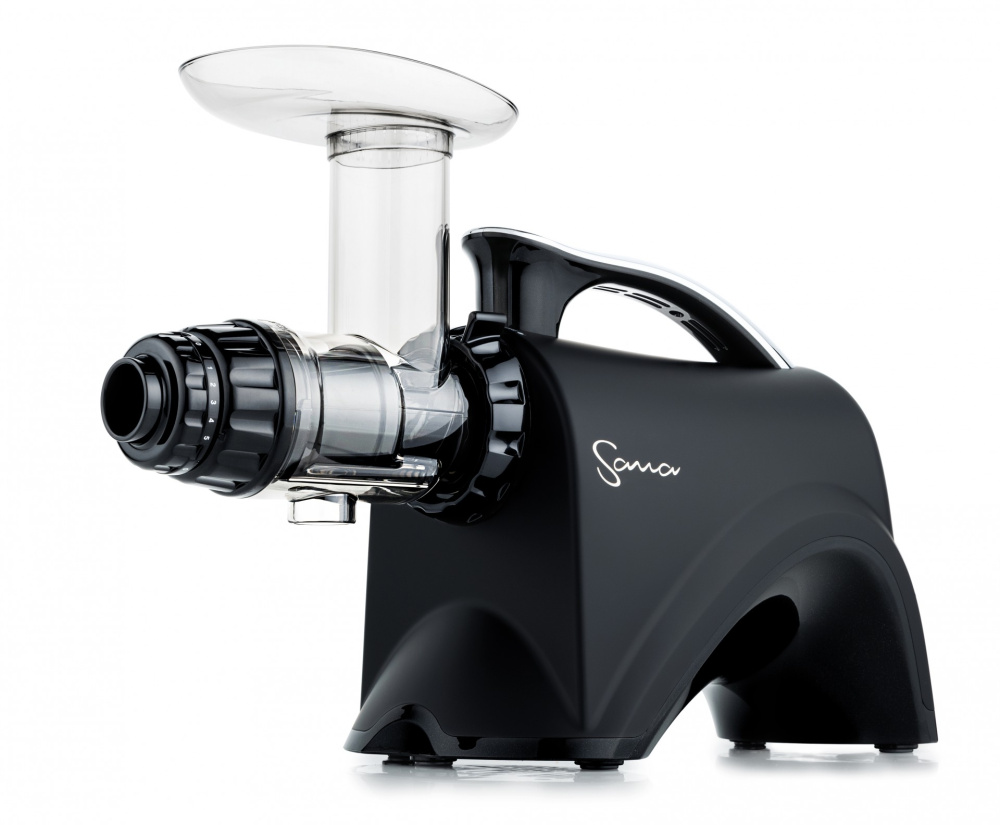
The basic arrangement is a horizontal auger juicer, but the useful detail is the pressure adjustment at the outlet. Sana describes a five-stage pulp regulator, and the model-linked instructions assign settings 1–2 to softer produce and 3–5 to firmer ingredients. That is a practical way to vary pressure and allow softer fruit pulp through more readily. It is not an RPM selector: the maker publishes a 63–75 rpm range but does not document a user-controlled speed dial. Nor is the pressure scale a measured juice-yield promise. No independent yield or texture testing was performed for this assessment.
The included parts support two different tasks. For juice, the manual uses the juicing strainer and adjustable pressure cap. For processing, it substitutes the processing strainer and a selected nozzle. Sana lists round, flat and bread-stick pasta nozzles; the product page describes the homogenizing setup for jobs such as nut butter, nut milk, sorbet and sauces. Change the installed pieces for the chosen task rather than expecting juicing and processing to happen together. An oil extractor is described as a separate optional accessory, not part of the ordinary package reviewed here.
Feeding is still a hands-on routine
This is not a self-feeding batch hopper. Its manual says to cut fruit or vegetables into pieces of about two inches, add a few pieces at a time, and press gently with the supplied pusher. That is a clearer preparation expectation than the large clear hopper in the product image might suggest. The maker gives no numeric feed-opening width, so there is no sound basis for matching the 606 to a strict chute minimum or promising whole-produce loading.
If material stops moving, the manual’s recovery sequence is also specific: stop the operation, use reverse two or three times, then resume with the on control. That is manual reverse, not automatic ingredient sensing or automatic jam clearing. The guide sets a maximum of 30 minutes of uninterrupted running. It does not establish a batch volume or a routine cool-down schedule in the sections reviewed, so do not infer one from the wattage, speed range or manufacturer’s premium-language claims.
Care takes hand washing, not dishwasher shortcuts
The linked instructions call for disassembling the drum set and washing the removed juicer parts in warm soapy water after use. They explicitly say not to put the parts in a dishwasher. The page’s broader durability language is not a reason to ignore the cleaning directions, and this review has no timed cleanup or long-term wear results. The manual lists two containers and a brush among the package parts; their capacities are not published. If a minimum pitcher size matters, this record cannot establish it.
The manufacturer specifies 48.4 × 18.3 × 32 cm and 6 kg on the global product page. The manual labels the dimensions as length, width and height, so only the 32 cm height is carried into a vertical-clearance check; the 48.4 cm length is not casually relabeled as counter depth. The published motor/parts warranty headline is 15/5 years on the global English page, but its exact regional terms and relevance to an old second-hand machine are not established. With the product officially discontinued, parts access and the condition of any used unit should be checked directly rather than assumed from that headline.
Who should keep it in view—and who should not
The Sana 606 is useful as a reference for an owner trying to identify the correct strainer, pressure setting or manual limit on a global 230 V unit, or for comparing the design’s combination of juicing and food-processing tools. It should not be selected for a U.S. kitchen from its similar name, appearance or family resemblance to another Sana. The current U.S. Sana 707C listing is a separate North American machine: its own voltage and package facts must be assessed from its own evidence, and its exact U.S. operation manual remains a separate open question. A seller must establish the actual nameplate and regional instructions before any purchase or use of a 606; this review does not provide transformer advice.
In short, the 606’s genuine distinctions are the five-step pressure cap, separate processing-strainer system and a documented 30-minute run ceiling. Its significant limitation for a U.S. finder is not a subjective score: the maker-linked manual specifies 230 V / 50 Hz, while the captured U.S. Sana collection shows no 606 offer. Unknown North American variants stay unknown, and this exact global version remains outside the buying shortlist.
Sources: Sana Products’ global Sana 606 page and its linked English manual; Sana USA’s current U.S. juicer collection is used only to check the current directory. This is a source-based product assessment, not an ownership, yield, noise, safety, or durability test.
Key details at a glance
| Extraction method | Slow-compression masticating extractor |
|---|---|
| Pulp bin placement | External side bin |
| Motor electrical rating | 200 W |
| Listed height | 12.6 in |
| Maximum continuous run listed by maker | 30 min |
| Body-fit measurement note | The exact manual labels length, width and height. Height converts to about 12.60 inches; the length axis is preserved as length rather than assigned to counter width or depth. |
| Continuous operation before rest | 30 min |
| Pasta-making attachments included | Yes |
| Removable parts dishwasher-safe per manual | No |
| Automatic ingredient-sensing mode | No |
| Batch-loading hopper | No |
| Manufacturer-listed voltage | 230 V |
| Included screen setups | The linked manual lists a juicing strainer and a processing strainer; Sana's exact page calls the latter a homogenizing screen. They are separate installations, not simultaneous modes. |
| Dimensions as listed (axes unspecified) | Length 484 mm x width 183 mm x height 320 mm (Sana page: 48.4 x 18.3 x 32.0 cm) |
Use the exact model’s instructions for operating limits, supplied equipment and version differences.
Sources for this assessment

Now check the model against your kitchen.
Use the finder for extraction style, batch, cleanup, control, and counter-fit requirements.