
Your needs, this model
Does it fit your priorities?
Do you want a one-speed vertical auger with an on/reverse switch rather than a speed selector?
The VSJ843Q product page and manual specify 43 rpm and a single On/Reverse control; reverse clears a jam rather than changing extraction speed.
Explore this need in the finder →Can a documented 30-minute maximum with a five-minute cooldown fit your session?
The exact domestic manual allows up to 30 minutes at a time, then calls for five minutes of cooling.
Explore this need in the finder →Is a masticating feed path acceptable if Omega has not published a numeric chute width?
The product page identifies a vertical cold-press auger but gives no chute measurement; do not require a hard numeric width.
Explore this need in the finder →Do top-rack parts below 140°F suit your cleanup, without needing a SANI cycle?
The manual allows removable pieces on the top rack, with water kept below 140°F; it does not approve high-heat SANI.
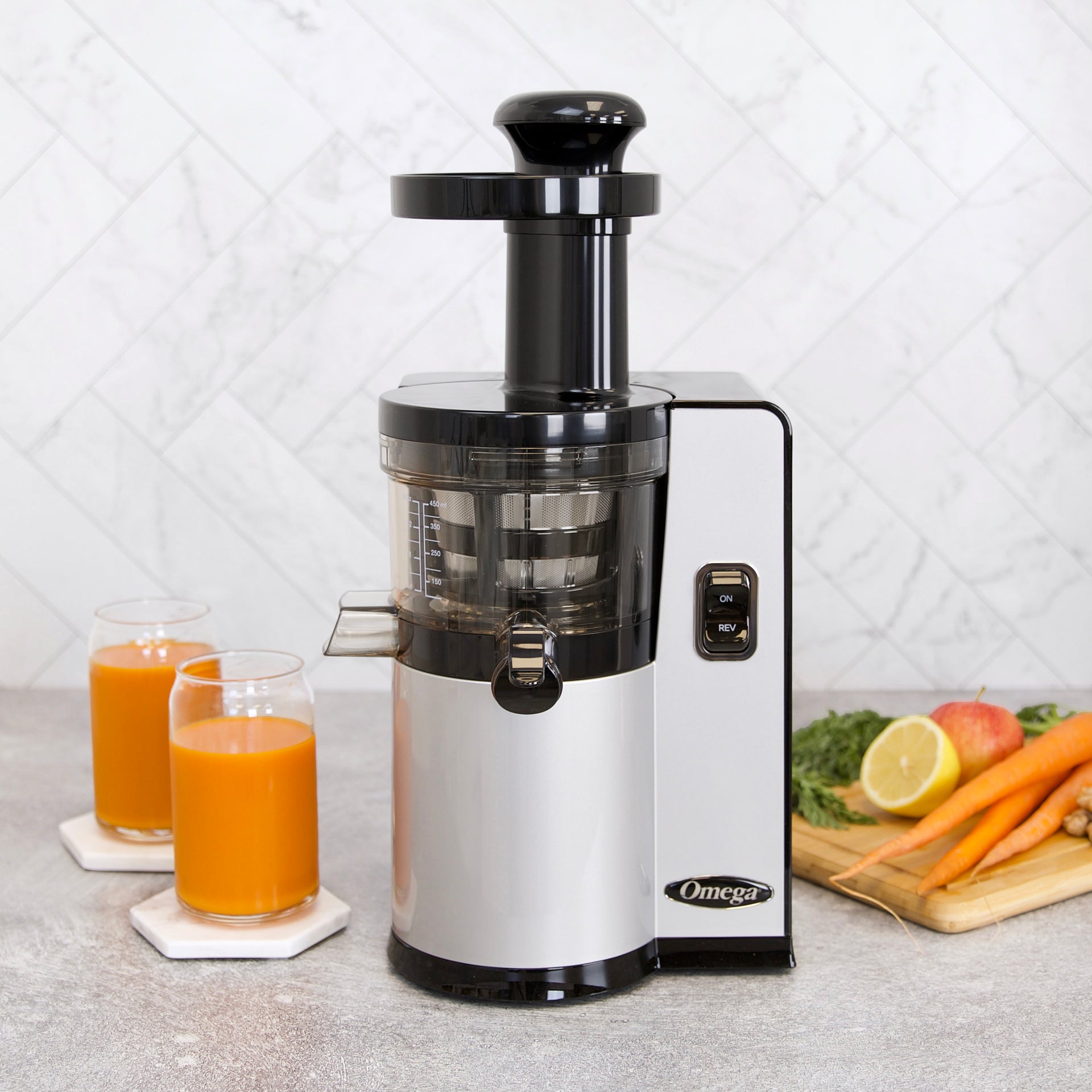
Explore this need in the finder →The Omega VSJ843Q is a current U.S. vertical slow juicer offered in silver (VSJ843QS) and red (VSJ843QR). The manufacturer’s product page and domestic manual identify one 43-rpm, 150-watt masticating setup in either finish. Its single On/Reverse control keeps the routine simpler than the JC4000’s low/high selector; the VSJ843Q manual instead allows up to 30 minutes of operation before a five-minute cooldown. It suits a shopper who values a longer documented interval, a mixing tap and familiar screen-and-auger cleanup over multiple speeds.
One slow setting and a deliberate feed
Omega describes the VSJ843Q as a vertical low-speed juicer with a dual-edge single auger, a no-drip juice tap, a mixing function and automatic pulp ejection. The domestic manual labels the parts: pusher, hopper, auger, screen, spinning brush, juice bowl, base, pulp and juice containers, cleaning brush, On/Off switch and power cord. Feed produce gradually with the pusher and lock the hopper into place. The machine does not document a batch-loading capacity, so a hopper-shaped part is not enough to pass a numerical batch-size requirement.
The product page names celery, citrus, fruits, leafy greens, vegetables, wheatgrass and nut milks among its possible preparations. That is a maker-described menu, not an independent test of yield or texture for every ingredient. The product page gives no numerical feed-chute width, so the model cannot satisfy a hard chute-width minimum just because the opening looks tall. Treat a specific fit or large-produce requirement separately from the general claim that it handles a broad range of foods.
Mixing and reverse are different controls
The VSJ843Q has an On/Reverse switch, not a variable speed selector. Omega’s instructions say to press On, feed steadily with the pusher, and stop when extraction is complete. The Reverse button is for a stalled auger: hold it for several seconds, let the rotation stop, and repeat the clearing procedure if needed. Do not read reverse as automatic ingredient sensing or a second extraction speed. The mix flap can hold juice in the bowl while it blends together, then open to release a glass; the flap also needs to close if you are saving juice for another serving.
Omega’s product copy describes quieter operation, but it provides no decibel figure or separate low-noise setting. The VSJ843Q is therefore not a match for a shopper who requires a documented quiet-speed mode. Similarly, the single 43-rpm figure describes the named machine setting; it does not prove that noise, oxidation or nutritional results were measured against other juicers.
More run time, with a cooling pause
The domestic manual lists VSJ843Q at 120 V, 60 Hz, 150 W and 43 rpm. Its safeguard says not to operate for more than 30 minutes at a time, then to cool the appliance for five minutes before starting again. That is meaningfully different from a short-session batch or high-speed juicer. It is still a maximum operating interval, not a suggested recipe length or a guarantee that a full hopper of produce will take 30 minutes.
The manual’s English section spans the first part of a multilingual booklet. These pages show a fitted screen and spinning brush, and explain how to place the screen below the brush groove, lock the hopper, seat the bowl packing and operate the juice flap. If the assembly is misaligned, the chamber may not close correctly; if pulp remains under the packing, cleaning takes more work than the phrase “easy cleaning” implies. Reverse can free a jam but is not a substitute for the manual’s stop-and-unplug disassembly instructions.
Cleanup is manageable, not care-free
After juicing, Omega recommends scrubbing the surfaces with warm soapy water and a brush. Its manual permits removable parts on the dishwasher’s top rack but says water must not go above 140°F. That is a lower-temperature instruction than a high-heat SANI cycle; a user who needs SANI approval should choose another documented fit. The motor housing must not be splashed or immersed. The screen and spinning brush deserve attention because pulp can lodge in the fine surface and brush assembly.
The manual gives the VSJ843Q body dimensions as 9 inches wide, 6 inches deep and 16 inches high; the alternate VSJ843R dimensions should not be substituted. Weight is left unknown: the manual lists about 11.5 pounds, whereas the current product page says 19.8 pounds. The manual wins for the exact Q dimensions because its table labels them by model, but the weight conflict makes a precise lifting need unconfirmed. The manufacturer does not state the supplied juice vessel’s capacity, and its visible graduations are not proof of yield.
Where it sits beside the JC4000 and batch models
Pick the VSJ843Q if you want a simple one-speed vertical masticating setup, its documented 30-minute interval, its five-minute cooldown and the current page’s 15-year limited warranty. Compare the JC4000 when a three-inch published mouth and low/high control matter more than the longer run interval: its own manual uses a stricter five-minute operating limit and lists only a one-year warranty. The OMJCSMVB is a separate batch-hopper arrangement; its manual caps continuous cycles at five minutes with a long rest and its produce-hopper volume remains unknown. The wide word “vertical” or a shared “cold press” label does not erase these operational differences.
Both VSJ843Q colors use the same documented base configuration, so this review treats finish as a variant rather than claiming a functional distinction. Avoid treating no-drip as no cleanup, the word “quiet” as a sound test, or the 30-minute interval as an output promise. If a fixed chute dimension, measured capacity, SANI cycle or exact weight is essential, the published information does not settle that need.
Sources: Omega’s Low Speed Vertical collection, the VSJ843Q product page, and its linked VSJ843Q / VSJ843R domestic manual. No personal ownership, lab yield or acoustic test is claimed.
Key details at a glance
| Extraction method | Slow-compression masticating extractor |
|---|---|
| Pulp bin placement | External side bin |
| Speed control | Single-speed on/off |
| Motor electrical rating | 150 W |
| Listed width | 9 in |
| Listed depth | 6 in |
| Listed height | 16 in |
| Dedicated Quiet selector label | No |
| Manual-described lower-noise juicing range | No |
| Maximum continuous run listed by maker | 30 min |
| Body-fit measurement note | Domestic manual product-spec table explicitly lists VSJ843Q at 9 W × 6 D × 16 H in; do not substitute VSJ843R. Weight is unknown because the manual says about 11.5 lb while the current page prints 19.8 lb. |
| Electrical-rating caveat | Manufacturer-rated input, not a yield, noise or durability test. |
| Continuous operation before rest | 30 min |
| Removable parts dishwasher-safe per manual | Yes |
| Batch-loading hopper | No |
| Manufacturer-listed voltage | 120 V |
| Maker-listed rotational speed | 43 rpm |
Use the exact model’s instructions for operating limits, supplied equipment and version differences.
Sources for this assessment

Now check the model against your kitchen.
Use the finder for extraction style, batch, cleanup, control, and counter-fit requirements.