
Your needs, this model
Does it fit your priorities?
Does the XL model’s manual-listed 3.25-inch chute meet your minimum?
The manual marks this exact model 3.25 in / 82.55 mm; the product page rounds the opening to 3.3 in. This is not a guarantee that every fruit fits whole.
Explore this need in the finder →Do two speeds and top-rack-safe removable juicing parts meet your routine?
The manual assigns low and high to softer and harder produce and permits top-rack washing of removable parts.
Explore this need in the finder →Is an included cup enough if its volume is not documented?
The product page lists a juice container but does not state its capacity; a required 32-ounce minimum therefore remains unknown.
Explore this need in the finder →Can the manual’s short, approximately one-minute operation instruction fit your session?
The use steps specify about one minute per operation; a separate rated-time entry does not confirm a 12-minute uninterrupted cycle.
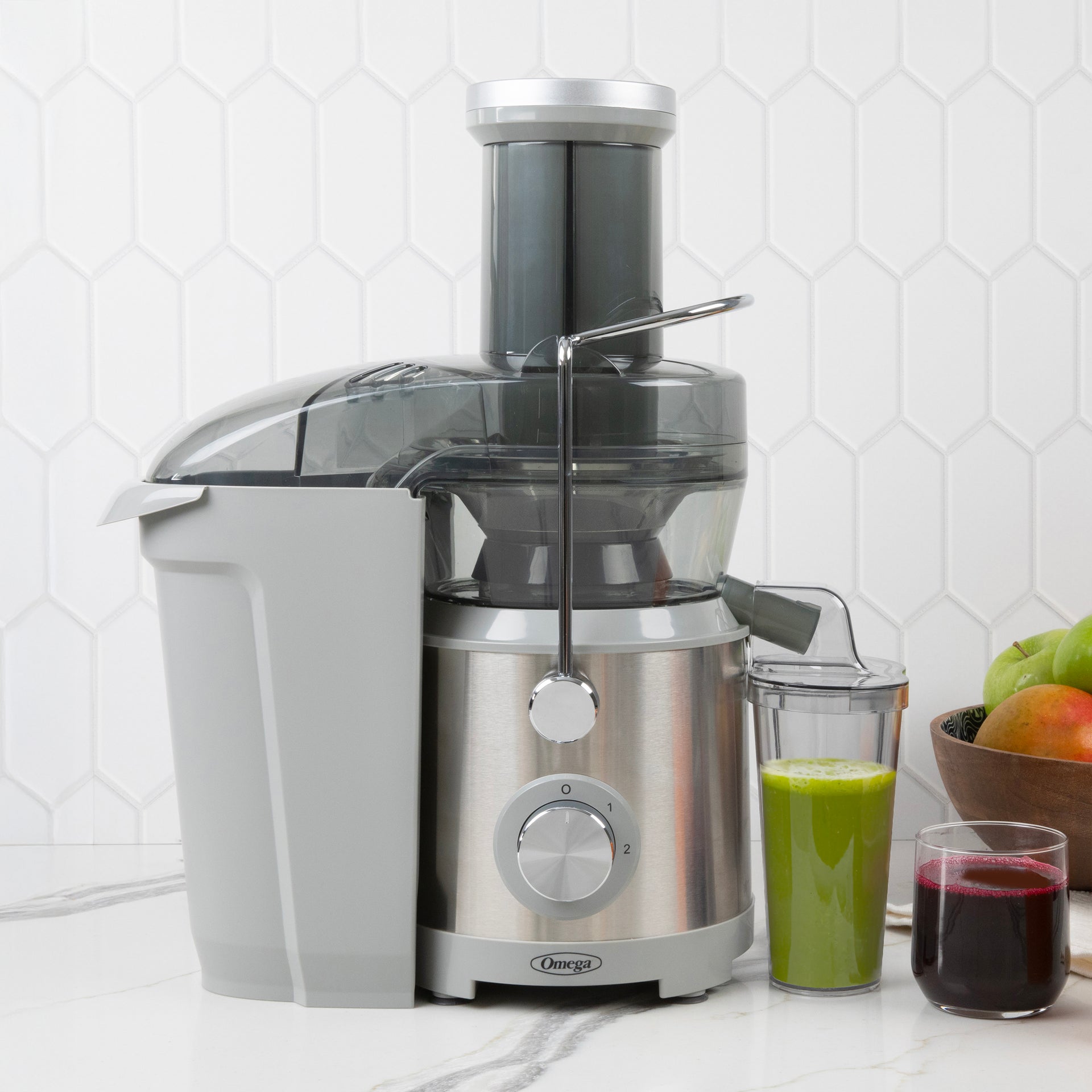
Explore this need in the finder →The Omega OMJCHSXLCSV13 is a current 120-volt centrifugal juicer with a 3.25-inch chute, 1,000-watt rating and two speeds. Omega’s product page rounds the opening to 3.3 inches; the model-specific manual diagram gives the more precise 3.25-inch / 82.55-mm figure. It is the wider of the two configurations in Omega’s shared high-speed manual, but still asks you to prepare produce and work in short cycles.
The wider chute saves some sizing, not all prep
The exact product page names OMJCHSXLCSV13 and the Stainless Steel finish; the manual’s model diagram pairs the XL SKU with a 3.25-inch opening. Omega’s page calls it 3.3 inches, apparently a rounded listing figure, while the manual supplies the matching metric dimension of 82.55 mm. The small difference is important when setting a strict minimum: the lower exact manual figure is the one used in matching. A wide opening can reduce cutting for some produce, but Omega’s manual still says to wash items, cut them into pieces and remove pits, hard seeds, thick skins and hard shells. Whole-fruit language should not be read as a guarantee that every item can be dropped in intact.
Inside, a rotating filter basket separates juice and pulp. The dial has two operating speeds, not a continuously variable range: low is for softer fruit and vegetables such as watermelon, tomato, cucumber and strawberries; high is for harder items such as carrots, apples and ginger. That makes this a quick-feed centrifugal option for mixed prepared produce. It is not an auger press, and Omega’s own category guidance says hard produce is a stronger match for the centrifugal style while masticating models are more efficient with leafy greens. No independent result establishes yield, foam, noise or nutrition.
Read the short operating direction literally
The manual rates the machine at 1,000 W and 12,500 rpm and specifies 120 V AC, 60 Hz and a 47-inch cord. It depicts the cover, filter basket, bowl, motor base, side pulp container and locking rod as a single assembled setup. The safety latch is a functional interlock: the unit should not start when the cover is not secured. Feed gradually with the pusher, do not press too hard, turn the control off and unplug after juicing, and never place a hand in the chute.
The instructions say to keep operation to about one minute at a time, while a separate specifications line states a rated operating time of less than 12 minutes. Those entries do not clearly establish one longer continuous cycle, so the practical assessment follows the more restrictive one-minute use direction. The 12-minute line is retained as a separate maker statement, not treated as a session promise. The troubleshooting section says to stop and unplug if the motor’s thermal protection activates and wait 20–30 minutes before restarting. That recovery instruction is not an ordinary scheduled rest interval.
Capacity, cleanup and countertop fit
Omega says a removable nine-cup pulp container is supplied, and the manual’s parts diagram shows a separate side bin. The product page also lists a juice container with a splash-guard lid, but does not state its capacity. A pulp-bin measure is not juice capacity or expected yield. If you need a pitcher that meets a particular ounce minimum, this model does not meet that requirement on the evidence available.
Omega describes the removable accessories as dishwasher-safe. The manual is more precise about the method: wash removable parts on the top rack, use the supplied brush on the filter basket and bowl, and wipe the motor housing without immersing or rinsing the base. The filter is the part most likely to need prompt attention after a fibrous or pulpy batch. The manual lists a 10-pound weight and dimensions of 8.8 inches wide, 14.3 inches long and 17.5 inches high. The product page gives 10.12 pounds, so the exact weight is not treated as a firm lifting threshold; measure the actual counter and leave handling space around the tall top assembly and side bin.
The product page states a one-year limited warranty. That is a maker term, not a durability test, and the page’s promotional wellness language is not a basis for health claims. This review is about the appliance’s documented use and fit, not a promise about what juice will do.
Where the XL configuration is the better Omega fit
Choose the XL over the OMJCHSLCBK13 only when its measured 3.25-inch opening changes a real prep constraint. The LC model’s manual diagram marks a 3-inch chute; both otherwise share a 1,000-watt motor rating, two-speed control and the same short-use instruction. The XL adds the model-specific drip-stop cap shown in the manual and the nine-cup pulp-bin claim on its page. The machine still needs cutting, loading, emptying and cleanup, so the benefit is a somewhat wider feed path rather than a hands-off routine.
This is a poor fit if a slower auger for routine leafy greens, a known juice-receiver capacity, a long uninterrupted session, or measured quietness is essential. Those facts are not established by the XL page or manual. If you prefer the smaller chute but are looking at a lower-cost earlier Omega configuration, compare its exact manual and condition rather than relying on the shared family name. If your essential needs include slow pressing or a numerically confirmed large pitcher, choose a documented model that answers those questions instead.
Sources: Omega’s exact product page, model-number manual directory, and shared high-speed manual. This assessment relies on maker documentation rather than an ownership or yield test.
Key details at a glance
| Extraction method | Centrifugal fruit-and-vegetable extractor |
|---|---|
| Pulp bin placement | External side bin |
| Published feed-chute width | 3.25 in |
| Speed control | Two speeds |
| Motor electrical rating | 1000 W |
| Listed width | 8.8 in |
| Listed height | 17.5 in |
| Dedicated Quiet selector label | No |
| Published feed-chute width (metric) | 82.55 mm |
| Body-fit measurement note | Manual lists 8.8 in width, 14.3 in length and 17.5 in height. Product page lists 10.12 lb whereas manual rounds to 10 lb; weight remains unknown for a strict limit. |
| Electrical-rating caveat | Omega-rated electrical input; not a yield, sound or durability test. |
| Continuous operation before rest | 1 min |
| Removable parts dishwasher-safe per manual | Yes |
| Batch-loading hopper | No |
| Included blank/sorbet strainer | No |
| Manufacturer-listed voltage | 120 V |
| Maker-listed rotational speed | 12500 rpm |
Use the exact model’s instructions for operating limits, supplied equipment and version differences.
Sources for this assessment

Now check the model against your kitchen.
Use the finder for extraction style, batch, cleanup, control, and counter-fit requirements.