
Your needs, this model
Does it fit your priorities?
Is the 3-inch OMJCHSLCBK13 chute wide enough for your produce routine?
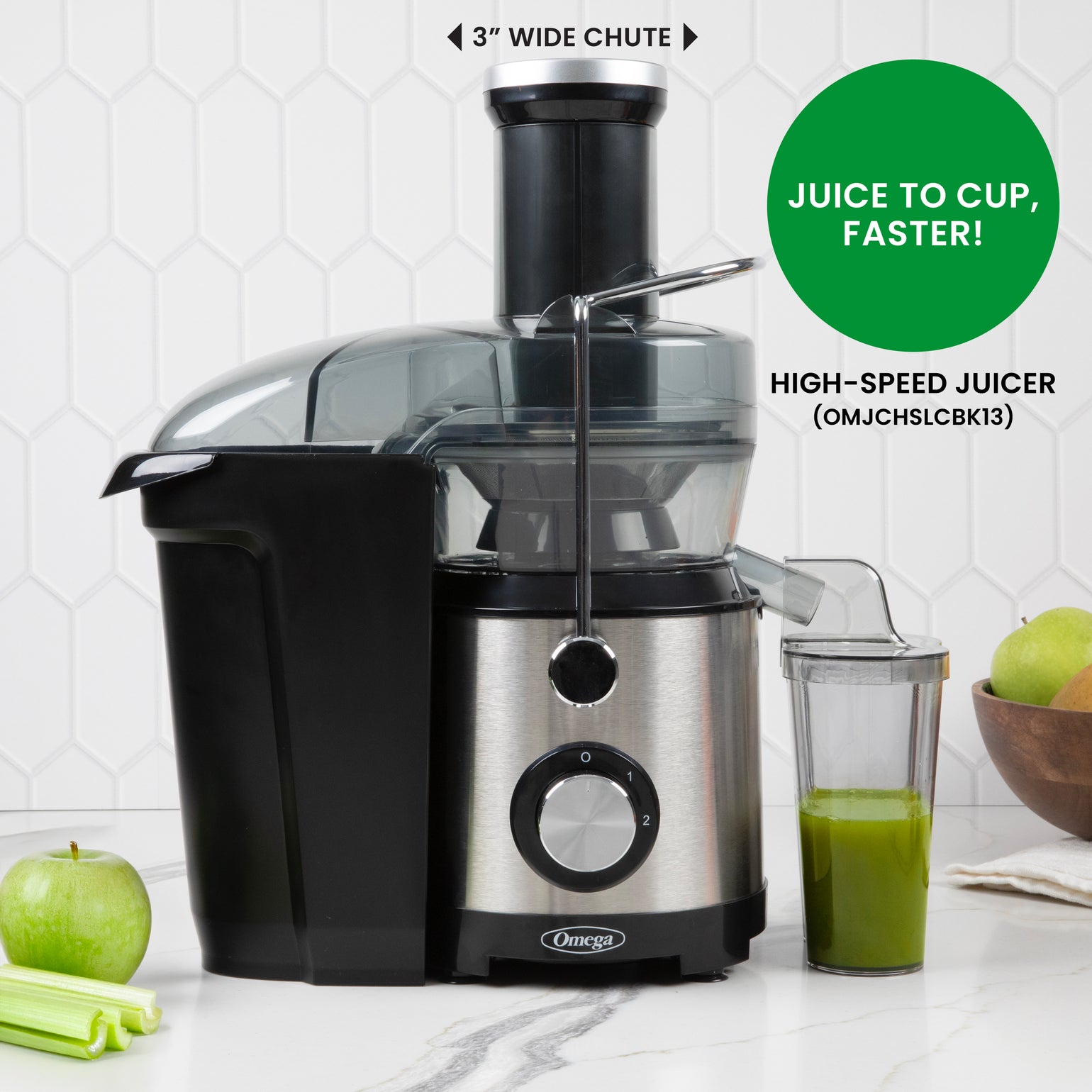
The shared Omega manual identifies this exact black configuration and marks its feed chute as 3 in / 76.2 mm. Its preparation instructions still require cutting and removing pits, hard seeds, thick skins and hard shells.
Explore this need in the finder →Must the removable parts be dishwasher-safe on the top rack?
The manual permits top-rack washing for removable parts; the motor housing must be wiped, not immersed.
Explore this need in the finder →Is a short, roughly one-minute operating interval acceptable?
The manual use steps say to keep an operation to about one minute; its separate rated-time line is not treated as a continuous 12-minute session.
Explore this need in the finder →Do you require an included receiver with a documented minimum capacity?
A juice container is listed, but the model manual does not state its capacity. It can meet an included-cup requirement, not a numeric minimum.
Explore this need in the finder →The Omega OMJCHSLCBK13 is an earlier household centrifugal juicer with a 3-inch chute, two speeds, a 1,000-watt rating and a separate pulp bin. Its model number appears in Omega’s shared high-speed manual, which distinguishes this black model from the slightly wider-chute stainless OMJCHSXLCSV13. Keep it on a used-model shortlist only if the exact version and parts check out: Omega’s current high-speed collection centers on the XL configuration, and the earlier listing was marked sold out.
A measured three-inch opening still needs ingredient preparation
The manual’s model diagram identifies OMJCHSLCBK13 and marks its chute as 3 inches (76.2 mm). That is a useful dimension for comparing feed openings, not a guarantee that every apple or other fruit will fit whole. In the same manual, Omega tells the operator to wash produce, cut it into pieces, and remove pits, hard seeds, thick skins and hard shells. Feed gradually and use the supplied pusher only as directed; never reach into the chute. If the reason you want a wide opening is to avoid all chopping, this documentation does not promise that result.
This model separates juice from pulp with a rapidly rotating filter basket. The control has off, low and high settings: Omega associates low with softer items such as watermelon, tomato, cucumber and strawberries, and high with harder items such as carrots, apples and ginger. That gives more control than an on/off-only centrifugal machine, but it is not a slow auger or a green-juice specialist. Omega’s category guidance says hard fruit and vegetables are a better match for centrifugal juicers and that leafy greens are handled more efficiently by masticating models. There is no comparative yield test here.
Use short runs and follow the safety lock
The shared manual specifies 120 V AC, 60 Hz, 1,000 W, 12,500 rpm and a 47-inch cord. It also says the top cover must be secured by the pull-rod safety latch before the motor will run. The use steps say operation time should be no more than about one minute, while the specification table lists a rated operating time below 12 minutes. Because those two instructions are not a single clear continuous-run allowance, this assessment uses the shorter one-minute operating interval and does not treat the 12-minute table entry as permission to run for 12 minutes at once. If the thermal protection stops the motor, the manual says to unplug, remove ingredients and wait 20–30 minutes before restarting.
The manual lists a 10-pound weight and a body envelope of 8.8 inches wide, 14.3 inches long and 17.5 inches high. Those figures help with a first counter check, but leave room for the top cover, pusher, side pulp bin, cup and access to the locking arm. Confirm the model label and available space on the actual unit; do not assume the listing’s stated body size includes a convenient working clearance.
What is included, and what remains unknown
The exploded parts page identifies a pusher, locking system, chute cover, filter basket/blade, juice bowl, splash-guard lid, juice container, two-speed dial, motor base, pulp container and cleaning brush. Omega’s current manual specifies dishwasher washing on the top rack for the removable parts, but the motor base must only be wiped and never immersed. Brush the fine filter and juice bowl after use; dried pulp is harder to clear. The manual does not give a juice-cup capacity or a numerical pulp-bin capacity for this model, so neither a large pitcher need nor a receiver-size requirement is confirmed.
The 1,000-watt figure is the maker’s electrical rating, not a measured juice yield, sound level or durability result. There is no substantiated decibel number, yield comparison, produce-size guarantee or batch volume in the inspected model manual. Nor should the nine-cup pulp-bin statement from the XL product page be transferred to this LC model. The two configurations share a manual but are not the same chute size or necessarily the same package.
Who should consider an OMJCHSLCBK13?
It can make sense for an owner who wants a quick centrifugal routine for prepared fruit and firmer vegetables, values two speeds, and can clean the basket promptly. Its 3-inch chute is the smaller of the two Omega high-speed configurations in the shared manual. The extra-large OMJCHSXLCSV13 is marked at 3.25 inches (82.55 mm) in that same diagram and adds a drip-stop cap, but its larger opening does not remove the manual’s preparation directions. If you need a known juice-cup size, a measured continuous session beyond one minute, quieter operation, or a genuinely slow press for frequent leafy greens, neither model’s documentation establishes that essential need.
For a secondhand purchase, check the exact OMJCHSLCBK13 label, the intact fine basket, safety latch, pusher, pulp container, cup and brush, and the original manual’s voltage requirements. The maker’s current manual directory still names this model, but Omega’s current high-speed shop page lists the XL sibling rather than the LC. That makes the LC useful as an earlier-model reference, not a current new-purchase recommendation. Do not substitute listings for the XL or the different JC4000 vertical slow juicer merely because a retailer uses broad “wide mouth” language.
Sources: Omega’s model-number manual directory, the shared OMJCHSLCBK13 / OMJCHSXLCSV13 manual, and the official high-speed juicer collection. This is a document-based assessment, not an ownership or extraction test.
Key details at a glance
| Extraction method | Centrifugal fruit-and-vegetable extractor |
|---|---|
| Pulp bin placement | External side bin |
| Published feed-chute width | 3 in |
| Speed control | Two speeds |
| Motor electrical rating | 1000 W |
| Listed width | 8.8 in |
| Listed height | 17.5 in |
| Dedicated Quiet selector label | No |
| Published feed-chute width (metric) | 76.2 mm |
| Body-fit measurement note | Rounded dimensions come from the exact shared manual diagram/specification page; working clearance is not included. |
| Electrical-rating caveat | Omega-rated electrical input; not a yield, sound or durability test. |
| Continuous operation before rest | 1 min |
| Removable parts dishwasher-safe per manual | Yes |
| Batch-loading hopper | No |
| Included blank/sorbet strainer | No |
| Manufacturer-listed voltage | 120 V |
| Maker-listed rotational speed | 12500 rpm |
Use the exact model’s instructions for operating limits, supplied equipment and version differences.
Sources for this assessment

Now check the model against your kitchen.
Use the finder for extraction style, batch, cleanup, control, and counter-fit requirements.