
Your needs, this model
Does it fit your priorities?
Does a verified three-inch feed opening fit the kind of produce you use?
The JC4000 manual and current page identify a three-inch opening; the manual still says to remove pits, hard seeds, thick skins and shells, cut fibrous stalks and feed gradually.
Explore this need in the finder →Would LOW for softer produce and HIGH for firmer produce be useful?
The JC4000 manual labels its separate LOW and HIGH speeds for different produce; reverse is a jam-clearing control, not another speed.
Explore this need in the finder →Can a conservative five-minute continuous-use limit fit your routine?
The manual gives conflicting five- and ten-minute instructions; this assessment follows the stricter five-minute safeguard.
Explore this need in the finder →Do you need ordinary top-rack cleanup but not a high-heat SANI approval?
The manual allows removable parts on a Normal or Eco top rack below 75°C/167°F; the motor base is wiped, and no SANI cycle is approved.
Explore this need in the finder →The Omega JC4000 is a current U.S. vertical cold-press juicer sold in a silver configuration identified as SKU JC4000SV13. Its three-inch opening and two speed settings put it between a small-feed slow juicer and a wide-batch hopper: there is room for larger pieces, but the manual still expects cutting, pitting and attention to fibrous stalks. The exact model manual lists 120 watts, a 45-rpm low setting and a 65-rpm high setting. This is a practical fit for someone who wants a vertical auger workflow and can work in short sessions.
A wide mouth helps with setup, not with every fruit
Omega’s current product page calls the opening three inches. That is a useful measurement when you compare feeds, but it is not a promise that you can drop whole produce into the machine. The JC4000 manual still tells users to remove pits, hard seeds, thick skins and hard shells, and gives two different feed paths: larger pieces through the wide opening and smaller pieces or strips through the smaller opening. Do not force a piece to fit just because the chute sounds generous in a listing.
The vertical chamber uses an auger and screen rather than a fast centrifugal basket. The two-speed touch controls are a meaningful difference from a simple one-speed slow juicer: the manual pairs LOW with softer produce and HIGH with firmer produce. Reverse is a clearing action when ingredients bind, not a third speed. Omega’s page describes a no-drip outlet and dishwasher-safe parts; the manual confirms a pulp container, juice cup, pusher and cleaning brush. The specific package is silver, not the separate red/silver VSJ843Q pair.
Follow the short-cycle operating plan
The model-specific manual specifies 120 V AC/60 Hz and 120 W, then shows 45 rpm LOW and 65 rpm HIGH. Omega’s web description gives 45–65 rpm, but the page’s technical information also has a different 50–75 rpm range. The exact manual’s two-speed table is the clearest basis for this review; the web conflict is not hidden. Neither number establishes juice yield, nutrient retention, quietness or durability in independent testing.
There is also a run-time discrepancy. The safeguards tell the operator not to exceed five continuous minutes, while another use/care passage allows up to ten; the specifications give a rated time below ten minutes. Rather than read the looser lines as permission to keep running, this assessment uses the stricter five-minute ceiling. A celery-specific instruction calls for cutting stalks into one- to two-inch pieces, leaving the chute lid open and limiting fresh celery to one pound per session. Those details matter more than the broad “less prep” claim if celery is your regular drink.
Set the cover and safety latch correctly before switching on; the appliance will not run unless its parts are installed as directed. Let the machine feed produce gradually and use the supplied pusher rather than fingers or an improvised utensil. The manual’s five-minute ceiling is not a promise of a large batch, nor does the machine’s 120-watt rating predict how much juice a shopping list of produce will yield.
Counter fit and cleanup need a little care
The JC4000 manual gives a body of 6.3 inches wide by 8.9 inches long by 18.6 inches high and a weight of 8.2 pounds. The current product page prints 8.86 × 6.30 × 17.33 inches without assigning those dimensions to axes, so the page and manual do not form a clean cabinet-clearance match. The shorter web height is not enough to make a 17.33-inch clearance a safe fit; measure a real machine and allow room to feed into the top. The exact dimensions are therefore not used for hard fit matching.
Omega permits removable components on the top rack of a Normal or Eco dishwasher setting below 75°C/167°F. The motor base is wiped clean and must not be immersed. Top-rack approval is not the same as a high-temperature SANI cycle. The mesh/screen and other food-contact parts still need prompt rinsing and brushing; dishwasher compatibility does not mean every surface will emerge clear of fibrous pulp without attention.
Which Omega model fits your routine?
Choose the JC4000 if a vertical masticating setup, two-speed soft-versus-firm selection and a three-inch opening are useful, and your batches can follow the conservative five-minute instruction. The VSJ843Q is the contrasting vertical option: it runs at a documented 43 rpm with one on/reverse control, has a 30-minute maximum interval with a five-minute cooldown, and carries the maker-listed 15-year limited warranty. If you want preloading rather than piece-by-piece feeding, Omega’s OMJCSMVB batch-hopper model is a different arrangement with its own short-cycle and rest directions; it also has a separate filter and cleaning routine. These are workflow differences, not a ranking.
The product page lists a 12-month limited warranty for the JC4000. A buyer who needs a verified vessel capacity, a precise cabinet height, a long uninterrupted session or a SANI-approved wash should not treat those details as established here. The visible cup scale in the product image is not a measured juice yield or a confirmed receiver capacity. The correct choice turns on the documented feed, control, time and care routine—not “cold press” as a performance promise.
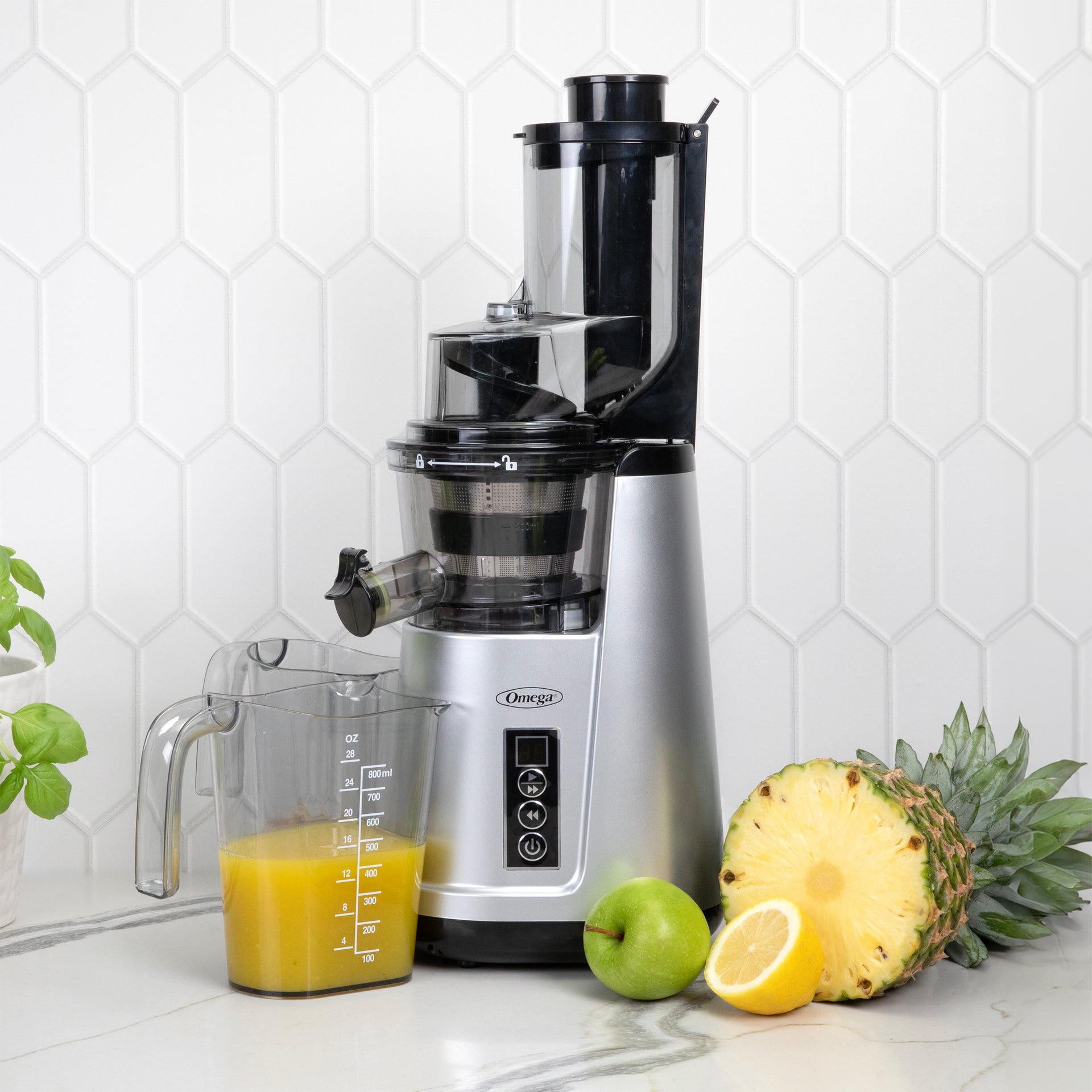
Sources: Omega’s Low Speed Vertical collection, the JC4000 product page, and its linked JC4000 manual. This is a source-based assessment, not an ownership, noise or extraction test.
Key details at a glance
| Extraction method | Slow-compression masticating extractor |
|---|---|
| Pulp bin placement | External side bin |
| Published feed-chute width | 3 in |
| Speed control | Two speeds |
| Motor electrical rating | 120 W |
| Dedicated Quiet selector label | No |
| Published feed-chute width (metric) | 76.2 mm |
| Manual-described lower-noise juicing range | No |
| Maximum continuous run listed by maker | 5 min |
| Body-fit measurement note | The manual lists 6.3 W × 8.9 L × 18.6 H inches and 8.2 lb; the product page lists 8.86 × 6.30 × 17.33 inches without axes and 8.16 lb. Weight is rounded consistently, but the dimension axes and height conflict, so dimensions remain unknown for strict fit needs. |
| Electrical-rating caveat | Manufacturer-rated electrical input, not a yield, noise or durability test. |
| Continuous operation before rest | 5 min |
| Removable parts dishwasher-safe per manual | Yes |
| Batch-loading hopper | No |
| Manufacturer-listed voltage | 120 V |
| Maker-listed rotational speed | 45 rpm |
Use the exact model’s instructions for operating limits, supplied equipment and version differences.
Sources for this assessment

Now check the model against your kitchen.
Use the finder for extraction style, batch, cleanup, control, and counter-fit requirements.