
On this page
Your needs, this model
Does it fit your priorities?
Are you identifying the C-20C as a dedicated electric citrus press rather than a mixed-produce juicer?
Omega’s C-20C manual shows a powered cone press for fruit halves, not a feed chute for apples, carrots or greens. This exact identity is kept as a reference and is not a current buying recommendation.
Explore this need in the finder →Do three cone sizes and a stainless-steel pulp strainer matter for the C-20C routine?
Omega’s manual lists three cone sizes and identifies a stainless-steel pulp strainer. It does not document a named adjustable pulp setting.
Explore this need in the finder →Must the C-20C removable parts be dishwasher-safe?
The manual allows removable food-contact pieces on the dishwasher top rack; the motor base must only be wiped and must not be immersed.
Explore this need in the finder →Do you require a supplied C-20C cup or pitcher rated for at least 16 fl oz?
The manual says to place a container under the spout, but the reviewed source pages do not confirm that a receiving cup is included or give its capacity. An essential receiver or volume requirement is therefore not met on known evidence.
Explore this need in the finder →Do you need a published minimum C-20C continuous-run time of one minute?
Omega's manual says not to operate this appliance for more than 30 minutes at a time. That documented upper interval supports a one-minute operating requirement, although the manual states no rest/cooldown schedule. This is a reference-only record and remains excluded from purchase recommendations.
Explore this need in the finder →The Omega C-20C is the 110-volt model in the maker’s Commercial Citrus Juicer manual, distinct from the 220-volt C-22C listed beside it. Its taller, heavier body, three cone sizes and stainless-steel juice bowl make it a very different counter presence from a small hand reamer. Omega’s current Citrus Juicers collection has no complete products listed, so this review is a careful identification and use reference, not a live purchase recommendation.
Keep C-20C and C-22C electrically separate
The manual cover uses broader C-20/C-22 wording, but its specification table separates the models explicitly: C-20C is rated at 110 volts, while C-22C is 220 volts. The C-20C line lists 50–60 hertz, 210 watts, 1/3 horsepower and 1,800 rpm. Do not copy the C-22C’s voltage or 1,450-rpm figure into a C-20C record. Because this source does not state a household-compatibility claim, an essential voltage compatibility requirement should be checked against the unit’s own rating plate rather than assumed from a product name.
The manual lists a 59.8-inch cord, 21.16-pound weight, and a footprint of 9.75 inches wide by 9.75 inches deep; the height is 17.5 inches. That makes storage and lifting a more substantial commitment than the smaller C-10W. “Commercial” is Omega’s product name here; the manual excerpt supplies no hourly throughput, duty-cycle rating or durability guarantee. The rpm and motor numbers are specifications, not proof that the press extracts more juice or lasts longer.
Use it as a pressure-start cone press
The manual’s routine is direct: place a container beneath the juice spout, halve citrus across its diameter, trim the ends when useful for a steadier cone contact, switch the machine on and set the fruit cut-side down. The motor and cone start under pressure. Lift the fruit to stop the cone, discard the spent half and empty the strainer as needed. Omega cautions against pressing too hard and warns users to stay clear of moving parts. This is a dedicated citrus press, not a chute-fed juicer for apples, carrots or leafy greens.
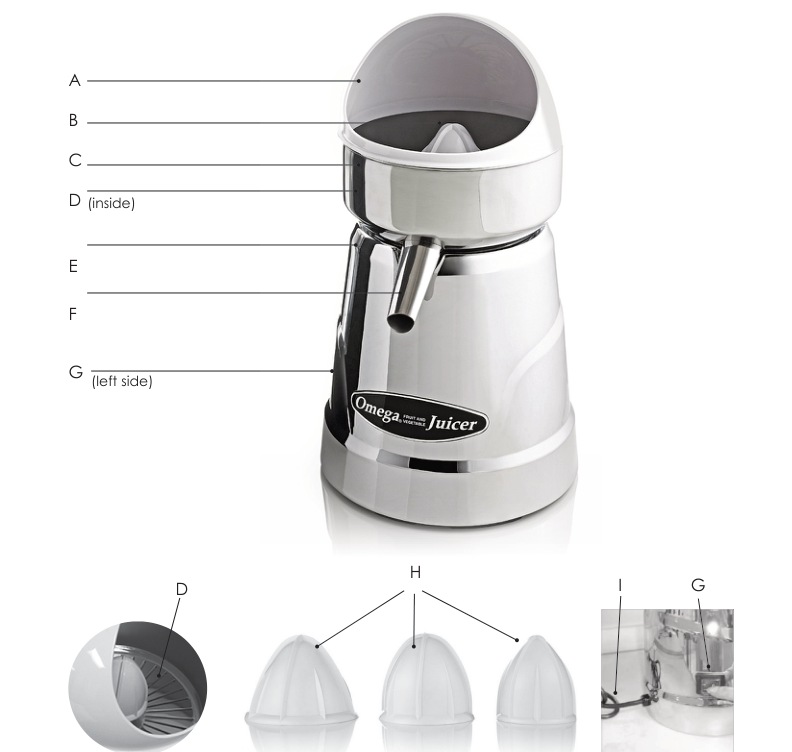
Three sizes of juicing cone are shown, alongside a stainless-steel bowl/juice collector and stainless-steel pulp strainer. The manual does not say which cone belongs with each fruit, so the practical choice is the cone that supports the cut face without forcing it. Pulp and seeds collect in the filter; do not let it overfill, because the manual warns that this can impair operation or damage the unit. A container is required under the spout, but the available evidence does not list an included receiver, separate carafe or volume rating for the bowl. The manual also gives no selectable pulp level.
Dishwasher care and a 30-minute session cap
Omega says removable parts may be washed in warm, soapy water or on the dishwasher’s top rack. Before disassembling, turn the appliance off and unplug it; clean the motor base with a soft, damp cloth and keep it out of the dishwasher. The large, heavy base still needs a stable counter and sensible clearance, even though the working bowl and filter lift away for cleaning.
The safety page cautions not to operate the C-20C for more than 30 minutes at a time. That is an upper limit, not a promised duty cycle or throughput figure, and the manual gives no rest or cooldown schedule. Each fruit half taking a few seconds describes an extraction step, not the time for a large batch. Do not use the word “commercial” to invent performance or daily-production claims; an owner planning service work still needs guidance for the specific machine.
How it differs from the C-10W and smaller presses
The same Omega manual family shows a C-10W at 150 rpm and 120 watts, with a 13.1875-inch height and 7.72-pound listed weight. The C-20C is materially larger and heavier and has a higher listed fixed rpm and wattage. Those facts describe the models; they do not establish a comparative extraction test or guarantee that the C-20C is faster in a real kitchen. Both manuals show a switch plus pressure-triggered cone action, three cone sizes, a stainless strainer and top-rack dishwasher cleaning for removable parts.
For a smaller currently documented citrus press, the Hurom Citrus Juicer has one universal cone, a handle-triggered motor and a drip-stop outlet, but its manual limits rated operation to less than 15 seconds. The Cuisinart CCJ-500P1 also suits a household citrus routine, while a manual Cuisinart CTG-00-CJ needs no powered base. These alternatives are better starting points for a new purchase search; the C-20C’s current stock, warranty, seller and exact original package are not established by its manual.
Omega’s current Citrus Juicers collection reported zero complete products at capture. The C-20C-tagged page did list three replacement cone products whose titles say “C10W”; that cross-listing does not resolve whether those cones are compatible with C-20C. Treat the manual’s three-cone illustration as evidence of the C-20C setup, but check the model-specific parts guidance before ordering replacements.
Key details at a glance
| Extraction method | Dedicated citrus reamer or cone press |
|---|---|
| Speed control | On/off with pressure-activated cone |
| Motor electrical rating | 210 W |
| Listed width | 9.75 in |
| Listed depth | 9.75 in |
| Listed height | 17.5 in |
More specifications and setup details
| Controls and use | The manual lists a fixed cone RPM and describes the cone starting under fruit pressure after the power switch is turned on; no user-selectable speed control is documented. |
|---|---|
| Manufacturer jug label | Integrated bowl is named a juice collector; a separate receiving cup and any volume rating are not confirmed. |
| Supplied cup nozzle | Yes |
| Filter configuration | Separate stainless steel strainer |
| Hand-powered operation | No |
| Continuous operation before rest | 30 min |
| Removable parts dishwasher-safe per manual | Yes |
| Included cup-top pulp strainer | Yes |
| Manufacturer-listed voltage | 110 V |
| Maker-listed rotational speed | 1800 rpm |
Use the exact model’s instructions for operating limits, supplied equipment and version differences.
Sources for this assessment
Now check the model against your kitchen.
Use the finder for extraction style, batch, cleanup, control, and counter-fit requirements.