
On this page
Your needs, this model
Does it fit your priorities?
Are you identifying the C-10W as a dedicated electric citrus press rather than a mixed-produce juicer?
Omega’s C-10W manual shows a powered cone press for fruit halves, not a feed chute for apples, carrots or greens. This exact identity is kept as a reference and is not a current buying recommendation.
Explore this need in the finder →Do three cone sizes and a stainless-steel pulp strainer matter for the C-10W routine?
Omega’s manual lists three cone sizes and identifies a stainless-steel pulp strainer. It does not document a named adjustable pulp setting.
Explore this need in the finder →Must the C-10W removable parts be dishwasher-safe?
The manual allows removable food-contact pieces on the dishwasher top rack; the motor base must only be wiped and must not be immersed.
Explore this need in the finder →Do you require a supplied C-10W cup or pitcher rated for at least 16 fl oz?
The manual says to place a container under the spout, but the reviewed source pages do not confirm that a receiving cup is included or give its capacity. An essential receiver or volume requirement is therefore not met on known evidence.
Explore this need in the finder →Do you need a published minimum C-10W continuous-run time of one minute?
Omega's manual says not to operate this appliance for more than 30 minutes at a time. That documented upper interval supports a one-minute operating requirement, although the manual states no rest/cooldown schedule. This is a reference-only record and remains excluded from purchase recommendations.
Explore this need in the finder →The Omega C-10W is a powered citrus press for someone who already owns the machine or is identifying one by its model plate. Omega’s manual lists a fixed 150-rpm cone, three cone sizes, a stainless-steel juice bowl and pulp strainer, and top-rack dishwasher care for removable parts. The present Citrus Juicers collection shows no complete juicers, so this is an owner’s reference—not a claim that a new C-10W is currently for sale.
Read the exact C-10W line, not just the manual cover
The manual cover groups C-10 with a C-12 reference, but its product-specification table names the C-10W and gives that exact row as 120 volts, 60 hertz, 120 watts and 150 rpm. That is the evidence used here; the cover’s adjacent C-12 wording is not a reason to transfer another model’s electrical rating. Omega calls this a Professional Citrus Juicer. The manual lists a 1/5 motor figure without printing a unit, so it should not be restated as horsepower.
The dimensions are labeled by axis: 8.375 inches deep, 8.375 inches wide and 13.1875 inches high. The listed weight is 7.72 pounds and the cord is 55 inches. Those measurements describe the body, not extra clearance for lifting or handling fruit. The upright machine occupies more counter height than a hand reamer, but it is still a dedicated citrus appliance rather than an all-produce extractor.
Three cones change the fit, not the job
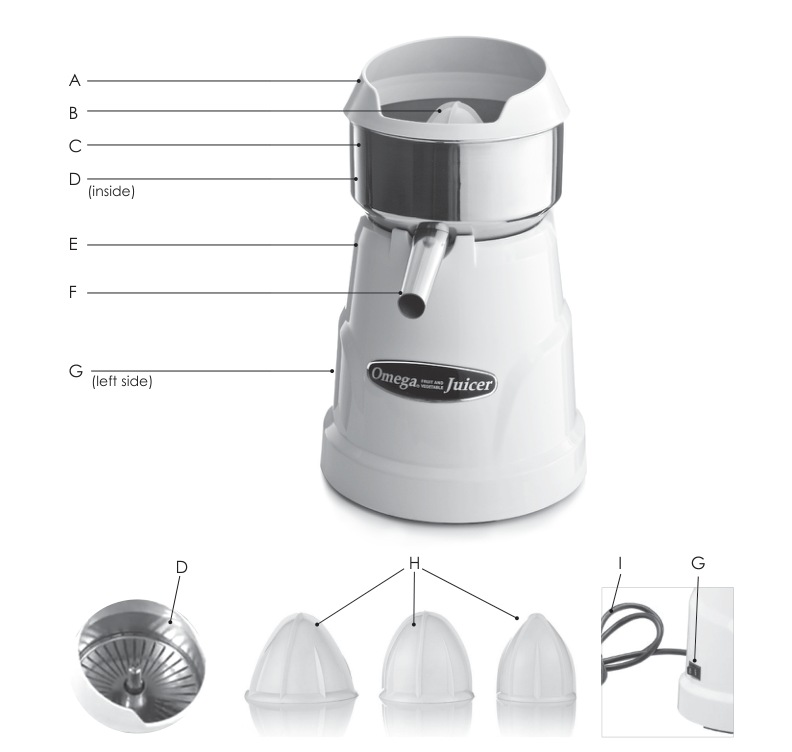
Omega labels three juicing-cone sizes for different citrus sizes. The manual does not assign a particular cone to each named fruit, so choose the one that sits securely against the cut face rather than treating the illustrations as a fruit-by-fruit chart. Rinse the fruit, cut across its diameter, trim protruding tips if helpful, switch the juicer on, then place the half cut-side down. The cone starts rotating when fruit pressure is applied; lift the fruit to stop it. Omega cautions against pressing too hard and says to keep hands clear of moving parts.
Juice runs through the spout into a container that the instructions tell you to place underneath. The stainless-steel pulp strainer catches pulp and seeds and must be emptied when full; the manual warns that an overfilled strainer can prevent correct operation or damage the unit. The stainless bowl is the machine’s juice collector, not a published-volume pitcher. No supplied cup, receiver capacity, or named pulp setting is established in the available manual. If a measured 16- or 24-ounce carafe is essential, treat that requirement as unconfirmed rather than assuming the bowl holds it.
Cleanup is more convenient than the compact layout suggests
The removable food-contact parts can be washed in warm, soapy water or on the dishwasher’s top shelf. Omega says to switch off and unplug the unit before disassembly and cleaning; the motor base is wiped with a soft, damp cloth and must not go in the dishwasher. This is a meaningful difference from some citrus presses whose manuals direct hand-washing only. It does not mean the complete appliance is dishwasher-safe.
The safety page cautions not to operate the C-10W for more than 30 minutes at a time. That is an upper limit, not a promised duty cycle or throughput figure, and the manual gives no rest or cooldown schedule. Its statement that each fruit half juices in a few seconds describes an extraction step, not how quickly a large batch can be completed. For a long brunch batch, clear the filter when needed and do not treat the 30-minute ceiling as a performance guarantee.
Who this reference helps—and what to compare
The C-10W makes sense to an owner who wants to identify the documented 120-V model, check its three-cone arrangement, or plan around its removable dishwasher-safe top pieces. Its single job is citrus: there is no feed chute for apples, carrots or greens. The fixed listed speed is not a user speed dial, and the manual does not substantiate a yield, noise level or performance advantage over another cone press.
For a current citrus-only option, compare the separately reviewed Hurom Citrus Juicer: its handle starts the motor and its outlet has a drip-stop action, but Hurom lists only one cone and rates its operation for less than 15 seconds. The Cuisinart CCJ-500P1 is another powered citrus press with a pressure-triggered cone and dishwasher-safe removable parts. A hand reamer such as Cuisinart CTG-00-CJ avoids a motor altogether but asks you to provide the pressing motion. Those models are alternatives, not proof that a C-10W is available now.
At this check, Omega’s Citrus Juicers collection reported zero products, while the C-10W-tagged page listed replacement cones. Neither establishes a current complete-machine offer, warranty, package contents beyond the manual’s identified pieces, or present stock. Use the exact nameplate and manual when servicing an existing unit; do not infer a seller, price or modern package from a parts listing.
Key details at a glance
| Extraction method | Dedicated citrus reamer or cone press |
|---|---|
| Speed control | On/off with pressure-activated cone |
| Motor electrical rating | 120 W |
| Listed width | 8.38 in |
| Listed depth | 8.38 in |
| Listed height | 13.19 in |
More specifications and setup details
| Controls and use | The manual lists a fixed cone RPM and describes the cone starting under fruit pressure after the power switch is turned on; no user-selectable speed control is documented. |
|---|---|
| Manufacturer jug label | Integrated bowl is named a juice collector; a separate receiving cup and any volume rating are not confirmed. |
| Supplied cup nozzle | Yes |
| Filter configuration | Separate stainless steel strainer |
| Hand-powered operation | No |
| Continuous operation before rest | 30 min |
| Removable parts dishwasher-safe per manual | Yes |
| Included cup-top pulp strainer | Yes |
| Manufacturer-listed voltage | 120 V |
| Maker-listed rotational speed | 150 rpm |
Use the exact model’s instructions for operating limits, supplied equipment and version differences.
Sources for this assessment
Now check the model against your kitchen.
Use the finder for extraction style, batch, cleanup, control, and counter-fit requirements.