
Your needs, this model
Does it fit your priorities?
Do you want an auger extractor rather than a centrifugal basket?
The HR-BBB14 product page and manual describe a 43 rpm screw/auger and a vertical extraction chamber.
Explore this need in the finder →Do you want the maker-listed choice between fine and coarse strainers?
The HR package lists both strainers; the manual distinguishes cleaner juice from thicker, pulpier soft-fruit mixtures. It does not name them Less Pulp/Lots of Pulp screens.
Explore this need in the finder →Is an included citrus squeezer set essential?
The exact HR box list and manual identify a separate cone-and-serving-spout citrus set; it is a second setup, not the regular auger hopper.
Explore this need in the finder →Is hand-cleaning acceptable, or do you require dishwasher-safe parts?
The HR manual directs washing the chamber assembly under running water and prohibits dishwasher/dryer cleaning.
Explore this need in the finder →Is wheatgrass support essential?
The exact manual names wheat and chives, but it does not specifically name wheatgrass; that requirement remains unconfirmed.
Explore this need in the finder →Do you require 17 fl oz or more in the included receiver?
The HR page lists a 500 ml internal chamber and an included separate juice container, but no receiver volume. A pitcher-size minimum cannot be confirmed.
Explore this need in the finder →The Hurom HR is a U.S.-listed vertical auger juicer with a 43 rpm screw, two strainers and a separate citrus-squeezing set. That unusually broad package is more interesting than its limited-edition styling: one base can handle ordinary produce juicing and a dedicated citrus-press arrangement. The exact black HR-BBB14 page was marked sold out when checked, so this review preserves the model’s reference value without promising current stock.
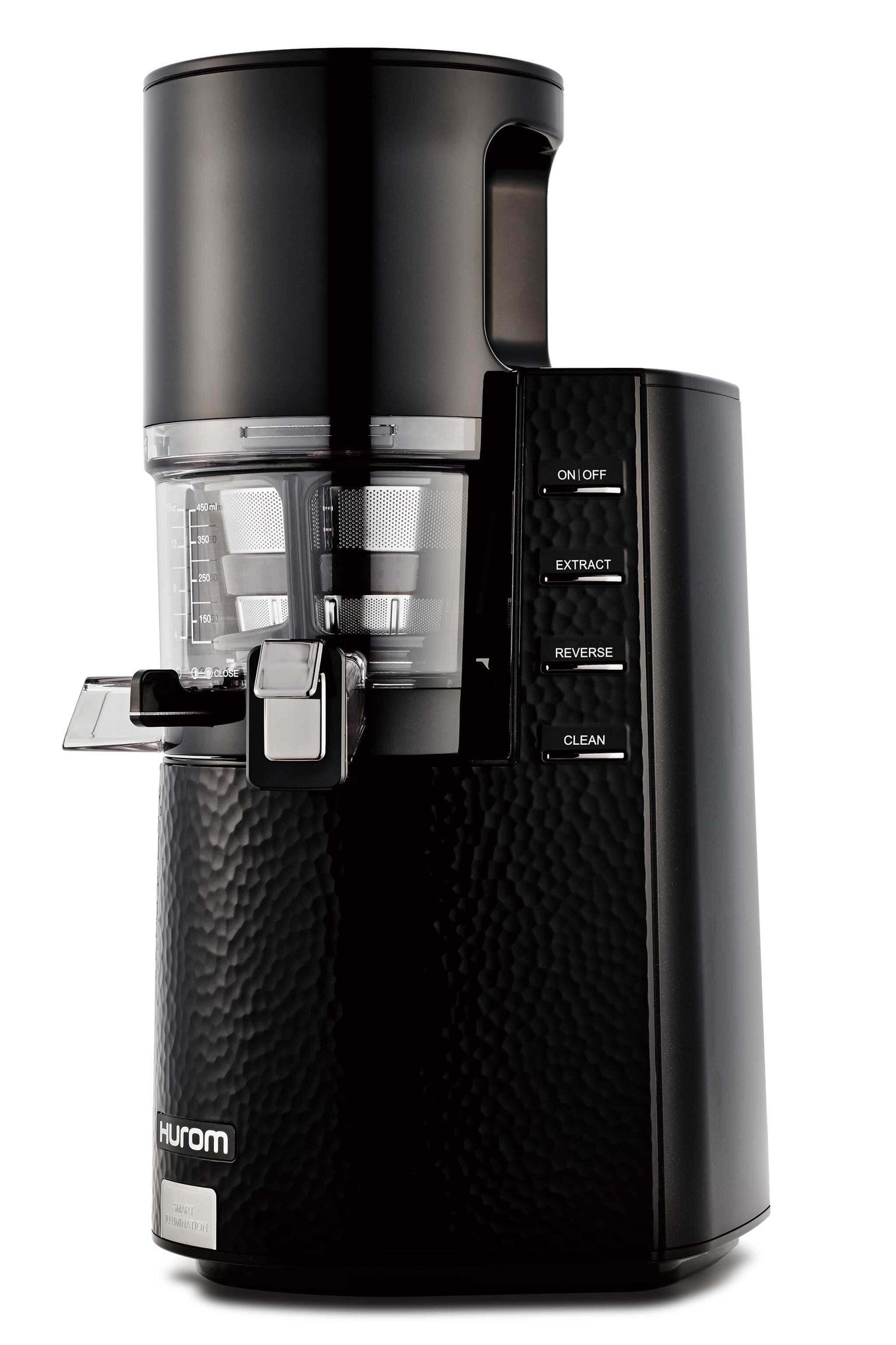
Two pulp paths and a separate citrus attachment
The HR uses a screw-style auger rather than a centrifugal basket. Hurom lists 43 rpm, a 500 ml internal chamber and a 50 mm (2 inch) hopper opening. The included fine and coarse strainers have different roles: the manual associates the fine strainer with a cleaner juice and the coarse one with thicker, pulpier juice and soft-fruit mixtures. A chamber control lever helps release pressure and pulp, but it is not a measured pulp percentage or a guarantee of a particular texture.
The exact package adds a citrus squeezer set, a tofu press, a juice container, a pulp container, two strainers and a rotating brush. For citrus, the manual shows removing the regular chamber assembly, mounting the separate serving spout and cone, then pressing halved fruit onto it. That is a real second use mode, but it does not turn the standard hopper into a citrus attachment or an all-purpose press. For a daily mixed-produce routine, the core auger configuration remains the appropriate matcher route; use the separate squeezer only for its documented citrus task.
Preparation and operation need a little attention
The two-inch opening is helpful, but it is still an opening with a limit. Hurom’s manual advises cutting fibrous stalk vegetables such as celery and kale into pieces under about three centimeters, removing hard pits, and feeding ingredients gradually. Use the included pusher only when the manual directs; do not force food into the chute. The chamber’s 500 ml figure is not the capacity of the supplied juice container, whose volume is not stated. A printed scale on a maker image is not a specification for a usable receiver volume.
The controls distinguish extraction, off, reverse and a simple-clean mode; 43 rpm is the listed extraction speed, not a variable-speed setting. The manual allows up to 30 minutes of continuous operation and then calls for a five-minute interval before restarting. Reverse is a press-and-hold aid when the screw stops; it is not an automatic clearing feature. Hurom also lists a 150 W, 120 V, 60 Hz motor. At 6.2 kg (13.6 lb), the unit is not a featherweight appliance to move in and out of storage every morning.
Cleaning button helps; hand washing still follows
The HR’s clean button runs a brief chamber rinse cycle, roughly 45 seconds according to its manual. That can loosen residue between ingredients, but the manual explicitly says residue may remain and the chamber should be disassembled and washed after simple cleaning. The detailed cleaning instructions call for unplugging first, removing the chamber set and washing parts under running water with the brushes. The body is wiped rather than immersed; the manual prohibits dishwasher and dryer cleaning and hot water at 80°C or above.
This routine is easier to manage if you clean promptly. The manual warns that dried pulp can stick and make disassembly difficult. The spinning brush rotates while juicing, but it is a component to remove and clean, not a self-cleaning replacement for rinsing. If your essential requirement is dishwasher-safe removable parts, this is the wrong configuration. If you want simplicity above all, a single strainer model may be easier than a package with separate fine/coarse screens, a squeezer, tofu pieces and several seals.
Fit, limits and alternatives
The HR is a fit for someone who wants both an auger extractor and a maker-included citrus setup, prefers a choice between fine and coarse straining, and will prepare fibrous ingredients and wash parts by hand. The manual lists wheat and chives, plus leafy and stalk vegetables, but does not specifically establish wheatgrass support; do not treat one as evidence for the other. Hurom’s product page also describes ice creams and sorbets, while the manual’s strainers guide describes thick or soft-fruit mixtures. That is maker-documented frozen-dessert capability, not permission to crush ice or ignore ingredient limits.
Compare the H-AI if self-feeding and a more automated hopper are the priority, or look at a current Easy Clean model if fewer screen parts matter more than the HR’s extra citrus and tofu components. The HR’s page lists dimensions as 8.6 × 9.7 × 16.3 inches but pairs them with an inconsistent millimeter sequence; use the exact counter clearance cautiously rather than treating that table as a precise fit guarantee. At the captured check, Hurom’s exact U.S. page described the HR as limited-edition and sold out. Check the model code and current offer before relying on availability, and treat the manual and any written warranty terms as the controlling documents.
Key details at a glance
| Extraction method | Slow-compression masticating extractor |
|---|---|
| Adjustable citrus pulp control | Yes |
| Published feed-chute width | 1.95 in |
| Speed control | Single-speed on/off |
| Motor electrical rating | 150 W |
| Controls and use | The exact U.S. page lists 43 rpm; separate Extract, Off, Reverse and Simple Clean buttons do not change the extraction speed. |
| Cleanup note | The exact HR manual directs hand washing under running water, wiping the motor body and avoiding the dishwasher, dryer, microwave and water at 80°C or hotter. |
| Published feed-chute width (metric) | 50 mm |
| Maximum continuous run listed by maker | 30 min |
| Filter configuration | Fine and coarse strainers |
| Continuous operation before rest | 30 min |
| Removable parts dishwasher-safe per manual | No |
| Automatic ingredient-sensing mode | No |
| Internal juicing chamber capacity | 16.9 fl oz |
| Included blank/sorbet strainer | Yes |
| Manufacturer-listed voltage | 120 V |
| Maker-listed rotational speed | 43 rpm |
| Dimensions as listed (axes unspecified) | Product page says 8.6 × 9.7 × 16.3 in, while its metric sequence is 219 × 247 × 4124 mm; dimensions are not used for exact fit matching. |
Use the exact model’s instructions for operating limits, supplied equipment and version differences.
Sources for this assessment

Now check the model against your kitchen.
Use the finder for extraction style, batch, cleanup, control, and counter-fit requirements.