
Your needs, this model
Does it fit your priorities?
Do you want an auger juicer rather than a spinning-basket centrifugal extractor?
Hurom's H70FT page and linked manual describe a powered auger/multi-screw chamber, not a centrifugal basket.
Explore this need in the finder →Is Hurom's strainer-free, two-part Easy Clean auger design the kind of chamber you want?
The maker describes a two-part auger that works with the chamber to strain juice without the conventional separate mesh strainer; the parts still require hand cleaning.
Explore this need in the finder →Will a 450 ml internal chamber meet your minimum chamber size, without treating it as a juice-pitcher capacity?
Hurom lists 450 ml (15.2 fl oz) for the H70 internal chamber; it separately lists a juice container without publishing its volume.
Explore this need in the finder →Does the conflicting H70FT manual establish at least 20 uninterrupted minutes before restart?
No. The U.S. page and manual give a 30-minute limit, but the same linked manual also says a safety timer stops the unit after five minutes. A hard 20-minute requirement remains unresolved.
Explore this need in the finder →Hurom’s H70 sits between its compact H310 and larger H400 Easy Clean machines, but the useful distinction is not a vague “Goldilocks” label. The U.S. page lists a 450 ml internal chamber, a 45 mm hopper opening and a 6.7 kg body. It is a powered auger juicer with a two-part Easy Clean chamber, not a centrifugal extractor and not a zero-cleanup appliance. The H70 is worth considering if you want a middling chamber size and are comfortable preparing produce and washing the assembly by hand.
Know what the 450 ml number means
Hurom describes the H70 as a batch-capable Easy Clean juicer and calls it larger than H310 but smaller than H400. Its specification table gives a 450 ml (15.2 fl oz) chamber. That is the internal chamber’s stated capacity, not the size of the separately listed juice container and certainly not the amount of juice a load of produce will yield. The page confirms a juice container and pulp container in the package, but I found no capacity for either receiver. If you need a particular pitcher volume, treat it as unknown rather than translating 450 ml into a jug size.
The listed opening is 45 mm (1.8 inches). “Self-feeding” describes the hopper’s loading design; it should not be read as a promise that whole apples or large vegetables fit. Prepare and cut ingredients as the H70 instructions direct, keep the hopper below its marked limit and use the supplied pusher only. Soft produce can pool in the chamber, and hard or fibrous ingredients can make the machine move or sound different. Those are reasons to follow the guide, not proof of a particular extraction rate.
Easy Clean changes the parts, not the need to clean
The maker’s Easy Clean arrangement uses two auger sections that work with the chamber to strain juice without the conventional separate mesh strainer. That removes one familiar screen from the assembly, but pulp still contacts parts and silicone seals. Hurom’s linked H70FT-series manual shows how to disassemble the multi-screw and chamber, wash parts under running water and clean promptly after use. It explicitly says not to put the parts in a dishwasher or dish dryer. This is a hand-wash choice, not a valid match for someone whose essential condition is dishwasher-safe removable components.
The difference from a conventional basket is real and useful for people who dislike scrubbing a fine mesh, but “strainer-free” does not mean no residue, no brush work or a guaranteed low-pulp texture. The page’s low-pulp wording is a manufacturer description; no independent yield, texture, noise or cleanup test is claimed here. It has a 150 W AC motor. Hurom lists 60/70 RPM, while the linked manual shows ON/OFF/REV controls rather than two user-selectable speeds. Do not choose it expecting a speed dial: the two RPM figures are not labeled as settings on the controls.
Runtime needs a cautious reading
The U.S. product page says standard use is up to 30 minutes continuously. The linked manual’s operating precautions also say not to use it for more than 30 minutes continuously and to pause about five minutes before starting again. But its troubleshooting page says a safety timer stops operation after five minutes and the switch must be pressed again. That is a material inconsistency in the exact manual, not a reason to erase one instruction. If you require a documented uninterrupted session longer than five minutes, the H70 does not have a clean evidentiary answer; its runtime is left unknown for hard questionnaire limits. If your routine is shorter and you accept the maker’s operation steps, the rest of the evidence still supports an ordinary masticating-juicer match.
The published body dimensions are 174 × 216 × 436 mm (6.8 × 8.5 × 17.2 in), but the page does not name width, depth and height axes. Measure the assembled unit and the counter opening rather than relying on an assumed orientation. Its listed weight is 6.7 kg (14.8 lb); that gives a lifting estimate, not a stability or portability test. The U.S. product page currently states a 15-year motor-and-parts warranty; the maker’s U.S. FAQ says warranty terms depend on ordinary household use and an authorized seller. That is a coverage statement, not evidence of a 15-year service life.
H70 or H400?
The H400 raises the listed internal chamber to 550 ml (18.6 fl oz), has a nesting pulp container and a longer, deeper-looking dimension sequence in the maker’s unlabelled order. It is the larger-batch choice if that extra chamber space matters and your counter accommodates it. H70’s appeal is the smaller stated chamber and body sequence, not proven faster extraction or superior yield. Both require hand cleaning and have unknown juice-container capacities. Choose by chamber size, working space, prep routine and clean-up tolerance; do not confuse hopper capacity, chamber capacity or jug volume.
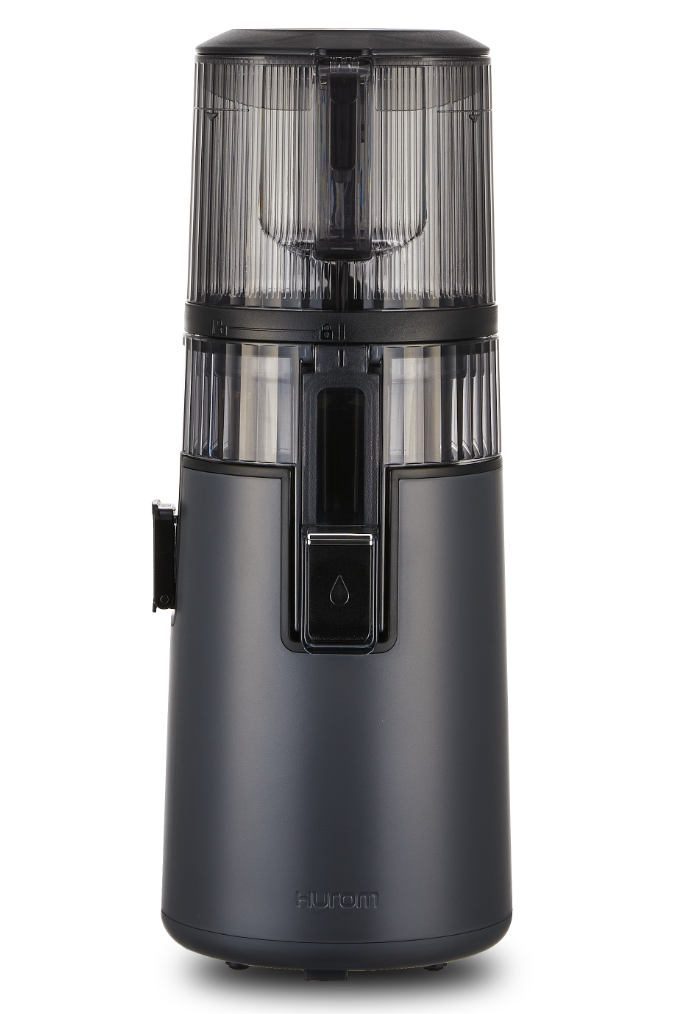
Sources: Hurom’s H70 Easy Clean product page and linked H70FT-series manual, plus the maker’s U.S. FAQ. Hurom does not identify the archived black product image as a photo or render. No personal ownership, laboratory test, customer-review summary or promised juice yield is claimed.
Key details at a glance
| Extraction method | Slow-compression masticating extractor |
|---|---|
| Published feed-chute width | 1.8 in |
| Speed control | Single-speed on/off |
| Motor electrical rating | 150 W |
| Controls and use | Forward juicing, off and manual reverse are documented; reverse is for clearing a stop, not a second juicing speed or automatic sensing mode. |
| Published feed-chute width (metric) | 45 mm |
| Body-fit measurement note | Hurom lists the body in an unlabelled three-number order; measure the assembled machine and working clearance rather than relying on guessed axes. |
| Filter configuration | Maker-described strainer-free, two-part auger chamber |
| Removable parts dishwasher-safe per manual | No |
| Automatic ingredient-sensing mode | No |
| Internal juicing chamber capacity | 15.2 fl oz |
| Batch-loading hopper | Yes |
| Manufacturer-listed voltage | 120 V |
Use the exact model’s instructions for operating limits, supplied equipment and version differences.
Sources for this assessment
Now check the model against your kitchen.
Use the finder for extraction style, batch, cleanup, control, and counter-fit requirements.