
Your needs, this model
Does it fit your priorities?
Do you want an auger juicer rather than a spinning-basket centrifugal extractor?
Hurom's H400 page and linked manual describe a powered auger/multi-screw chamber, not a centrifugal basket.
Explore this need in the finder →Is Hurom's strainer-free, two-part Easy Clean auger design the kind of chamber you want?
The maker describes a two-part auger that works with the chamber to strain juice without the conventional separate mesh strainer; the parts still require hand cleaning.
Explore this need in the finder →Does the 550 ml internal chamber meet your minimum chamber size without substituting pitcher capacity or yield?
Hurom lists 550 ml (18.6 fl oz) for the H400 internal chamber; it separately lists a juice container but does not publish its volume.
Explore this need in the finder →Can one H400 session run for 30 minutes, and does the manual allow 31 minutes before a rest?
The H400 page and linked manual support a 30-minute maximum before a five-minute rest; 31 minutes is above the stated limit.
Explore this need in the finder →The Hurom H400 is the larger of the two current U.S. Easy Clean machines assessed here. Its strongest evidence-backed reason to choose it is the 550 ml internal chamber and a nesting pulp container—not an unverified claim that it extracts more juice per dollar. It suits a household that wants a bigger internal working chamber, will prepare ingredients for a 45 mm opening and is willing to wash the juicing assembly by hand after use.
Large internal chamber, separate receiving vessels
The manufacturer lists a 550 ml (18.6 fl oz) chamber and includes a separate juice container and pulp container. These are three different things. The 550 ml figure is chamber capacity; it is not the included juice vessel’s capacity and not the yield from a batch of produce. Hurom does not give the juice container’s volume on the product details page I inspected, so shoppers who need a minimum pitcher size should treat that field as unknown. The larger hopper and chamber make the H400 a more natural fit than the H70 for a larger loading routine, but the page does not supply a measured hopper capacity.
Hurom calls the H400 its largest Easy Clean slow juicer and describes its hopper as self-feeding. It also lists a 45 mm (1.8-inch) hopper opening. The practical reading is not “put anything in whole”: follow the manual’s produce-preparation directions, keep the feed below the limit line and use its designated pusher. The manual says soft ingredients alone may pool, and certain dense or fibrous produce needs particular care. The actual recipe and prep method matter more than a marketing label.
Two-part Easy Clean design, with real hand-washing
The chamber works with a two-part auger to strain juice without a conventional separate mesh strainer. That can remove the most familiar small screen from the post-juicing routine. It does not eliminate disassembly: Hurom’s H400-series manual shows the chamber set, hopper, multi-screw, pulp outlet cover, seals and containers coming apart. It instructs users to wash parts promptly under running water and to clean the silicone packings. It specifically says not to place parts in a dishwasher or dryer. Anyone who treats dishwasher cleaning as essential should not select the H400 on the strength of “Easy Clean.”
The nesting pulp container is a practical detail for a session that produces a lot of residue; Hurom says it helps prevent pulp spilling while you work. The manual still tells the user to empty the rear pulp cup during larger extractions. So this is not a maintenance-free or never-empty bin. The motor is listed at 150 W, with one forward juicing mode and Reverse available in the operating controls. Reverse is a manual clearing step, not an automatic ingredient-sensing program or an extra extraction speed. The page’s 90 RPM figure is an electrical/mechanical specification, not a comparison test.
Batch claims and storage are not the same question
The H400 page promotes preparing juice ahead for up to three days. Hurom’s current U.S. FAQ, however, advises drinking juice fresh, refrigerating leftovers promptly in an airtight container and not keeping it longer than 48 hours. A product page’s batch-juicing copy is not a food-safety guarantee, and the maker’s sources do not agree on a precise storage period. No sealed-storage-day value is used for matching. If storage length is essential, follow the instructions supplied with the exact unit and ask Hurom to reconcile the statements before relying on a three-day plan.
The H400’s listed working limit is clearer: the product table says up to 30 minutes continuously, and the linked H400 manual says to stop after 30 minutes and allow about five minutes before operating again. Use this as a maker limit, not a claim about how much produce can be handled in one session. The U.S. listing states 120 V, 60 Hz and 150 W; use a matching household supply and do not infer that an international model with a similar name is interchangeable.
How it compares with H70
The H70 has a 450 ml (15.2 fl oz) chamber and a smaller listed body-size sequence; the H400’s 550 ml chamber and nesting pulp container better suit the shopper who values larger internal capacity. Both are 6.7 kg (14.8 lb), have 45 mm openings, list 150 W motors and require hand washing. Their published dimension sequences are not labeled by axis, so do not let an assumed width or height decide cabinet fit. H70’s linked manual also contains conflicting five-minute timer and 30-minute operating instructions, while H400’s linked H400 manual supports the 30-minute limit without that separate five-minute timer note.
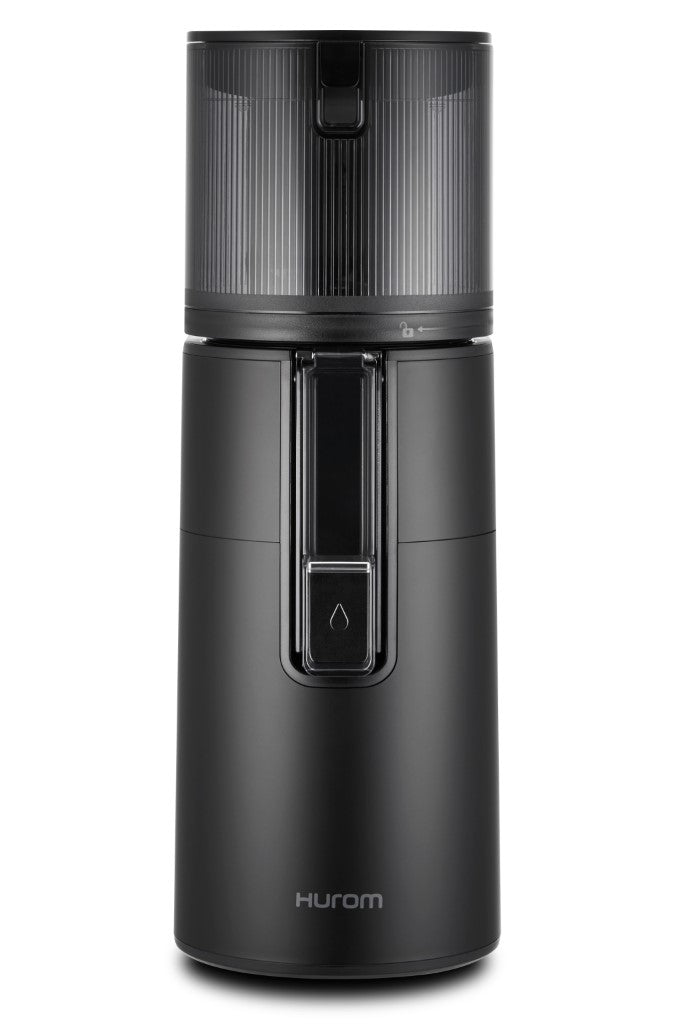
Hurom currently states 15-year motor-and-parts coverage for the H400 on its U.S. product page and FAQ, subject to written warranty terms and authorized-seller conditions. That is not a durability test. The official page lists five finish SKUs—Matte Black, Matte Titanium Grey, White, Two Tone Oat and Two Tone Pink—with no functional package difference stated on the page. The archived black image depicts the model, not the condition of an individual unit; the maker does not say whether it is a photograph or render.
Sources: Hurom’s H400 Easy Clean product page and linked H400-series manual, plus Hurom’s U.S. FAQ. No personal ownership, measured output, customer-review evidence, current price or stock claim is made.
Key details at a glance
| Extraction method | Slow-compression masticating extractor |
|---|---|
| Pulp bin placement | Behind the base |
| Published feed-chute width | 1.8 in |
| Speed control | Single-speed on/off |
| Motor electrical rating | 150 W |
| Controls and use | Forward juicing, off and manual reverse are documented; reverse is for clearing a stop, not a second juicing speed or automatic sensing mode. |
| Published feed-chute width (metric) | 45 mm |
| Maximum continuous run listed by maker | 30 min |
| Body-fit measurement note | Hurom lists the body in an unlabelled three-number order; measure the assembled machine and working clearance rather than relying on guessed axes. |
| Filter configuration | Maker-described strainer-free, two-part auger chamber |
| Continuous operation before rest | 30 min |
| Removable parts dishwasher-safe per manual | No |
| Automatic ingredient-sensing mode | No |
| Internal juicing chamber capacity | 18.6 fl oz |
| Batch-loading hopper | Yes |
| Manufacturer-listed voltage | 120 V |
Use the exact model’s instructions for operating limits, supplied equipment and version differences.
Sources for this assessment
Now check the model against your kitchen.
Use the finder for extraction style, batch, cleanup, control, and counter-fit requirements.