
Your needs, this model
Does it fit your priorities?
Do you want a powered citrus cone rather than a produce feed-chute juicer?
Model 66342J presses halved citrus fruit and has no chute for apples, carrots, leafy greens, or other whole produce.
Explore this need in the finder →Is a 34 fl oz supplied pitcher a useful minimum batch size?
The maker lists a detachable 34 fl oz pitcher; it is a vessel capacity, not a measured juice yield.
Explore this need in the finder →Would an adjustable pulp dial help you choose how much pulp to catch?
The 66342J slider adjusts the pulp strainer and the manual illustrates moving it right for less pulp. It does not label low/medium/high levels or promise a percentage.
Explore this need in the finder →Must the removable juicing parts be dishwasher-safe?
The manual names the lid, reamers, pulp basket, and pitcher as top-rack-safe; the base is wiped rather than immersed.
Explore this need in the finder →Will a 9-inch listed height fit below the cabinet?
The maker lists a 9-inch body height; leave additional room for fruit handling and lifting the pitcher and lid.
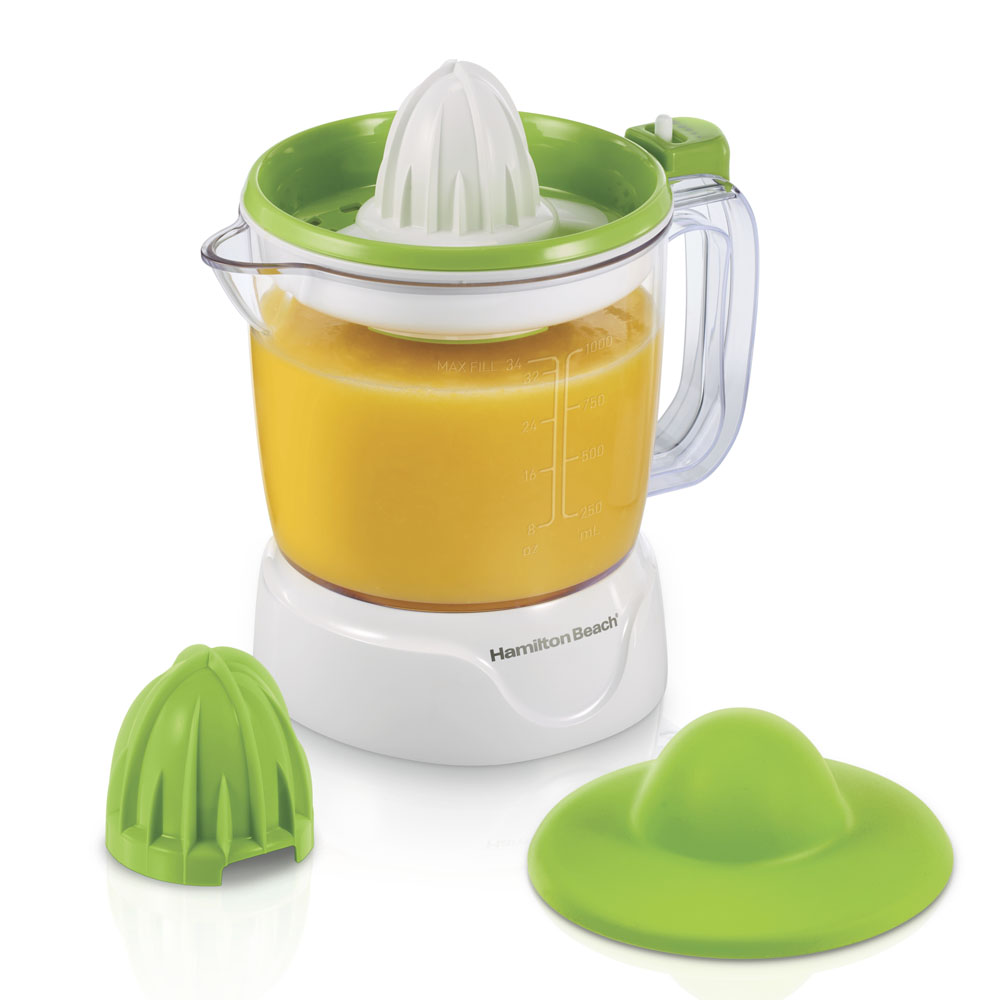
Explore this need in the finder →The Hamilton Beach Electric Citrus Juicer with Gripper Lid, model 66342J, is a current-reference powered reamer for halved lemons, limes, oranges, and grapefruit. Its defining combination is a detachable 34-ounce pitcher, two auto-reversing reamers, a slide-adjustable pulp strainer, and a silicone lid that grips fruit, opens jars, and covers the stored parts. It remains a citrus-only appliance: it has no feed chute for apples, carrots, greens, or other produce.
Fruit preparation still sets the pace
The exact Use & Care guide describes a familiar pressure-start routine. Lock the pitcher onto the base, fit together the two pulp-control pieces, add the small reamer, then place the larger reamer on top for larger citrus. The manual says the silicone gripper can be placed over fruit to hold it while pressing. Once plugged in, press a halved fruit onto the cone to start; lift it off to stop. The cone automatically reverses direction from time to time. You still need to wash, halve, position, and repeat fruit one half at a time, so the lid can steady the fruit but does not make the process hands-free.
The small reamer is intended for lemons and limes, while the large one is optimized for oranges and grapefruit. That is a practical division, not a promise about every unusually large fruit. Hamilton Beach says the fruit does not need peeling; the manual recommends room-temperature citrus and rolling it before cutting. It provides no timed yield trial or pulp-percentage data, so marketing language about getting the most from citrus should not be read as a measured comparison.
The useful difference is adjustable pulp, not a named texture scale
The pulp strainer has a sliding dial that changes how much pulp is caught; the manual’s diagram says to slide right for less pulp. The product page also describes customizing the amount. That is a real control absent from the 66333 FreshMix’s documented two-piece basket, but this 66342J guide does not label the dial with low, medium, or high positions. If a specifically named setting is essential, this model should not be treated as meeting that requirement. Nor does a dial promise a repeatable pulp percentage across different citrus varieties.
Its 34 fl oz pitcher gives you a larger stated collection capacity than FreshMix’s 16-ounce carafe. The maker says the pitcher detaches for serving, has a pour spout and easy-read markings, and can hold leftover juice in the refrigerator with the silicone gripper lid. Capacity is the vessel’s listed size, not a yield guarantee. The gripper lid does not turn the juicer into a separate food processor; when used on a jar, it is a jar-opening aid, and when stored over the reamers it keeps them covered.
Check the actual footprint and wash boundaries
Hamilton Beach lists the body at 9 inches high, 8.2 inches wide, and 5.8 inches deep. The side-to-side space is broader than the listed 66333 footprint, even though the height is slightly lower. Leave extra room to put fruit on the cone, remove the pitcher, and lift parts from the counter. The linked manual’s rating panel identifies model 66342J, type J14, 120 V, 60 Hz, and 30 W. Those electrical ratings do not establish sound level or extraction speed.
The manufacturer lists the silicone lid, reamers, pulp basket, and pitcher as dishwasher-safe; the manual specifies the top rack. Unplug before disassembly and wipe the base with a damp cloth rather than immersing it. The nested parts and cord storage are helpful for putting the appliance away, but the reamer, basket, pitcher and lid still need to be separated and rinsed. The lid can hold a fruit half during pressing, but the normal cleaning routine still involves handling the small parts.
One warranty detail needs confirmation
The exact product page advertises a one-year limited warranty, while the linked Use & Care manual states a three-year limited warranty in the U.S. and Canada. Because both are manufacturer materials connected to model 66342J, the mismatch remains unresolved; do not rely on either duration as a hard comparison point without checking the terms that apply to the exact seller and purchase date. The page currently presents this exact model as a new offer, but stock and terms can change.
Choose the 66342J for its current citrus setup
This model suits someone who wants a powered cone, a larger supplied pitcher than 16 ounces, and an adjustable pulp-control dial in a small citrus station. It is a weak fit if you need manual-only juicing, a defined low/medium/high pulp setting, or one appliance for leafy greens and whole-produce extraction. Compare the earlier 66333 if you specifically want its documented hand-powered fallback and mixing wand; compare Cuisinart’s CCJ-500P1 if its low/medium/high labels or direct-to-glass arrangement are more important. For non-citrus produce, compare centrifugal or slow juicers instead of assuming a citrus cone can cover both jobs.
Read Hamilton Beach’s 66342J product page and linked Use & Care manual before choosing. This is a documentation-based assessment rather than a hands-on review; no measured yield, extraction time, noise level, long-term durability, or comparative cleaning result is claimed.
Key details at a glance
| Extraction method | Dedicated citrus reamer or cone press |
|---|---|
| Included juice receiver capacity | 34 fl oz |
| Adjustable citrus pulp control | Yes |
| Speed control | On/off with pressure-activated cone |
| Motor electrical rating | 30 W |
| Listed width | 8.2 in |
| Listed depth | 5.8 in |
| Listed height | 9 in |
| Dedicated Quiet selector label | No |
| Controls and use | The exact manual says the juicer starts when fruit is pressed down on the reamer and stops when fruit is lifted. Its automatic reversal is not a user-selectable speed setting. |
| Cleanup note | The linked manual says the silicone lid, reamers, pulp-control basket, and pitcher can be washed in hot, soapy water or on the top rack. Unplug and wipe the base with a damp cloth; do not immerse it. Parts nest for storage. |
| Manufacturer jug label | Manufacturer-listed 34 oz detachable pitcher; capacity is not a promised juice yield. |
| Manual-described lower-noise juicing range | No |
| Body-fit measurement note | The exact U.S. page lists 9 H × 8.2 W × 5.8 D inches. Allow extra operating room to position fruit, remove the pitcher, and handle the attachments. |
| Hand-powered operation | No |
| Removable parts dishwasher-safe per manual | Yes |
| Manufacturer-listed voltage | 120 V |
Use the exact model’s instructions for operating limits, supplied equipment and version differences.
Sources for this assessment

Now check the model against your kitchen.
Use the finder for extraction style, batch, cleanup, control, and counter-fit requirements.