
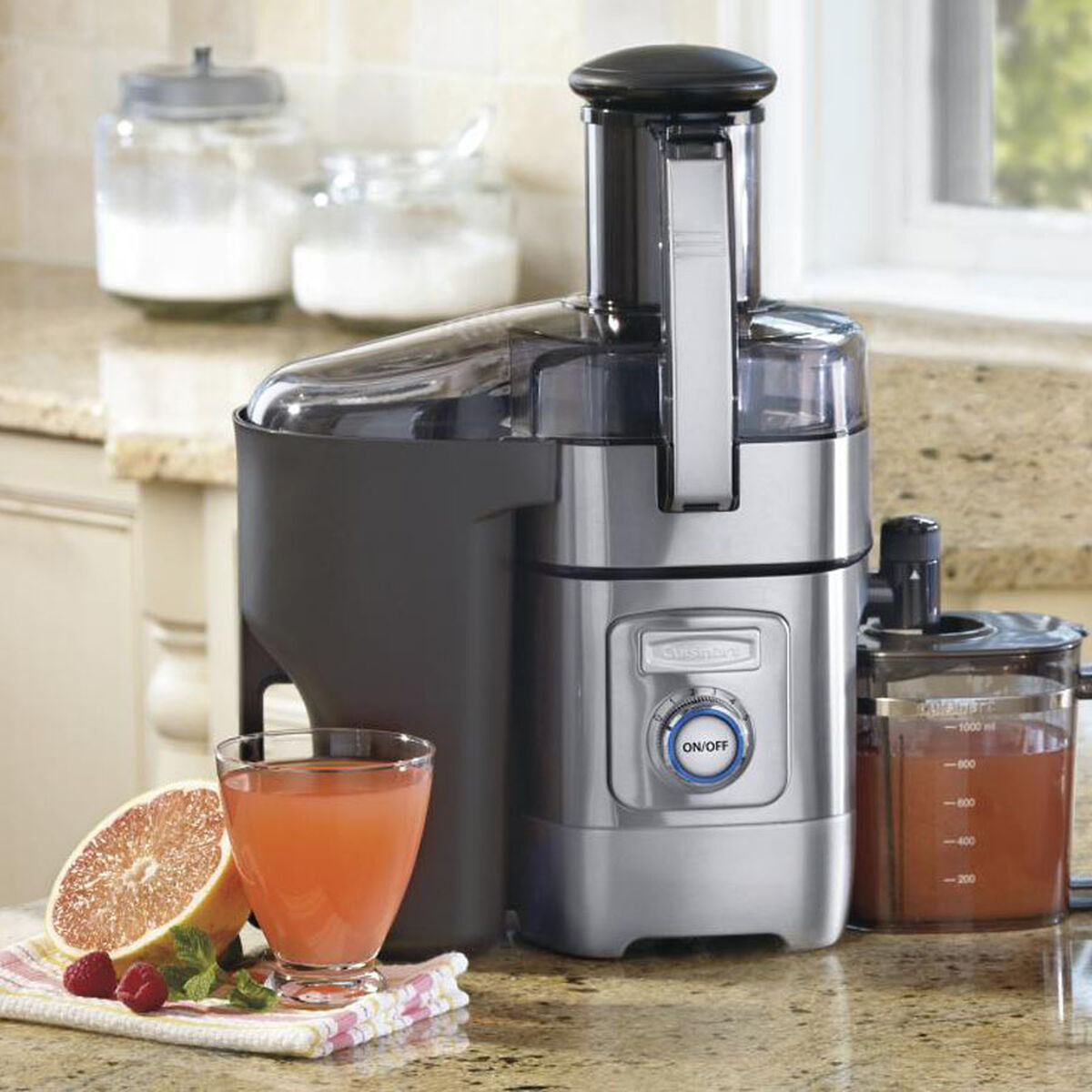
Your needs, this model
Does it fit your priorities?
Is a published three-inch feed tube sufficient for your usual produce?
The manual says fruit and vegetables wider than three inches must be cut. The diameter is an opening measurement, not a promise that every food can go through whole.
Explore this need in the finder →Would a one-liter pitcher meet the amount you make before stopping?
The manufacturer labels this pitcher 1 liter, about 33.8 U.S. fluid ounces. It fits a 32-ounce minimum, but not a strict 34-ounce minimum; container size is not a promised yield.
Explore this need in the finder →Do you prefer five discrete speed positions on a dial?
The CJE-1000 has a five-speed dial with a separate central On/Off control. Its settings are discrete and do not establish variable-speed operation or a named Quiet mode.
Explore this need in the finder →Do you want the manual-described lower-foam setup?
Use the supplied foam-management disk with a smaller spout opening for the lower-foam setup. This is an adjustment, not a quantified or guaranteed foam result.
Explore this need in the finder →Is a selector specifically named Quiet essential?
The product page says “quiet operation,” but the manual documents a five-speed dial without a Quiet-labeled setting or sound-level measurement.
Explore this need in the finder →The Cuisinart CJE-1000 is an earlier U.S. centrifugal juicer for shoppers comparing a specific older offer. Cuisinart labels this exact model discontinued and out of stock. Its five-position speed dial, 3-inch feed tube, one-liter pitcher and adjustable foam setup are useful distinctions, but the small jug and missing body dimensions matter. This is the CJE-1000, not the separately coded CJE-1000P1; do not assume a seller's model suffix or included parts from a similar-looking listing.
A conventional centrifugal setup with a five-speed dial
The CJE-1000 uses a stainless micro-mesh filter basket and cutting blades to separate juice from pulp. The manufacturer lists a 3-inch feed tube and a five-speed control dial with an illuminated ring. That is a discrete dial, not a variable-speed selector or five separate buttons. The instruction book gives ingredient-specific speed guidance: in general, softer produce goes at lower speeds and firmer ingredients at higher speeds. It also suggests putting leafy greens between other ingredients in a combination. These instructions are more useful than treating the numbers as a quality ranking.
Three inches is a published opening size, not a promise that every apple, beet, or other piece will fit intact. The manual specifically says produce wider than three inches must be cut, and it calls for peeling some thick or inedible skins and removing pits and hard seeds. If avoiding prep is essential, compare the exact diameter with your usual ingredients rather than relying on the broad “whole fruits” wording in product copy.
One liter is a modest collection jug
The maker lists a 1-liter juice pitcher, which converts to about 33.8 U.S. fluid ounces. That is below a strict 34-ounce minimum, even though the rounded numbers can look close. The matcher therefore treats 32 ounces as a possible minimum but does not pass the 34-ounce threshold. A pitcher is only a container capacity; it says nothing about how much juice a particular load of produce will yield. The listed 2-liter pulp container is roughly 67.6 U.S. fluid ounces by volume, not an output or yield figure.
The foam-management arrangement is unusually specific. To aim for less foam, the manual says to install the foam-management disk and turn the spout to a smaller opening; to allow more foam, remove the disk and use a larger opening. Those are operating choices, not guaranteed texture or a measured foam percentage. The spout must be open during juicing; it can be closed after the motor stops to reduce drips while removing the pitcher. If you want a hands-off or measured foam result, the manual does not establish one.
Cleanup is straightforward only if you clean promptly
Cuisinart says the removable parts are dishwasher-safe. The instruction book gives top-rack guidance for the named removable parts and says not to put the motor housing in water or the dishwasher; wipe the base with a damp cloth. The rotating basket has sharp blades and a fine mesh, so use the included nylon brush and rinse soon after use. The manual warns that dried pulp is harder to remove. A dishwasher-safe parts requirement is therefore not the same as a dishwasher-cleaning routine for the whole appliance.
The machine also has a handle-tab safety break that stops the basket when the lock is released. The manual asks you to unplug before disassembly and wait until moving parts stop. Cuisinart lists 1000 watts on the product page, but the manual clarifies that its maximum rating is based on a food-chopper attachment that draws the most power and that other attachments can draw less. Do not read that label as a measured juicing load or an extraction-performance result.
Fit and an older offer need extra checking
The CJE-1000 product page shows an inch dimension heading without numerical measurements. The listing is therefore not a good choice for a hard counter-depth or cabinet-height requirement unless you can verify the exact unit separately. Do not substitute the dimensions of the distinct CJE-1000P1. The old CJE-1000 page and its linked CJE-1000 booklet describe a three-year limited consumer warranty, but a used, refurbished, or long-stored machine may not retain warranty coverage. Inspect condition, the exact suffix, and the presence of the basket, foam disk, pitcher, lid, pulp container, brush, and pusher before comparing any offer.
The maker's CJE-1000 product page and instruction book support the operating and capacity details above; neither gives numerical body dimensions. The page's general “quiet operation” wording is not a named Quiet speed or a decibel measurement. If a specific low-noise setting is essential, do not count the CJE-1000 as meeting it. For a larger batch jug or a named Quiet selector range, compare the Breville BJE830 assessment; it is a different, taller configuration, and its quiet setting is still not a guarantee of silence.
Bottom line: Consider this earlier model if a three-inch centrifugal chute, five discrete dial speeds, removable dishwasher-safe parts, and a manual-adjustable foam routine suit your batch. Pass if you need a 34-ounce-or-larger pitcher, verified appliance dimensions, a dedicated Quiet setting, or current manufacturer stock.
Key details at a glance
| Extraction method | Centrifugal fruit-and-vegetable extractor |
|---|---|
| Included juice receiver capacity | 33.8 fl oz |
| Published feed-chute width | 3 in |
| Speed control | Five-position speed dial |
| Motor electrical rating | 1000 W |
| Dedicated Quiet selector label | No |
| Juice jug and lid dishwasher-safe | Yes |
| Filter basket dishwasher-safe | Yes |
| Controls and use | Five discrete speed positions on a dial, with a central On/Off button and blue LED ring. The booklet gives produce-specific speed guidance. The product-page phrase “quiet operation” is not a named speed setting or decibel measurement. |
| Cleanup note | Rinse soon after juicing because dried fruit and vegetable residue is harder to clean. Use the supplied nylon brush on the fine micro-mesh basket; the blade edges are sharp. Wipe the motor housing with a damp cloth only. |
| Manufacturer jug label | 1 liter (about 33.8 U.S. fl oz by conversion) |
| Body/base construction | Die-cast and brushed stainless-steel housing; product page identifies Stainless Steel finish. |
| Jug capacity (metric label) | 1 L |
| Pulp collector capacity | 2 L |
| Manual foam-management setup | For less foam, the manual says to use the foam-management filter disk and a smaller spout opening; for more foam, remove the disk and use a larger opening. Never juice with the spout closed. |
| Body-fit measurement note | Numeric body dimensions are not published for the exact CJE-1000 page or booklet; verify the exact unit before relying on a hard fit limit. |
| Electrical-rating caveat | Cuisinart lists 1000 watts. The booklet clarifies that the maximum rating is based on a food-chopper attachment drawing the greatest power and that other attachments may draw less; it is not measured juicing performance. |
| Removable parts dishwasher-safe per manual | Yes |
| Manufacturer-listed voltage | 120 V |
Use the exact model’s instructions for operating limits, supplied equipment and version differences.
Sources for this assessment
- Cuisinart discontinued Juice Extractor CJE-1000 product page; browser-rendered observation transcript (direct HTML retrieval returned 404)
- Cuisinart CJE-1000 Instruction Booklet, 10 pages, linked by the exact CJE-1000 manufacturer page
- Cuisinart U.S. Juicer Manuals directory; 9 of 9 entries, including distinct CJE-1000P1 code
- Cuisinart official CJE-1000 image asset
- U.S. CPSC recall search, exact CJE-1000 query; historic recall reconciliation incomplete

Now check the model against your kitchen.
Use the finder for extraction style, batch, cleanup, control, and counter-fit requirements.