
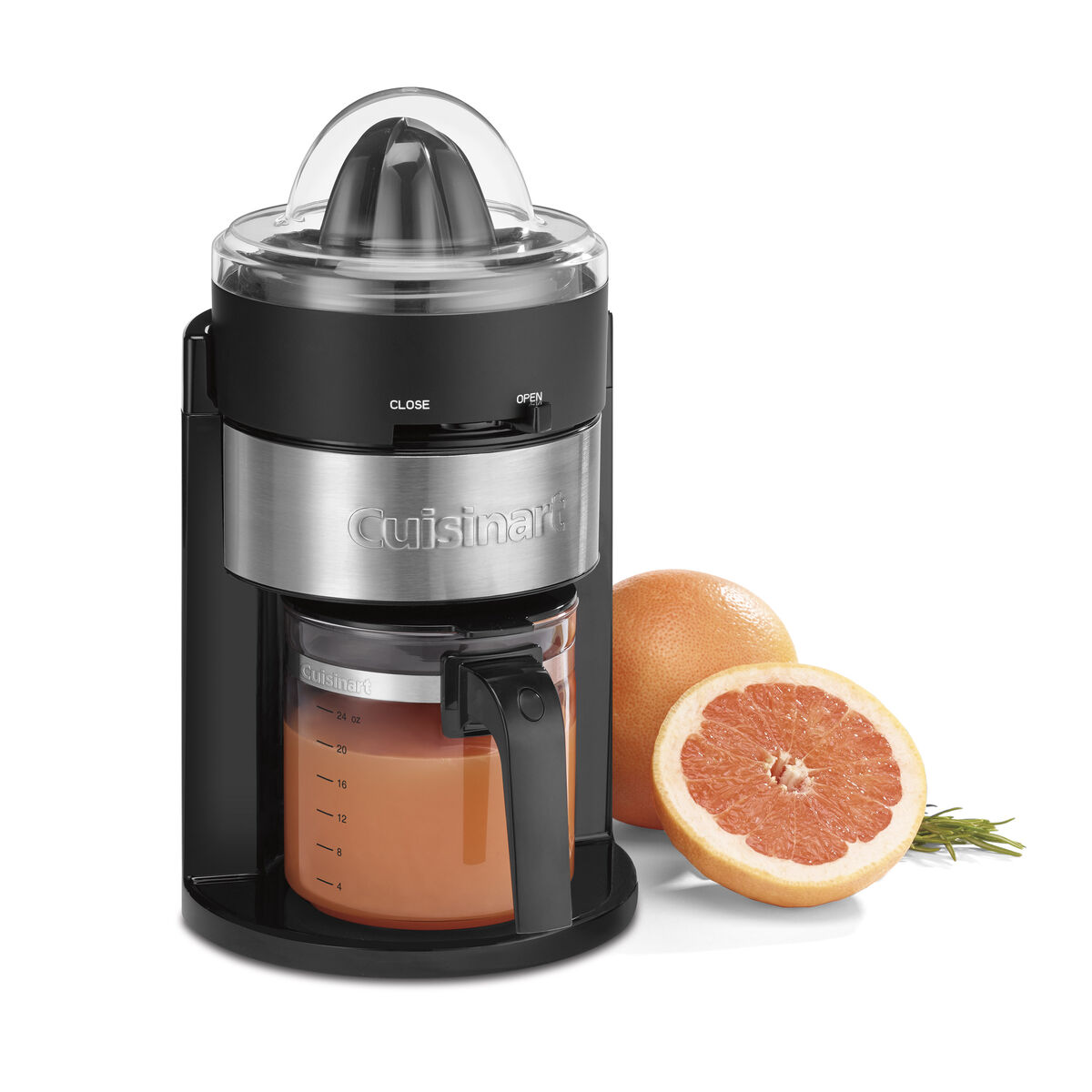
Your needs, this model
Does it fit your priorities?
Are you shopping for a dedicated citrus press?
The CCJ-900P1 reamer is for halved citrus; this does not replace a produce-feed juicer.
Explore this need in the finder →Do you need a lidded carafe to collect and store juice?
The exact P1 page lists a glass carafe and lid. Confirm the P1 code and carafe on an out-of-stock-era seller offer.
Explore this need in the finder →Would a labeled high-pulp position be useful?
The page and linked CCJ-900 Series booklet describe low, medium, and high pulp settings.
Explore this need in the finder →Will your glass fit beneath the spout?
The linked CCJ-900 Series booklet limits a glass/container to 4 3/4 inches high.
Explore this need in the finder →Is at least a 32-ounce confirmed collection vessel essential?
The exact P1 page says 22 ounces but its linked series manual and image indicate 24; the exact capacity is not treated as confirmed and cannot meet this hard minimum.
Explore this need in the finder →Would an adjustable pulp selector help you choose how much the sieve catches?
The linked CCJ-900 Series booklet identifies three selectable sieve positions: low, medium, and high. They are maker labels, not a quantified pulp result.
Explore this need in the finder →The Cuisinart CCJ-900P1 is a discontinued electric citrus juicer with a glass carafe. Its U.S. product page says the model is out of stock and describes a black-and-stainless unit that can collect juice in the supplied carafe or direct it into a drinking glass. It belongs on a shortlist only if citrus is the job: this is not a feed-chute extractor for apples, vegetables or greens. Its differences from a small direct-to-glass citrus press are the carafe, its storage lid, an anti-drip lever spout, and a cover-activated final-spin step.
A batch-and-store format with a model-code caveat
Cuisinart’s CCJ-900P1 page specifies a 22-ounce easy-pour glass carafe with lid. The same page also allows direct use of a single glass. That is a useful arrangement when you want to collect several halves in one place and refrigerate a batch, but a 22-ounce container still sets a small-batch boundary: it is far short of the 32-ounce finder cutoff and is not a claim about how much juice a given pile of fruit will yield. The carafe is a serving and storage vessel, not a throughput rating.
There is a genuine source discrepancy worth respecting before an exact-capacity purchase. The P1 page links a booklet titled for the CCJ-900 Series, and that booklet identifies a 24-ounce carafe; the official product image attached to the P1 page also appears to show graduations through 24 ounces. The page itself says 22 ounces. Because those sources do not agree, this review does not treat either number as a verified hard matching capacity for the P1. Check the carafe and model marking on the exact offer. The unsuffixed CCJ-900 has its own Cuisinart page and a matching 24-ounce manual, so do not silently treat CCJ-900 and CCJ-900P1 as the same exact offer or assume their carafes interchange.
Three pulp levels and a second spin
The product page lists low, medium and high pulp settings, and the attached CCJ-900 Series booklet describes the reamer, sieve, angled juice container, drip spout and cover. Halve the fruit, put the center over the cone, and press with steady pressure. The manual says the cone can change direction as pressure is released and reapplied; the auto-reversing action is not a selectable speed. When a sieve looks full, remove the rind, put the cover in place and press it to run the final-spin step, which is intended to separate remaining juice from the pulp. These settings and steps are helpful when you make a few cups, but there is no documented juice-yield guarantee or pulp percentage.
The lever-controlled spout offers a more deliberate way to stop the flow than simply lifting a glass away. The glass carafe’s lid is intended for refrigerator storage. Still, this is a tabletop press with a cut-and-place routine: you wash, halve, seed as needed, press each piece and empty/rinse the sieve as the booklet directs. If you routinely need a few liters at once, a small carafe and repeated hand positioning may feel like the wrong workflow even if the features look convenient.
Measure the whole working setup
Cuisinart lists the CCJ-900P1 body at 6.89 inches long by 8.19 inches wide by 12.32 inches high. For counter planning, treat the listed length as front-to-back depth, then leave room for the carafe below the spout, clearance to raise the cover, and enough space to clean. Do not compare the body height alone with a cabinet opening: the fruit and cover need room above the base during use. The manufacturer says the removable juicing components are dishwasher-safe and that the cord stores in the base. The series booklet gives the practical boundary: rinse the container, reamer/sieve, carafe and lid before putting them on the dishwasher’s top rack; wipe the stainless motor housing and keep it out of liquids.
Who should look for one now?
The CCJ-900P1 suits someone checking a specific earlier-model listing who wants an electric citrus cone and a covered glass carafe rather than a separate glass under a spout. It is not the obvious choice if you require a capacity-verified pitcher, need a large batch, or want a contemporary model with a currently stocked manufacturer offer: Cuisinart labels this one discontinued and out of stock. If you continue shopping for this exact model, use the exact “Cuisinart CCJ-900P1” search rather than an image or family name alone, then verify the P1 marking and the delivered carafe. No ASIN or seller stock is assumed here.
For a current smaller citrus task, compare the Cuisinart CCJ-500P1; it has three pulp labels and a direct-glass snap-up spout but no listed carafe. For a lever-based alternative, compare Breville’s BCP600 or 800CPXL; those models use an arm rather than this cover-triggered spinner. If you want to juice apples, vegetables or leafy produce, choose a centrifugal or slow-compression machine instead. This review summarizes manufacturer documentation, not hands-on tests; noise, actual yield and time-per-fruit have not been measured. Consult Cuisinart’s CCJ-900P1 page and its linked CCJ-900 Series booklet.
Key details at a glance
| Extraction method | Dedicated citrus reamer or cone press |
|---|---|
| Adjustable citrus pulp control | Yes |
| Speed control | On/off with pressure-activated cone |
| Listed width | 8.19 in |
| Listed depth | 6.89 in |
| Listed height | 12.32 in |
| Dedicated Quiet selector label | No |
| Controls and use | The user centers a halved citrus fruit on the motorized reamer and applies pressure. The manual says the cone may reverse direction when pressure is removed and reapplied. There is no selectable speed control. |
| Manufacturer jug label | Unresolved exact capacity: the CCJ-900P1 page says 22 oz, while its linked CCJ-900 Series manual and product image indicate 24 oz. Unknown for hard matching. |
| Body/base construction | Stainless-steel housing/accents on a black base, as described by Cuisinart; the manufacturer does not enumerate every component material. |
| Body-fit measurement note | Manufacturer order is L × W × H; listed length is mapped to front-to-back depth for hard-fit matching. Allow extra operating room for fruit, cover lift, container placement, and removable-part handling. |
| Removable parts dishwasher-safe per manual | Yes |
Use the exact model’s instructions for operating limits, supplied equipment and version differences.
Sources for this assessment
- Cuisinart U.S. discontinued CCJ-900P1 Citrus Juicer with Carafe exact product page; rendered observation preserved because direct retrieval returned HTTP 404
- Cuisinart CCJ-900 Series instruction and recipe booklet linked from the exact product page
- Cuisinart U.S. Juicer Manuals directory (showing 9 of 9 results)
- Official Cuisinart image linked from the exact CCJ-900P1 page; 24-ounce graduations conflict with the page’s 22-ounce label
- CPSC exact-model recall review not completed for this model
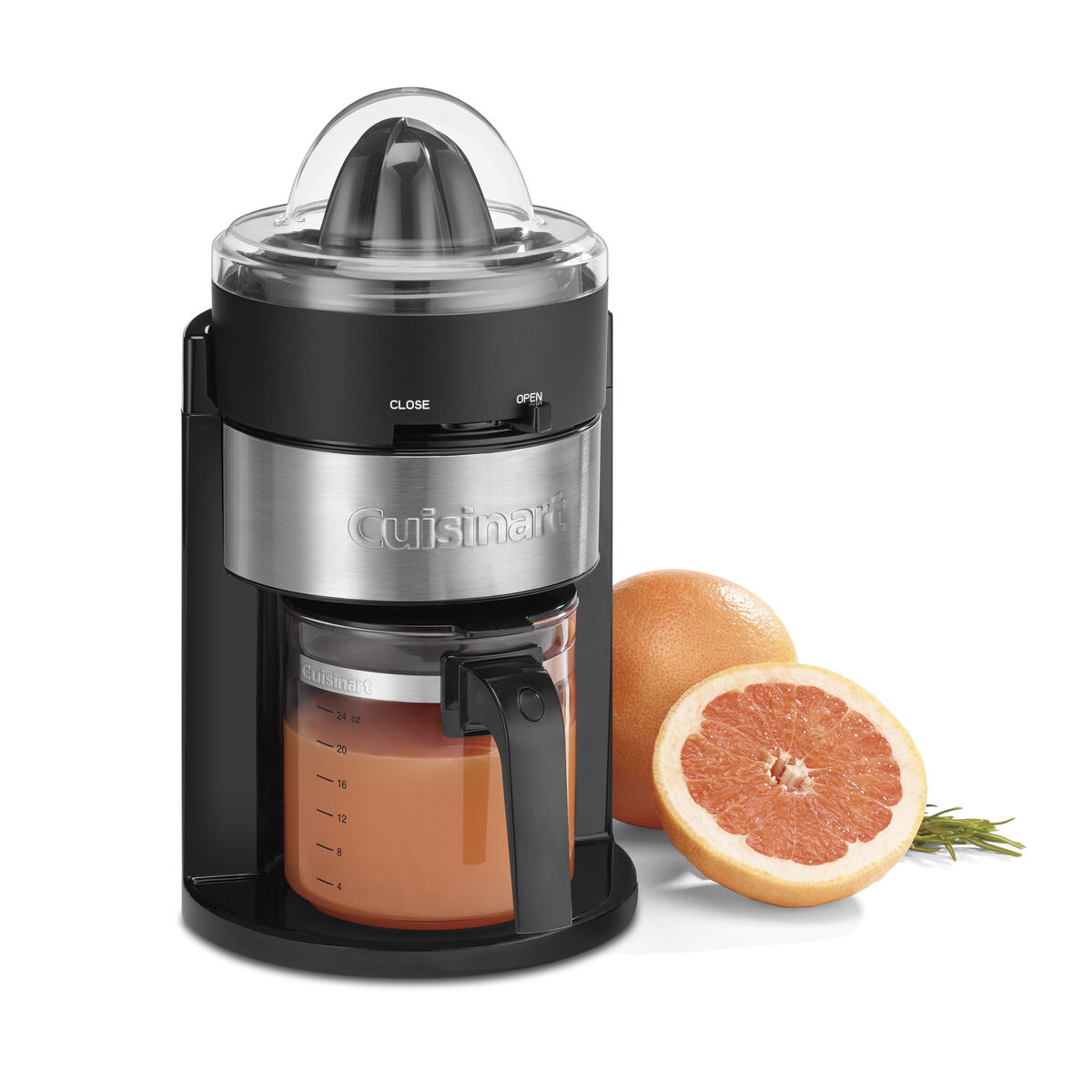
Now check the model against your kitchen.
Use the finder for extraction style, batch, cleanup, control, and counter-fit requirements.