
Your needs, this model
Does it fit your priorities?
Are you shopping for a citrus-only press rather than a fruit-and-vegetable juicer?
CCJ-500P1 is a motorized cone press for halved citrus; it does not process apples, greens, or other produce through a feed chute.
Explore this need in the finder →Would a low, medium, or high labeled pulp setting help you choose texture?
The linked CCJ-500 Series booklet identifies those three positions on the adjustable sieve. The labels do not specify a measured pulp percentage.
Explore this need in the finder →How tall is the glass you need to place beneath the outlet?
The booklet specifies a receiving glass or container no higher than 5 3/8 inches under the spout.
Explore this need in the finder →Do you need a separate lidded carafe for refrigerator storage?
The exact page describes a removable juice container and snap-up spout, not a separate lidded carafe. Choose a carafe requirement only if you want that additional vessel.
Explore this need in the finder →Will the published body measurements fit the counter space you have?
Cuisinart lists 8.42 in L × 12.83 in W × 7.24 in H. Allow room to position fruit and glass and lift the cover.
Explore this need in the finder →Would an adjustable pulp selector help you choose how much the sieve catches?
The linked CCJ-500 Series booklet identifies three selectable sieve positions: low, medium, and high. They are maker labels, not a quantified pulp result.
Explore this need in the finder →The Cuisinart CCJ-500P1 is a compact electric citrus press, not a general-purpose juicer. Cut citrus in half, center each half on the reamer and press down; the machine turns only while pressure is applied. Cuisinart currently lists it as the Pulp Control Citrus Juicer in a black-stainless finish. Its useful distinctions are a three-position pulp selector, a snap-up outlet for pouring into a glass, and a cover-triggered spin step for the remaining juice. Those are small, task-specific conveniences—not evidence that it can replace a feed-chute juicer for apples, leafy greens or carrots.
Choose it for repeat citrus work
This shape makes sense when most of your juicing is lemon, lime, orange or grapefruit, especially if you want to press a few halves without holding each one against a hand reamer. The manual says the cone accommodates a range from limes to grapefruit; it does not provide a size chart for unusually small or large fruit. You still need to wash and halve each piece, remove seeds, and keep zest work separate. There is no feed tube, produce pusher, or broad ingredient program here.
Operating it is hands-on but simple: apply steady pressure to a cut half, ease off when that piece is done, and repeat. The manual notes that the reamer can reverse when pressure is released and reapplied; that reversal is part of the operating behavior, not a speed setting. If you want the machine itself to hold fruit down through an arm, compare lever presses such as Breville’s BCP600 or 800CPXL. The Cuisinart does not have a long press arm or the named cone-material specification available on the 800CPXL page.
Pulp selection is concrete; yield claims are not
The adjustable sieve is labeled low, medium and high pulp. That is a practical choice when different people use the same juice or when you switch between a strained drink and juice for a recipe. The labels do not specify a percentage of pulp, and the maker’s “Final-Spin” wording should not be read as a measured yield guarantee. With roughly a pound of fruit, the booklet says the sieve may look full; it directs you to remove the rind and press the cover to spin juice out of the pulp before continuing. The step is useful for a little batch-making rhythm, but it is still one half at a time.
The outlet is a long snap-up spout intended to reach over more glasses and limit drips. The booklet says the receiving glass or container should be no taller than 5⅜ inches. That clearance is worth checking if you use a favorite tumbler. Unlike the CCJ-900 models, the CCJ-500P1 does not come with a listed glass carafe; the product page shows juice flowing through the unit’s container and spout. It is a direct-to-glass arrangement rather than a supplied fridge-storage pitcher.
Check the counter and cleaning routine
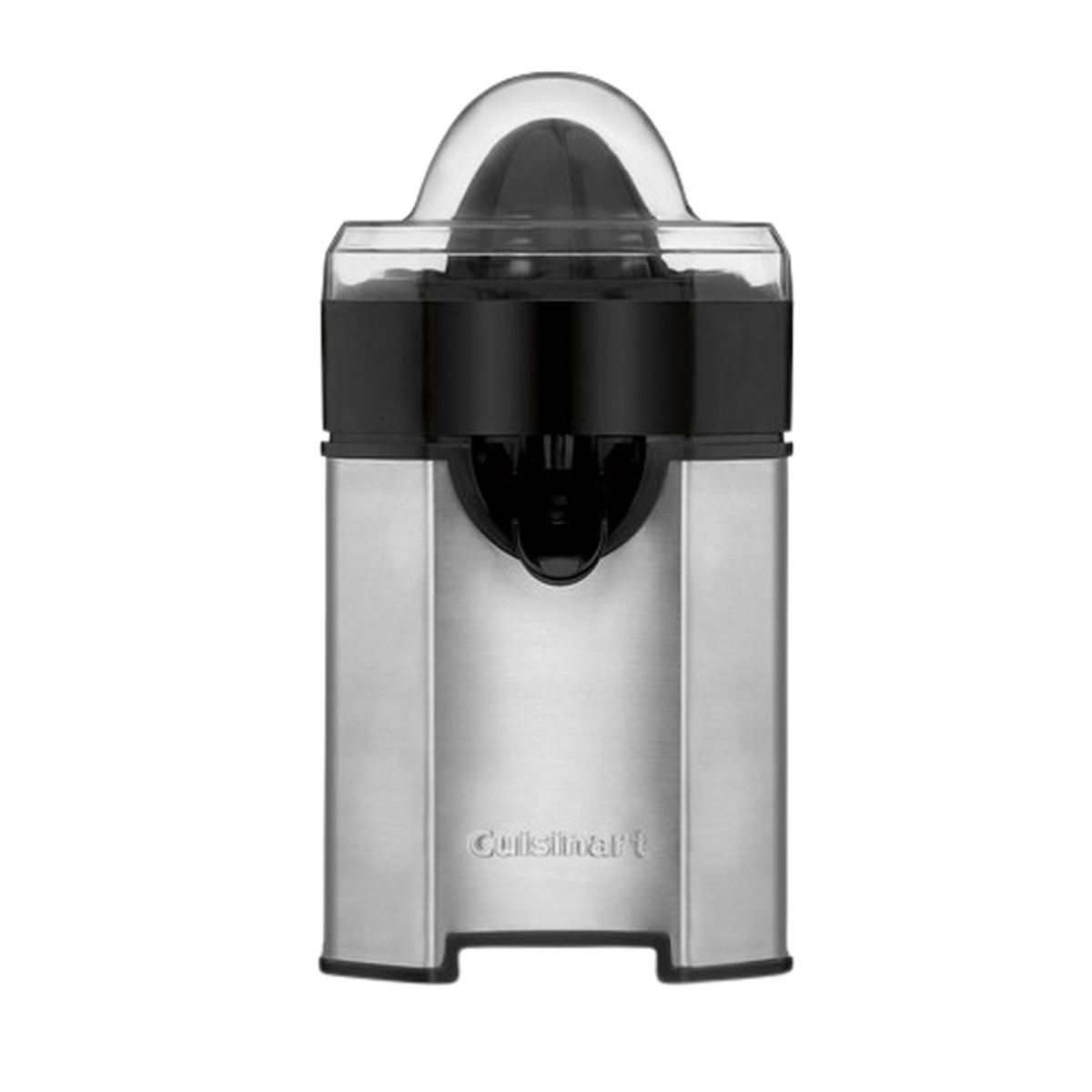
Cuisinart lists the body at 8.42 inches long by 12.83 inches wide by 7.24 inches high. I map the listed length to front-to-back depth for a counter check; leave extra room to lift the cover, position fruit, set a glass below the spout, and remove the washable parts. The manufacturer page also prints a weight value of 3.45 without a unit in the text available here, so weight is not a useful comparison point. The image supplied by Cuisinart is a product-only cutout; it shows the black-stainless body but does not settle finish differences beyond the page’s own label.
Cuisinart describes the removable juicing parts as dishwasher-safe. The linked CCJ-500 Series booklet gives more useful care boundaries: rinse the juice container, reamer/sieve assembly and cover before putting them on the top rack, and wipe the stainless motor housing with a damp cloth. Never put the base in water. Prompt rinsing should make the residue easier to handle than leaving citrus pulp to dry, but a dishwasher-safe claim does not eliminate disassembly or rinsing.
Who should choose it—and who should not
Choose the CCJ-500P1 when you want a powered cone, an adjustable three-level pulp sieve, and a compact body with no separate pitcher to store. In the finder, select “citrus-only cone press” to remove centrifugal and slow-compression machines; choose the low, medium or high pulp option only if that exact label matters. A requirement for a 32-ounce pitcher or a feed tube is not confirmed for this model, so it should not survive those essential filters. If you need juice from whole produce, look at the Cuisinart CJE family, Breville Juice Fountains, or a masticating juicer instead.
One specification deserves a last check: the current manufacturer page shows both “1-Year Limited Warranty” in its offer area and “Limited 3-year warranty” in its feature list, while its linked series booklet describes a three-year limited warranty. Confirm which terms apply to the exact seller and purchase date rather than assuming the page is internally consistent. This is a documentation-based assessment, not a hands-on performance test; no extraction-time, sound-level or comparative-yield measurement is available. See Cuisinart’s CCJ-500P1 listing and linked CCJ-500 Series booklet for the current model-specific details.
Key details at a glance
| Extraction method | Dedicated citrus reamer or cone press |
|---|---|
| Adjustable citrus pulp control | Yes |
| Speed control | On/off with pressure-activated cone |
| Listed width | 12.83 in |
| Listed depth | 8.42 in |
| Listed height | 7.24 in |
| Dedicated Quiet selector label | No |
| Controls and use | The user centers a halved citrus fruit on the motorized reamer and applies pressure. The manual says the cone may reverse direction when pressure is removed and reapplied. There is no selectable speed control. |
| Manufacturer jug label | No separate lidded carafe capacity is listed; the page/linked manual show a juice container with snap-up spout for direct glass collection. |
| Body/base construction | Stainless-steel housing/accents on a black base, as described by Cuisinart; the manufacturer does not enumerate every component material. |
| Body-fit measurement note | Manufacturer order is L × W × H; listed length is mapped to front-to-back depth for hard-fit matching. Allow extra operating room for fruit, cover lift, container placement, and removable-part handling. |
| Removable parts dishwasher-safe per manual | Yes |
Use the exact model’s instructions for operating limits, supplied equipment and version differences.
Sources for this assessment
- Cuisinart U.S. CCJ-500P1 Pulp Control Citrus Juicer exact offer page; rendered observation preserved because direct retrieval returned HTTP 404
- Cuisinart CCJ-500 Series instruction and recipe booklet linked from the exact CCJ-500P1 page
- Cuisinart U.S. Juicer Manuals directory (showing 9 of 9 results)
- Official Cuisinart CCJ-500P1 product-only image linked from its exact U.S. page
- CPSC exact-model recall review not completed for this model

Now check the model against your kitchen.
Use the finder for extraction style, batch, cleanup, control, and counter-fit requirements.