
Your needs, this model
Does it fit your priorities?
Is a 2 L maker-labeled jug enough for your batch?
The ANZ page calls the vessel 2 L, about 67.6 U.S. fl oz. It clears the 34 fl oz minimum but not a strict 70 fl oz minimum; the higher motor wattage is not a juice-yield measurement.
Explore this need in the finder →Does an included nozzle for filling a cup change your routine?
The product page lists the nozzle and the manual says it fits the outlet for direct-to-cup collection. That accessory is confirmed in the ANZ offer only, not the U.S. support-directory item.
Explore this need in the finder →Is 84 mm of chute width adequate for your preparation routine?
Breville publishes 84 mm. The approximate inch conversion is 3.31 inches, but peeling, pitting, and trimming still follow the specific manual and the shape of your produce.
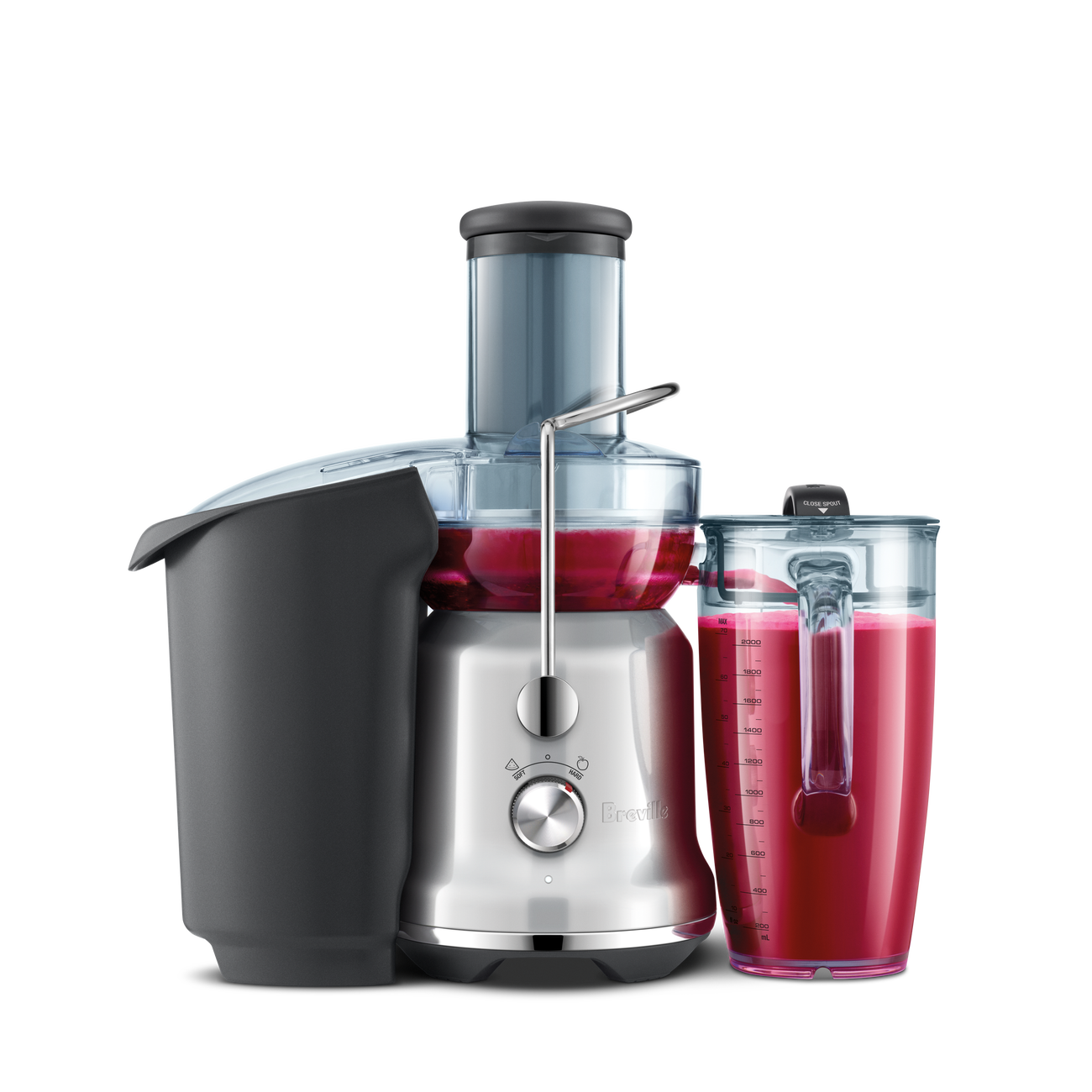
Explore this need in the finder →The Juice Fountain Fresh BJE440 is the largest-batch ANZ member of Breville’s refreshed Fresh centrifugal family. Its manufacturer page lists a 2 L sealing jug, a 3.4 L pulp container, an 84 mm feed chute, two speeds and a supplied nozzle for filling a cup. The linked ANZ manual identifies a 1,250 W motor and the model’s handling limits. This review describes SKU BJE440SIL4IAN1, not an established U.S. electrical version or buying offer.
The meaningful step up is container size
Compared with the Fresh 95 BJE420, the BJE440 adds 0.6 L of jug capacity and 0.4 L of pulp capacity while retaining the 84 mm chute, two-speed control and nozzle. Its jug label of 2 L converts to about 67.6 U.S. fluid ounces, so it is larger than a 34 fl oz batch but does not meet a strict 70 fl oz requirement. Container capacity is not an estimate of juice yield: actual yield depends on the produce, how it is prepared and how it is fed.
The extra container volume is useful only if it fits your serving pattern and counter. The product page lists the body at 46 × 21.7 × 43.1 cm (W × D × H). The pulp collector is an external side bin, not a built-in reservoir. Leave room at the side for the bin, in front for the jug, above for the pusher and around the assembly for removal and cleaning. A parked-body measurement does not include those working clearances.
Its dual speeds are labeled SOFT and HARD in the manual. Breville describes matching the speed to produce; the ingredient guide gives examples and should take priority over guessing from hardness alone. The wide chute reduces preparation for some items, but citrus must be peeled and stone fruit pitted. Breville’s 1,250 W rating describes electrical input, not tested extraction speed or a guaranteed advantage in yield over the BJE420 or another juicer.
Plan for the manual’s operating rhythm
The booklet advises one minute of motor rest between uses, limits carrot processing to 3 kg at a time and gives 5 kg of beetroot over two minutes as an example of anticipated heavy loading. For a sustained session, follow those limits rather than assuming that a 2 L jug makes the appliance a continuous-duty machine. Let the motor reach speed before feeding, use the supplied pusher, and avoid forcing hard ingredients down the chute. If the unit overheats or its overload protection operates, follow the manual’s stop, unplug and cooling directions.
The included nozzle can be fitted over the outlet to direct juice into a cup instead of the jug. The jug lid includes a froth separator, and Breville says sealed juice can be chilled in the jug for up to three days. That is the maker’s instruction, not a guarantee for every mix or a substitute for proper refrigeration. The separate pulp bin is also a practical decision: it carries capacity for a substantial session, but it occupies side space and must be emptied before it overfills.
Cleaning is still part of a fast juicer routine
The manual lists the cover, filter-bowl surround, jug and lid, pulp bin, nozzle and food-pusher pieces as dishwasher-safe; the micro-mesh basket is limited to the top rack. Rinse wet pulp away soon after juicing and brush the mesh while it is still moist. Dried fiber is harder to remove and can block the fine openings. Wipe the base instead of immersing it, and handle the basket carefully because its cutting blades are sharp. The dishwasher list does not remove the work of checking every mesh hole and drying the parts.
Do not confuse this with a U.S. BJE440
Breville’s U.S. support record identifies the BJE440 Fresh and lists the silver item number BJE440SIL1ANA1. It still provides no U.S. instruction book or product specifications, and its product-image field is a generic unavailable placeholder. The facts here come from the Australian product page and ANZ manual, which explicitly instructs connection to a 220/240 V outlet. Do not transfer this configuration’s motor rating or accessory set to a U.S. unit merely because the parent model code matches. This ANZ SKU remains a regional reference, not a U.S. buying match.
For a U.S. shopper seeking a large batch, compare the current BJE530 Cold Plus, whose U.S. documents list a 70 fl oz jug, a two-speed control, rear pulp bin and direct-cup nozzle, or the BJE830 Cold XL if a variable dial and dedicated Quiet position matter. The BJE440’s 2 L is not the same as the BJE530’s 70 fl oz label, though the latter is slightly larger by nominal volume. Review each U.S. model’s exact manual for basket care, footprint and speed guidance rather than carrying over the Fresh edition’s claims.
Bottom line
The ANZ BJE440 is the Fresh range’s larger jug-and-bin configuration, not a different extraction method. Its 2 L jug is the clearest distinction over the BJE420; its chute, two speeds, nozzle and external side-bin routine remain familiar. If that is your target, the regional version still needs the correct local power supply. Breville’s U.S. support record lists BJE440SIL1ANA1 as a silver item number, but without a local manual or feature specification that code cannot establish equivalence with the ANZ appliance.
Key details at a glance
| Extraction method | Centrifugal fruit-and-vegetable extractor |
|---|---|
| Included juice receiver capacity | 67.6 fl oz |
| Pulp bin placement | External side bin |
| Published feed-chute width | 3.31 in |
| Speed control | Two speeds |
| Motor electrical rating | 1250 W |
| Listed width | 18.11 in |
| Listed depth | 8.54 in |
| Listed height | 16.97 in |
| Juice jug and lid dishwasher-safe | Yes |
| Filter basket dishwasher-safe | Yes |
| Cleanup note | The manual lists the removable parts as dishwasher-safe and limits the filter basket to the top rack. Rinse the basket promptly and use the supplied brush; the motor base is wiped, not immersed. |
| Supplied cup nozzle | Yes |
| Published feed-chute width (metric) | 84 mm |
| Jug capacity (metric label) | 2 L |
| Pulp collector capacity | 3.4 L |
Use the exact model’s instructions for operating limits, supplied equipment and version differences.
Sources for this assessment
Now check the model against your kitchen.
Use the finder for extraction style, batch, cleanup, control, and counter-fit requirements.