
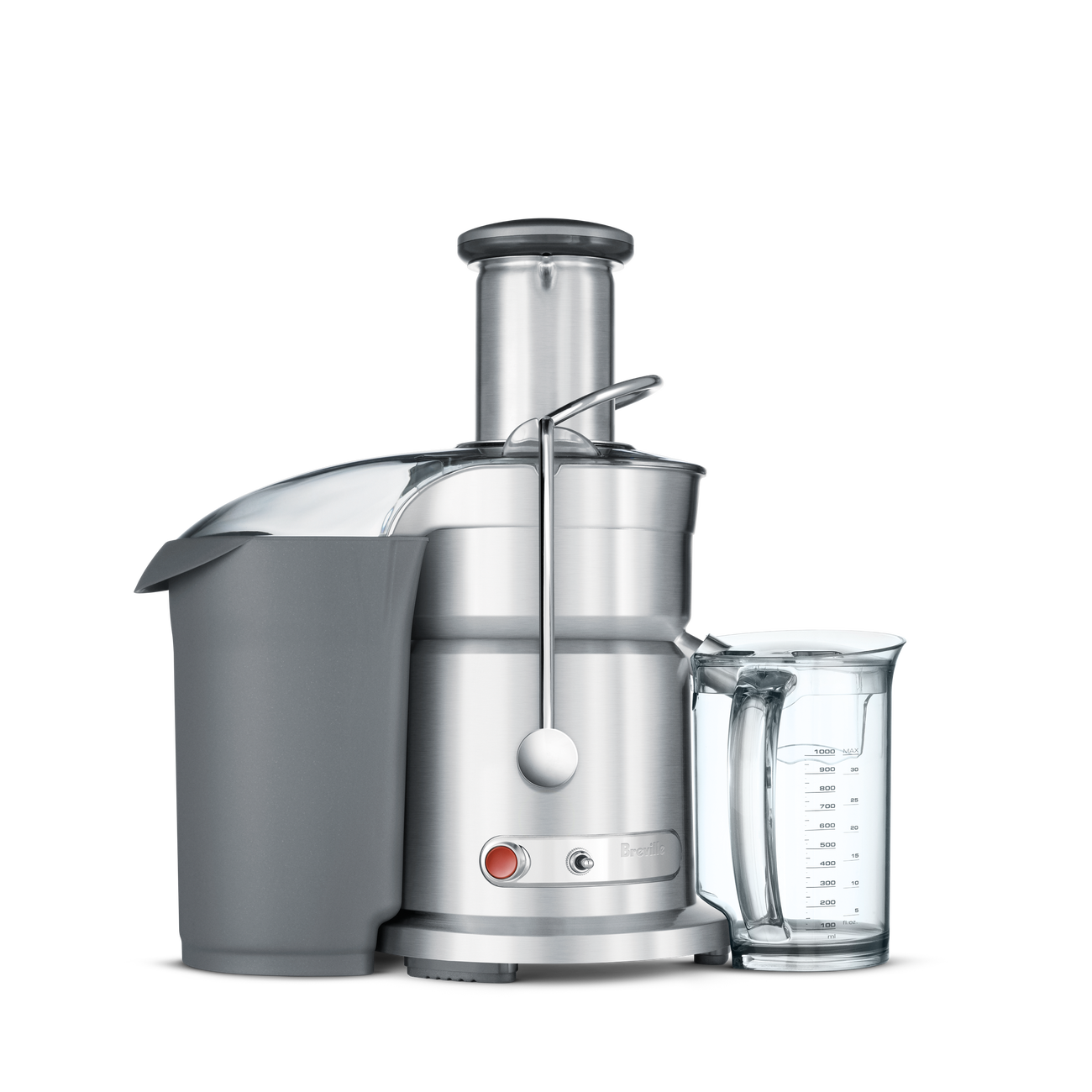
Your needs, this model
Does it fit your priorities?
Would the manual’s 34 fl oz (1 litre) jug meet your starting batch size?
Breville’s U.S. booklet labels the supplied jug 34 fl oz (1 litre); the product page calls it 1.1 qt. Either label puts it well below the 70 fl oz Cold-series jug tier.
Explore this need in the finder →Does a simple two-speed switch fit the produce you juice?
The manual directs softer produce to Low and harder produce to High. The selector is not a variable dial, and the maker does not name it Quiet.
Explore this need in the finder →Is a published 3-inch feed chute enough for your preparation routine?
Breville lists a 3-inch chute and gives apples, carrots, tomatoes, and peeled oranges as examples. You still need to prepare hard skins and pit stone fruit as the manual directs.
Explore this need in the finder →Is a supplied nozzle for juicing directly into a cup essential?
The reviewed 800JEXL U.S. product/manual record does not confirm a supplied cup nozzle. If that accessory is essential, this model cannot satisfy the need without exact offer evidence.
Explore this need in the finder →The Breville Juice Fountain Elite 800JEXL is a two-speed centrifugal juicer for people who want a wide feed chute and a real collection jug, but do not need the very large pitcher found on Breville's Cold models. Its documented strengths are straightforward: a 3-inch chute, a stainless-steel cutting-and-filter assembly, two produce-specific speed ranges, and a 34 fl oz jug in the instruction booklet. The tradeoffs are equally practical: this is still a noisy, fast-spinning disc machine, the jug is not a 70-ounce batch vessel, and its mesh basket needs prompt attention after juicing.
Wide feeding helps, but does not remove preparation
Breville calls the chute 3 inches wide and gives apples, carrots, tomatoes, and peeled oranges as examples that can fit whole. That opening can reduce cutting but does not guarantee every item fits untouched. The manual still calls for washing, peeling hard or inedible skins such as pineapple and melon, and pitting stone fruit. Citrus should be peeled before it goes through the extractor. If your routine mainly involves halved oranges or lemons, a dedicated citrus press is a more direct tool; the Elite is for feeding prepared fruit and vegetables through its chute.
The U.S. product page describes a titanium-reinforced cutting disc and an Italian-made micro-mesh filter basket. The manual calls the removable part a stainless-steel Nutri Disc and warns that its teeth and blade are sharp. Breville rates the motor at 1000 watts and advertises speeds up to 13,000 rpm. Those are equipment specifications and maker statements, not a measured guarantee of juice volume, texture, nutrient retention, or durability.
Two speeds create a simple operating plan
The selector has Low and High, with the manual steering softer fruits and vegetables toward Low and denser produce toward High. For mixed loads, it advises starting with softer ingredients and moving to harder ones. Feed gradually and guide food with the supplied pusher rather than forcing it: the troubleshooting page advises a slower push if the motor seems to stall, the appropriate speed for hard items, and cleaning the mesh if pulp is wet or juice flow drops. Leafy herbs and sprouts can be wrapped together or fed between other ingredients as a bundle. This is useful control, but it is not a variable dial, a separately named Quiet mode, or a cold-press setting.
The shopper choices should reflect those limits. A requirement for a centrifugal fruit-and-vegetable machine fits this model; a citrus-only requirement does not. A published minimum chute width of 3 inches fits, but a 3.5-inch minimum does not. The two-speed choice fits, while an essential variable-speed dial or a maker-described lower-noise setting is not documented for this model. The booklet describes a 34 fl oz (1 litre) jug; the current U.S. page rounds the vessel description to 1.1 quarts. That is a modest collection size, not the 70 fl oz pitcher supplied with the BJE430, BJE530, and BJE830. The 3.2-quart pulp container is a separate bin, not extra juice capacity.
Measure the assembled footprint and plan the rinse
Breville lists the Elite at 12 by 13.1 by 10.6 inches in width-by-depth-by-height order. Use that as the maker's published dimension, not a substitute for checking your own counter, cabinet clearance, jug position, and access to remove the pulp container. The tall feed chute and pusher need working room above the body; the outlet also needs space for the included jug. The product page lists a froth separator in that jug, while the booklet labels its capacity as 34 fl oz (1 litre).
The manual's cleaning sequence is central to owning a fine-mesh extractor: turn the machine off, unplug it, disassemble it, and rinse the removable pieces soon after a batch so pulp does not dry into the screen. Use the included nylon brush on the inside of the filter basket and check the pores against the light. The booklet says the cover, filter-bowl surround, pulp container, Nutri Disc, and jug can go on the dishwasher's top rack; it specifically says the food pusher is not dishwasher-safe. Wipe the motor base with a damp cloth. If pulp begins to block the screen, the manual recommends soaking the disc in hot soapy water for about ten minutes before brushing. These instructions are more useful than assuming that “dishwasher safe” means every part can be left dirty until the next cycle.
Where it fits among Breville's extractors
The Elite is closest in routine to the Juice Fountain Plus JE98XL: both are centrifugal machines with a 3-inch chute and two speeds. The 800JEXL has a 1000-watt rating; the Plus is rated at 850 watts, but that difference alone does not establish better extraction. Their jug labels are close, and both suit a household that pours a few glasses rather than filling a large pitcher. The BJE530 Cold Plus is a better fit if you need its 70 fl oz jug, published 3.5-inch chute, rear pulp bin, and maker-described lower-noise Low speed. It is also a taller, larger installed setup. Choose among them by collection size, space, and cleanup—not by the Elite name or motor wattage alone.
Bottom line
Consider the 800JEXL when two fixed speeds, a documented 3-inch chute, a moderate jug, and a stainless disc-and-mesh assembly match the routine you will repeat. It is a poor fit for a required 70-ounce batch, variable speed, a designated quieter setting, or citrus-only pressing. Breville's U.S. product route uses the SKU 800JEXL, while its support directory shortens the Elite entry to 800JE; use the full 800JEXL term when comparing listings and check the unit label before buying. The model name's “Elite” language is not a reason to expect a particular yield or a hands-off cleanup routine.
Key details at a glance
| Extraction method | Centrifugal fruit-and-vegetable extractor |
|---|---|
| Included juice receiver capacity | 34 fl oz |
| Published feed-chute width | 3 in |
| Speed control | Two speeds |
| Motor electrical rating | 1000 W |
| Listed width | 12 in |
| Listed depth | 13.1 in |
| Listed height | 10.6 in |
| Dedicated Quiet selector label | No |
| Juice jug and lid dishwasher-safe | Yes |
| Filter basket dishwasher-safe | Yes |
| Controls and use | Two-speed Low/High switch. The manual directs softer fruits and vegetables to Low and denser produce to High; no variable selector or Quiet label is documented. |
| Cleanup note | Rinse removable parts immediately after use. Brush the inside of the fine mesh; if pores are blocked, the manual suggests soaking the disc in hot soapy water for about 10 minutes before brushing. All dishwasher-safe parts are top-rack only; the pusher is not dishwasher-safe and the motor base is wiped with a damp cloth. |
| Manufacturer jug label | Instruction booklet: 34 fl oz (1 litre); U.S. product page: 1.1 qt. Source labels retained; not a 70 fl oz batch jug. |
| Product-page listed width; check source note | 12 in |
| Product-page listed depth; check source note | 13.1 in |
| Product-page listed height; check source note | 10.6 in |
Use the exact model’s instructions for operating limits, supplied equipment and version differences.
Sources for this assessment
- Breville U.S. Juice Fountain Elite product page, SKU 800JEXL
- Breville U.S./Canada 800JE instruction booklet, covering 800JEXL series, Issue E15
- Breville U.S. centrifugal juice extractor support directory; Elite key 800JE
- Breville U.S. juicer shopping directory; Elite SKU 800JEXL
- CPSC recalls and product safety warnings search
Now check the model against your kitchen.
Use the finder for extraction style, batch, cleanup, control, and counter-fit requirements.