
Your needs, this model
Does it fit your priorities?
Is a centrifugal fruit-and-vegetable extractor what you need, rather than a citrus cone press?
The exact JE2200B listing identifies a fruit-and-vegetable extractor with a cutter and strainer; it is distinct from the maker’s CJ625/CJ630-2 citrus presses.
Explore this need in the finder →Is one on/off switch enough, or do you need selectable speed?
The exact listing and JE2200-family booklet document on/off operation, not a variable- or multi-speed selector.
Explore this need in the finder →Would an included 300 mL juice cup work for your serving size?
The page lists a small 300 mL pitcher, about 10.14 U.S. fl oz; its separate 28 oz container collects pulp, not juice.
Explore this need in the finder →Does standard dishwasher-safe cleanup fit, or is a high-heat SANI cycle essential?
The exact page says removable parts are dishwasher-safe and the family booklet specifies top-rack-only washing; neither source establishes SANI-cycle approval.
Explore this need in the finder →Can your routine stop to empty pulp without a timed session limit, or must a minimum uninterrupted run be documented?
The family booklet tells users to stop, unplug, empty the nearly full pulp container and clean the cutter/strainer, but does not give a numeric continuous-run interval.
Explore this need in the finder →Will the listed 13-inch body width fit, and is the axis documented?
The exact page names width 13 inches and height 9 inches; it calls the 9-inch third measure length, not depth.
Explore this need in the finder →Is the listed 9-inch height enough, or is a separately named depth measurement essential?
The exact page names height as 9 inches and the other 9-inch dimension as length. It does not publish a depth axis, so the two measures are not interchangeable.
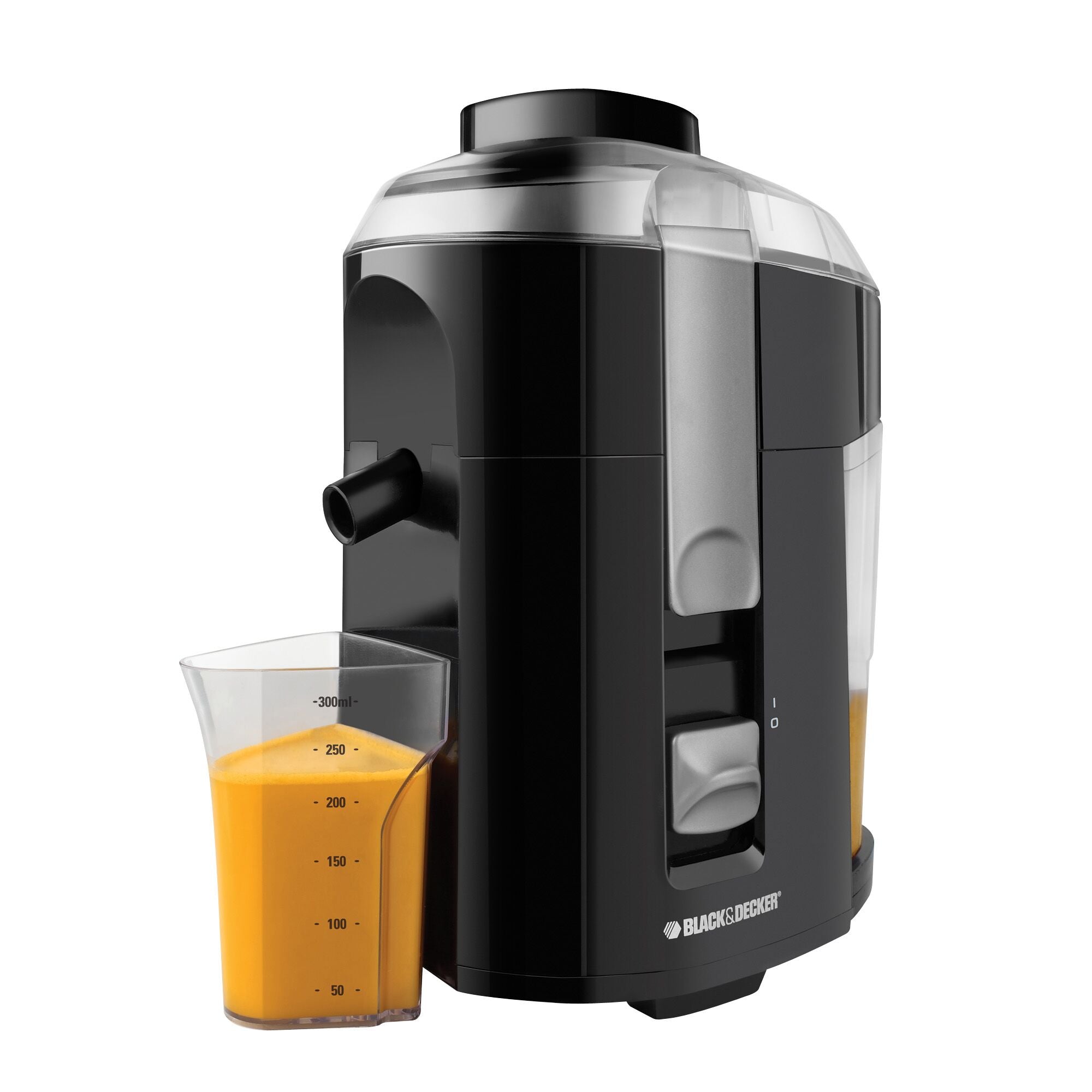
Explore this need in the finder →The BLACK+DECKER JE2200B is a corded fruit-and-vegetable juicer with one on/off switch, a stainless-steel cutter and strainer, and a surprisingly small 300 mL juice cup. Its separate 28-ounce container is for pulp, not a large pitcher for juice. That distinction matters: this model may suit a single small serving of juice from produce, but it is not a convenient one-pass batch machine just because the pulp collector is larger.
Read the two container sizes as different jobs
The manufacturer lists a 300 mL pitcher beneath the spout. That is about 10.1 U.S. fluid ounces, so it is a small receiver: pour into another vessel or empty it if you are making more than one glass. The same page describes a 28-ounce container for separated pulp. Do not treat that larger number as juice capacity or expected yield. The page publishes capacity, not how much juice any chosen apple, carrot, tomato, or other ingredient will produce.
For someone who usually wants a single modest serving and prefers a supplied cup, this difference may be welcome. If several people share juice, a larger pitcher becomes a more meaningful requirement than the 28-ounce pulp bin. The JE2200B does not meet a 32-ounce juice-receiver minimum; the small cup and pulp collector serve separate purposes.
A straightforward centrifugal routine
BLACK+DECKER describes a 400 W fruit-and-vegetable extractor with a simple on/off control. The original JE2200 family booklet shows the working stack: pulp separator, rotating stainless cutter/strainer, removable pulp container, clear cover and both locking latches. It also identifies JE2200B parts in the diagram, although the cover is marked JE2200 rather than JE2200B. It is a relevant family booklet, not a guarantee that every retail bundle or electrical variant is identical.
Cut produce to fit the chute and use the supplied pusher gently. The manual recommends feeding carrots one at a time with light pressure. It also notes that avocado and banana turn into puree rather than juice, which is a useful boundary when planning recipes. There is no published chute-width measurement, so a hard minimum opening cannot be confirmed, and the word “extractor” should not be read as a promise that whole fruit fits.
There is only an on/off switch, not a low/high or variable-speed selection. If you want to adjust speed for different produce, this is not the documented setup. Likewise, neither the page nor the booklet gives a numerical continuous-running time. The manual instead tells you to switch off and unplug when the pulp container is nearly full, empty it, and clean the cutter/strainer before continuing. That is an interruption point, not a timed session rating.
Plan for its small juice cup and cleaning rhythm
The cup marked 300 mL appears under the outlet in the official product image, and the manufacturer page lists that capacity. It is a practical small-serving vessel rather than a sealed storage jug; no lid for refrigerator storage is identified. The separate pulp bin is removable, but its capacity does not solve the need to transfer juice when the cup fills.
The product page says removable parts are dishwasher-safe. The JE2200-family instructions narrow that advice to the top rack and say to wipe the motor base with a damp cloth instead of immersing it. They also warn that the cutter/strainer teeth are sharp. Prompt cleaning matters in practice: the manual says to clear the strainer when emptying a nearly full pulp collector, and notes that carrots or beets may discolor parts over time. The page's broad dishwasher claim should not be read as permission to put the base in a dishwasher or use an unlisted high-heat cycle.
Measure the counter space rather than guessing
BLACK+DECKER lists the body as 13 inches wide, 9 inches long and 9 inches high, with a 5.6-pound weight. The page calls its vertical arrangement space-saving, but a 13-inch listed width is still worth checking against your counter. The manufacturer calls the front-to-back value “length,” so it is not automatically a published depth measurement for a tight cabinet fit. Leave room to feed cut produce, place the cup, access the pulp container and remove the top assembly. No feed-chute width or numeric working footprint is stated.
The page and family booklet both list a two-year limited warranty. The booklet prints electrical data for more than one supply variant, while the current U.S. page gives the exact JE2200B identity and 400 W but no voltage or frequency. If your purchase depends on a specific electrical label, verify the unit’s own rating rather than assigning one of the booklet’s regional values to every suffix.
Who should consider it?
Choose the JE2200B when you want a simple centrifugal fruit-and-vegetable routine, one switch is enough, a small cup is useful, and washing removable parts matters. In the finder, select centrifugal extraction, single-speed on/off and dishwasher-safe removable parts. Do not select it for a 32-ounce juice jug, a measured chute minimum, a documented quiet mode, a hard depth ceiling or a timed continuous-run requirement: those details are absent or too small for the stated threshold.
If your main task is squeezing citrus halves, compare a dedicated cone press such as the BLACK+DECKER CJ625 or CJ630-2; those do not replace the JE2200B for apples and carrots. If several servings at once or selectable speed matters more, compare a centrifugal model with a larger documented juice pitcher and controls that match your routine. This assessment draws on the exact U.S. JE2200B product page and the original Applica/Spectrum JE2200 family use-and-care booklet; it does not claim hands-on yield, noise or durability testing.
Key details at a glance
| Extraction method | Centrifugal fruit-and-vegetable extractor |
|---|---|
| Included juice receiver capacity | 10.14 fl oz |
| Speed control | Single-speed on/off |
| Motor electrical rating | 400 W |
| Listed width | 13 in |
| Listed height | 9 in |
| Dedicated Quiet selector label | No |
| Juice jug and lid dishwasher-safe | Yes |
| Filter basket dishwasher-safe | Yes |
| Controls and use | The exact page documents an on/off switch; the family booklet also shows a single I/0 switch. No variable-speed or multi-speed control is documented. |
| Manufacturer jug label | Exact U.S. page lists a 300 mL juice pitcher (about 10.14 U.S. fl oz); this is vessel capacity, not juice yield. |
| Fast/firm juicing guidance | Neither exact page nor the JE2200 family booklet publishes a numeric continuous-run interval. Manual guidance is to stop, unplug, empty the nearly full pulp collector and clean the cutter/strainer before continuing. |
| Jug capacity (metric label) | 0.3 L |
| Pulp container capacity | 28 oz |
| Body-fit measurement note | Exact U.S. product page gives H 9 in, L 9 in, W 13 in. Depth is unknown; leave workspace for produce feeding, cup, pulp container, cord and disassembly. |
| Electrical-rating caveat | The exact U.S. product page lists 400 W. Family booklet also lists 400 W for its regional variants, but exact JE2200B voltage/frequency are not assigned from that family panel. |
| Removable parts dishwasher-safe per manual | Yes |
Use the exact model’s instructions for operating limits, supplied equipment and version differences.
Sources for this assessment
- BLACK+DECKER U.S. exact JE2200B product page
- Applica/Spectrum JE2200-family use-and-care booklet; cover model JE2200, B-specific component list
- Exact JE2200B gallery image 1, product and 300 mL cup
- Exact JE2200B gallery image 2, cutter/strainer and pulp collector
- Exact JE2200B gallery image 3, pulp-bin detail
- Official exact page manual link and ToolServiceNet lookup
- CPSC recall model search/status reference
- Stanley Black & Decker ServiceNet exact public search for JE2200B


Now check the model against your kitchen.
Use the finder for extraction style, batch, cleanup, control, and counter-fit requirements.