
Your needs, this model
Does it fit your priorities?
Are you mainly pressing halved citrus rather than juicing apples, vegetables, or leafy greens?
The CJ650W is an electric citrus cone. The manual calls for halving fruit and pressing it onto the cone; it does not describe a produce feed chute.
Explore this need in the finder →Would a 32-ounce-marked pitcher and adjustable pulp opening suit your usual citrus batches?
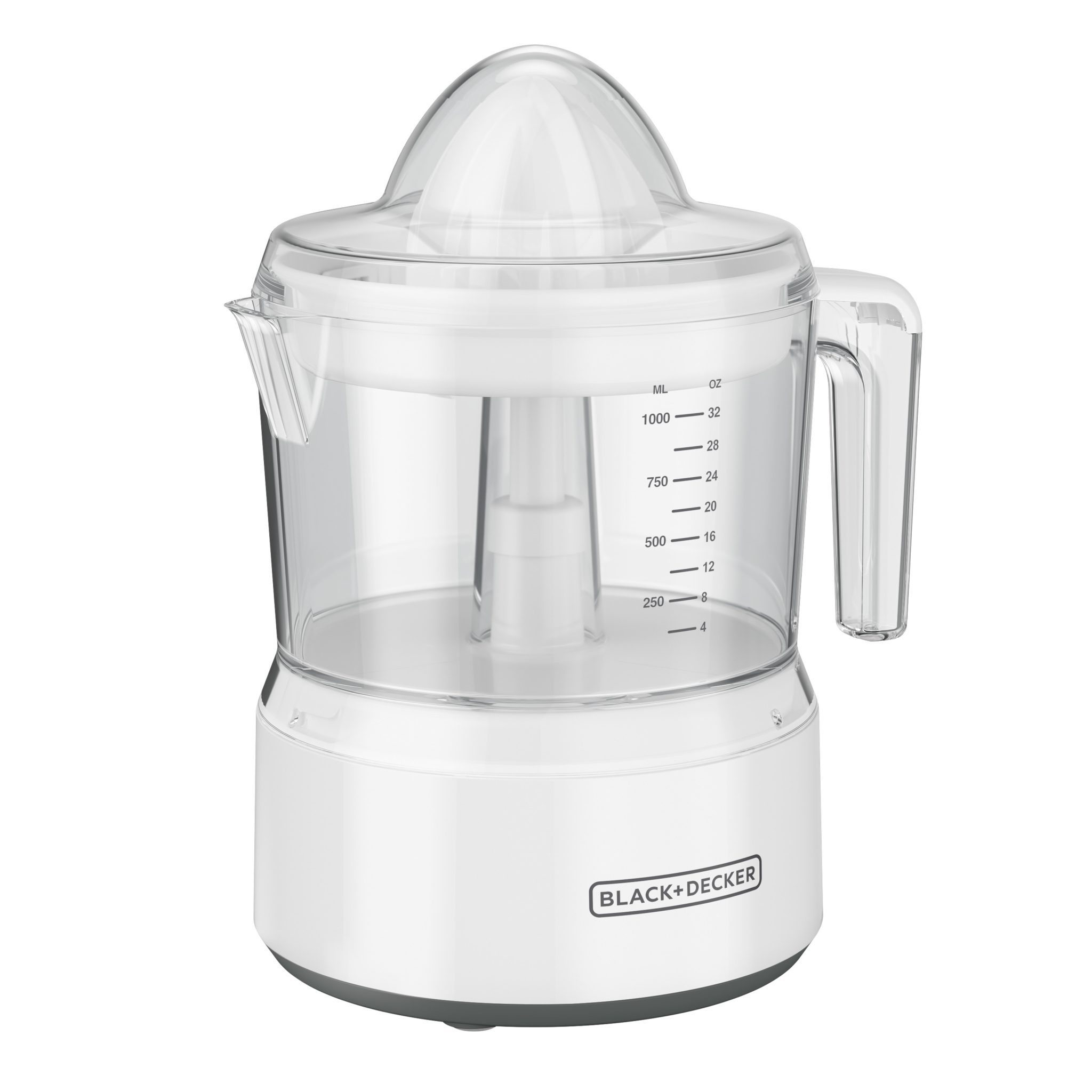
The manual and official gallery pair a 32-ounce / 1-liter receiver with an adjustable pulp basket. The text shows more/less pulp, not calibrated levels.
Explore this need in the finder →Do you need the manual-supported ten-minute operating interval, but not a longer uninterrupted run?
The maker booklet says not to operate it for more than ten minutes at a time; a longer interval is not supported.
Explore this need in the finder →Is a verified 120 V / 60 Hz rating essential for your kitchen?
The archived exact CJ650W table prints 120 V ~50 Hz. This assessment does not assume 60-Hz compatibility from the different CJ650M family.
Explore this need in the finder →The CJ650W is not a general-purpose juice extractor. It is a small electric reamer for people who regularly cut citrus in half and want a marked pitcher beneath the cone. That distinction matters more than the motor rating: this machine is for lemons, limes, oranges, and grapefruit, not whole apples, leafy greens, or carrots. A U.S. retailer lists the white 32-ounce CJ650W by that exact model code; the BLACK+DECKER/Spectrum booklet describes a 32-ounce (1-liter) citrus juicer and a two-year U.S./Canada limited warranty. Treat the model as an earlier U.S. product rather than assuming an online listing means it is in stock.
Press halves; do not expect a feed chute
Use is simple but hands-on. The instructions call for locking the receiver on the base, fitting the cone and pulp-control basket together, plugging in the machine, then pushing a cut citrus half down onto the cone. That pressure starts the motor; releasing the fruit stops it. The manual describes a dual-purpose cone for small citrus such as limes and larger fruit such as grapefruit, and the motor reverses direction at intervals and when pressure is released and applied again. This can make alternating halves less monotonous, but it does not turn the appliance into an automatic press: each fruit still has to be cut, held, and pressed.
Ask yourself whether citrus is the job. If you want carrots, apples, celery, or greens, choose a centrifugal or auger-style juicer instead. If repeated hand pressure is the part you dislike, compare a lever press that moves the load to a handle, or a machine that feeds prepared produce. The CJ650W’s narrow purpose is also its practical advantage: there is no large extractor assembly to manage when you only want a pitcher of citrus juice.
A receiver marked for a modest batch
The manufacturer booklet labels the vessel “32 oz.” and “1 liter,” while the official product image shows graduations through 1,000 mL and 32 oz. Those are the maker’s paired marks, not a measurement of juice yield. For strict questionnaire matching, this review uses the 32-ounce label: it supports a 32-ounce minimum, not a 34-ounce minimum. A pitcher is useful for collecting juice before pouring, but if you are pressing for a crowd you may need to empty it or use another container. The booklet does not promise how many fruits or servings one fill will take, and citrus size and juiciness vary.
Adjustable pulp, with a manual cleanup step
The pulp-control basket adjusts by changing the opening, and the instructions illustrate “less pulp” and “more pulp.” That is a real choice, but it is not a calibrated low/medium/high dial or a promise of a particular texture. If a named setting is essential, this model does not document one. The manual caps use at ten minutes at a time; that is an operating ceiling, not a tested yield figure. The small removable parts—the cover, cone, pulp basket, and juice vessel—may be washed on the dishwasher’s top rack. Wipe the motor base with a damp cloth; do not immerse it. Separating the cone from the basket before washing helps expose the contact surfaces, and unplug the unit before assembly, disassembly, or cleaning.
One electrical detail deserves a check
The archived Spectrum Brands booklet’s rating table prints “CJ650W 120V ~50Hz 30W.” A separate manufacturer booklet for the CJ650M family says 120 V / 60 Hz, but that is a different model code and should not be silently substituted. Since 50 Hz is unusual in a U.S. household context, confirm the rating label on the exact unit and its compatibility with your supply before buying or using it; this assessment does not claim that the CJ650W is verified for 60-Hz operation. No reliable dimensions, weight, noise, or yield figures are published with this model information. If counter fit or recall status is decisive, verify those details against the exact unit and current safety notices; do not infer them from another CJ650 variant.
Who should consider it?
Consider the CJ650W if your routine is mostly citrus, a 32-ounce-marked receiver is adequate, and you are comfortable pressing each half by hand. Its pressure activation and reversing cone simplify the sequence, while adjustable pulp capture gives you some control without a sophisticated setting system. The booklet’s dishwasher instructions are helpful, but they do not make the motor base washable. The ten-minute limit also makes this a small-batch appliance rather than a choice for uninterrupted commercial service.
Choose another type if you want one appliance for citrus and vegetables, need a feed chute, want an exact pulp level, or require a verified 60-Hz rating without checking the unit label. A manual lever press may better fit someone avoiding repeated wrist pressure; a larger citrus model may be more useful if pitcher volume and counter dimensions are essential, but compare exact manuals rather than assuming related BLACK+DECKER models share them. The CJ650W is a narrowly useful option, not a universal juicer.
Key details at a glance
| Extraction method | Dedicated citrus reamer or cone press |
|---|---|
| Included juice receiver capacity | 32 fl oz |
| Adjustable citrus pulp control | Yes |
| Speed control | On/off with pressure-activated cone |
| Motor electrical rating | 30 W |
| Juice jug and lid dishwasher-safe | Yes |
| Controls and use | The motor starts when a halved citrus fruit is pressed onto the cone and stops when pressure is fully released; automatic reversal occurs from time to time and after pressure is released and reapplied. No selectable speed control is documented. |
| Manufacturer jug label | Manufacturer labels the receiver 32 oz / 1 liter and graduates its gallery image to 32 oz / 1,000 mL; retain the stated 32-ounce threshold rather than converting the rounded pairing to 34 fl oz. |
| Fast/firm juicing guidance | The manual says not to operate the unit for more than ten minutes at a time; this is a stated ceiling, not an extraction-yield test. |
| Jug capacity (metric label) | 1 L |
| Maximum continuous run listed by maker | 10 min |
| Electrical-rating caveat | Spectrum's exact-model table prints 30 W alongside 120 V ~50 Hz for CJ650W. |
| Manufacturer-listed voltage | 120 V |
Use the exact model’s instructions for operating limits, supplied equipment and version differences.
Sources for this assessment
- Spectrum Brands-hosted BLACK+DECKER CJ650 use-and-care booklet
- BLACK+DECKER regional CJ650W product page
- Home Depot U.S. CJ650W product detail page
- Spectrum Brands BLACK+DECKER product-manual index
- BLACK+DECKER CJ650M-family use-and-care booklet
- BLACK+DECKER CJ650-series use-and-care booklet
- Manufacturer CJ650W catalog image
- CPSC recall reconciliation for CJ650W

Now check the model against your kitchen.
Use the finder for extraction style, batch, cleanup, control, and counter-fit requirements.