
Your needs, this model
Does it fit your priorities?
Are you mainly pressing halved citrus instead of feeding apples, carrots, or leafy greens?
The official CJ650M instructions describe halved citrus pressed onto a cone; they do not describe a feed chute or vegetable extraction mode.
Explore this need in the finder →Would a receiver marked 32 ounces meet your minimum batch-container size?
The manual labels the receiver 32 oz / 1 L. That supports a 32-ounce minimum, but not a strict 34-ounce minimum or a claim about juice yield.
Explore this need in the finder →Do you want an adjustable pulp opening rather than a fixed strainer?
The manual shows a user-adjusted opening for less or more pulp, without calibrated low/medium/high positions.
Explore this need in the finder →Do you need a documented continuous-use interval of at least ten minutes?
The manual says not to operate it for more than ten minutes at a time; a longer interval is not supported.
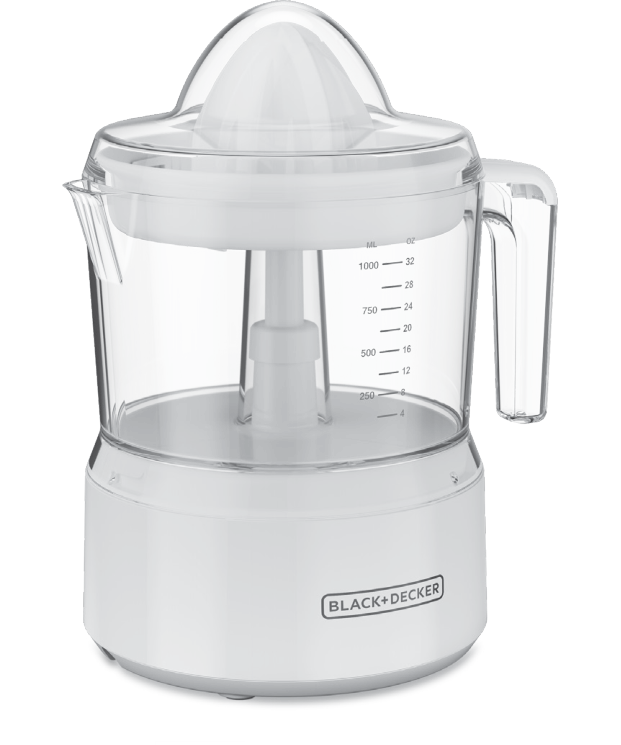
Explore this need in the finder →The BLACK+DECKER CJ650M family is a small electric citrus reamer, not a general fruit-and-vegetable juicer. Its official use-and-care booklets document the base CJ650M and later CJ650M-1, CJ650M-2, and CJ650M-3 codes. The manuals describe the same basic setup: a 32-ounce (1-liter) receiver, a reaming cone, an adjustable pulp basket, and a pressure-started motor that reverses direction. They do not explain what changes between the suffixes, so this review treats them as one documented operating family rather than inventing a color, package, or finish difference.
Best for a citrus routine
Each fruit must be cut in half and pressed against the cone. The motor starts under pressure and stops when you release it. The manual says the cone works with small citrus such as limes and larger fruit such as grapefruit, and describes automatic reversal from time to time and when pressure is lifted and reapplied. That gives the unit a straightforward rhythm for a pitcher of lemon or orange juice, but it is still a hand-guided process: you prepare and position each half yourself. There is no feed chute for apples, carrots, celery, or leafy greens, and no documented setting for extracting other produce.
If you want one appliance for mixed produce, compare a centrifugal or auger juicer instead. If repeated hand pressure is the part you want to avoid, a lever-style citrus press may be a better match. The CJ650M's advantage is narrower: it concentrates on halved citrus and uses a fairly simple assembly rather than a large extractor with a pulp bin and produce chute.
A marked pitcher, not a yield promise
The manual labels the receiver 32 oz / 1 liter. That is a useful batch-size reference, but not a promise that one run will yield a full pitcher; fruit size, ripeness, and how thoroughly each half is reamed change the result. For a firm minimum, the documented 32-ounce mark supports a 32 fl oz receiver choice. It does not meet a strict 34 fl oz minimum. If you need more volume, plan on emptying the vessel or compare a larger exact-model receiver rather than assuming another BLACK+DECKER citrus model has the same one.
The pulp basket can be adjusted by holding it steady and rotating the cone assembly. The illustration distinguishes “less pulp” and “more pulp,” but it does not define calibrated low, medium, and high levels or a guaranteed texture. It is a useful simple adjustment, not a precision control.
Short, hands-on sessions and easy-to-miss limits
The maker says not to operate the unit for more than ten minutes at a time. That is a ceiling for a continuous interval, not a measured serving count or evidence of commercial duty. For a typical household citrus batch, the more relevant practical questions are whether you are willing to halve and press fruit individually and whether the 32-ounce marked receiver is large enough for the occasion.
For cleanup, the official manual allows the cover, cone, pulp-control basket, and receiver on the dishwasher's top rack. It says to wipe the base with a damp cloth and not immerse it. Unplug before assembly, disassembly, or cleaning. Separating the cone from the pulp basket before washing exposes the parts that collect the most citrus pulp; do not treat a dishwasher-safe attachment as permission to wash the motor base.
Keep the model codes and electrical rating straight
The exact CJ650M booklet prints 120 V, 60 Hz, and 30 W. A later official series manual lists CJ650M-1, -2, and -3 with that same rating and shared instructions. This is not the same evidence as the separate CJ650W manual, which prints 120 V / 50 Hz. Do not transfer a rating from one suffix to another: if you are evaluating an old or stored unit, check its own nameplate before plugging it in. The M-family booklet also describes a two-year U.S./Canada limited warranty, but that dated warranty language does not establish present coverage for an old-stock or secondhand unit.
The maker manual illustration is marked as a representation and says the product may vary slightly from what is shown. It is a useful identification aid, not proof that every suffix has the illustrated finish. The sources reviewed here do not establish current retail stock, exact dimensions, weight, noise, juice yield, or an exact CPSC recall disposition for these model codes. Those unknowns matter if availability, lifting, counter clearance, noise, or safety status is essential.
Who should consider it?
Consider the CJ650M family when your priority is a basic electric citrus cone, adjustable pulp capture, and a receiver marked for 32 ounces, and you are comfortable pressing prepared fruit by hand. It is a poor fit if you want to feed whole produce, need a larger marked batch vessel, require calibrated pulp levels, or depend on verified current inventory. The 2017 and 2023 manuals document a recognizable U.S.-voltage household configuration, but they are not proof of a current offer. When comparing a specific sale, check whether the nameplate is CJ650M or one of the three M suffixes, what parts are actually included, and whether the seller's condition and return terms suit an older appliance.
Within the citrus category, the Cuisinart CCJ-500P1 is a useful comparison if labeled low/medium/high pulp positions matter; the maker booklet for that model names those settings. If you prefer a simpler adjustable opening and accept the manual's less/more description, the CJ650M family is the more basic proposition. Choose on the exact model plate and documented setup, not on a shared brand name or a similar-looking illustration.
Key details at a glance
| Extraction method | Dedicated citrus reamer or cone press |
|---|---|
| Included juice receiver capacity | 32 fl oz |
| Adjustable citrus pulp control | Yes |
| Speed control | On/off with pressure-activated cone |
| Motor electrical rating | 30 W |
| Juice jug and lid dishwasher-safe | Yes |
| Controls and use | Pressing a halved fruit onto the cone starts the motor; fully releasing pressure stops it. The maker describes automatic reversal from time to time and after pressure is released and reapplied. No user-selectable speed is documented. |
| Manufacturer jug label | The manual pairs 32 oz with 1 L. For matching, retain the manufacturer's 32-ounce mark rather than treating the rounded pairing as a strict 34 fl oz capacity. Container capacity is not extraction yield. |
| Fast/firm juicing guidance | The exact manual says not to operate for more than ten minutes at a time. This is an operating ceiling, not a measured yield or recommended batch size. |
| Jug capacity (metric label) | 1 L |
| Maximum continuous run listed by maker | 10 min |
| Manufacturer-listed voltage | 120 V |
Use the exact model’s instructions for operating limits, supplied equipment and version differences.
Sources for this assessment
- BLACK+DECKER CJ650M Use and Care Manual; original model, 32 oz / 1 L configuration, U.S./Canada warranty section and rating table
- BLACK+DECKER CJ650-series Use and Care Manual for CJ650M-1/-2/-3 and separate 220-240 V CJ650W-AR/-CL editions
- Spectrum Brands BLACK+DECKER manual index
- CPSC model-specific recall status not reconciled
- CPSC exact-code recall status not reconciled
Now check the model against your kitchen.
Use the finder for extraction style, batch, cleanup, control, and counter-fit requirements.