
Your needs, this model
Does it fit your priorities?
Are you mainly pressing halved citrus rather than juicing apples, carrots, or leafy greens?
The exact CJ650 booklet describes a halved-fruit citrus cone, not a feed chute or non-citrus extraction method. Opt into earlier models to consider this documented model.
Explore this need in the finder →Would a marked 32-ounce receiver be enough for the citrus batches you plan to make?
The manufacturer labels the supplied receiver 32 oz / 1 L; this is capacity, not a promise of juice yield.
Explore this need in the finder →Do you want a simple adjustable pulp basket rather than a labeled low/medium/high selector?
The manual shows a rotating opening for less or more pulp but does not name calibrated levels.
Explore this need in the finder →Must removable citrus-juicing parts be dishwasher-safe?
The booklet permits the cover, cone, basket, and receiver on the dishwasher top rack; the motor base must be wiped and kept out of water.
Explore this need in the finder →Do you need a manufacturer-labeled low pulp setting?
The instructions show less/more adjustment only, so a named Low setting is not confirmed.
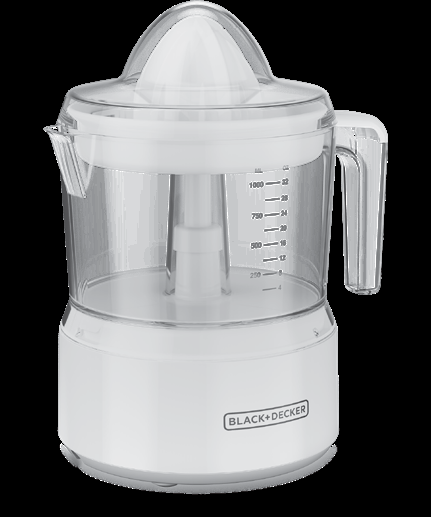
Explore this need in the finder →The BLACK+DECKER CJ650 is a small electric citrus reamer, not a general produce extractor. The maker’s support index lists CJ650 and CJ650WC separately but sends both to the same CJ650 use-and-care booklet; that booklet’s cover names CJ650 and describes a 32-ounce (1-liter) citrus juicer. This supports a shared manual-documented setup, not a claim that the suffix has the same finish, box contents, or every detail. It is also not the CJ650W or CJ650M: keep those model codes and their separate manuals distinct.
For cut citrus, not a produce chute
The documented routine is direct: lock the marked juice container onto the base, assemble the cone and pulp basket, plug in, and press a halved citrus fruit onto the cone. Pressure starts the motor; releasing pressure stops it. The booklet describes a dual-purpose cone for smaller citrus such as limes and larger fruit such as grapefruit, with automatic reversal from time to time and when you release and reapply pressure. You still halve and guide each piece yourself. There is no described feed chute or extraction method for apples, carrots, celery, or leafy greens.
That difference should drive the choice before motor wattage or a product photo does. If your routine is citrus for a pitcher or a recipe, a compact reamer can be a simpler match than a centrifugal basket or screw press. If you expect one machine to process mixed produce, choose a documented centrifugal or auger model. If using your hand to press every half is the part you want to avoid, compare a lever-style citrus press instead; the CJ650 does not document an active arm that takes over that effort.
The receiver is marked 32 ounces; yield is not
The manual labels the supplied juice container 32 oz / 1 liter and identifies it as part CJ650-04. That makes the documented setup a reasonable fit for a 32-fl-oz receiver requirement. It does not satisfy a strict 34-fl-oz minimum, and the marked vessel capacity is not a promise that a batch of fruit will fill it. Fruit size, preparation, and how much you ream affect the collected volume; no yield test or serving count is supplied.
For a large gathering, the receiver may need to be emptied between batches. Do not borrow a larger vessel figure from another citrus machine just because the product name begins with CJ650. The 32-ounce figure belongs to this booklet, while a different model’s container or listing needs its own confirmation.
Adjustable pulp, without named levels
The pulp-control basket sits beneath the cone. The booklet says to hold the basket steady and rotate the cone to adjust the opening; its diagram labels “less pulp” and “more pulp.” That is useful if you want a simple manual adjustment, but it is not a calibrated low/medium/high selector or a measured pulp percentage. If a named setting is essential, treat that requirement as unconfirmed and compare a model whose instructions explicitly label the positions.
Simple parts, with a ten-minute ceiling
The maker says not to operate the juicer for more than ten minutes at a time. That is a documented maximum interval, not an output-rate figure or evidence of commercial duty. Removable components—the cover, cone, pulp basket, and container—may be washed by hand or placed on the dishwasher’s top rack. The base is wiped with a damp cloth and must not be immersed. Unplug before assembly, disassembly, or cleaning. These instructions keep cleanup straightforward, but the unit is not “all dishwasher-safe”; the motor base stays out of the sink and machine.
Exact-code checks matter more than a similar name
The Spectrum Brands support index is useful for resolving the spelling, but it is not a current inventory page. The reviewed evidence does not establish that CJ650 or CJ650WC is currently sold, or what a particular seller would include. Check the appliance nameplate and confirm the exact model and condition before buying an older or secondhand unit. The booklet’s U.S./Canada warranty section is dated documentation, not proof of present coverage, and its electrical-rating table does not state a rating for bare CJ650. Do not transfer the separate CJ650W 120 V / 50 Hz entry—or the CJ650M family’s different rating—to this model; if voltage or frequency matters, read the exact unit’s nameplate.
The official booklet illustration is labeled as an illustration and says the product may vary slightly. The sources reviewed here also leave exact dimensions, weight, noise, extraction yield, current parts availability, and model-specific recall status unconfirmed. Do not use the illustration as a promise of color or package contents, or treat silence in the booklet as proof of a recall-free history.
Who should consider the CJ650?
It is a possible fit for a household that wants to press halved citrus, can work with a 32-ounce-marked receiver, appreciates a movable pulp opening, and accepts the hands-on routine and ten-minute limit. It is a poor match for mixed produce, a 34-ounce receiver minimum, a required labeled pulp level, verified current stock, or a fixed counter-clearance requirement. On the finder, opt into earlier models and choose citrus pressing; then apply only the requirements that the manual actually documents. For a specific offer, compare the full model code, nameplate, included parts, condition, and seller terms before relying on a common-looking CJ650 label.
Key details at a glance
| Extraction method | Dedicated citrus reamer or cone press |
|---|---|
| Included juice receiver capacity | 32 fl oz |
| Adjustable citrus pulp control | Yes |
| Speed control | On/off with pressure-activated cone |
| Juice jug and lid dishwasher-safe | Yes |
| Controls and use | Pressing a halved citrus fruit starts the motor, and releasing pressure stops it. The manual states automatic reversal from time to time and after pressure is released and reapplied; it documents no selectable speed. |
| Manufacturer jug label | The exact CJ650 booklet labels the receiver 32 oz / 1 liter. This is vessel capacity, not expected juice yield. |
| Fast/firm juicing guidance | The manufacturer says not to operate longer than ten minutes at a time; this is a use ceiling, not a batch/yield or commercial-duty rating. |
| Jug capacity (metric label) | 1 L |
| Maximum continuous run listed by maker | 10 min |
| Removable parts dishwasher-safe per manual | Yes |
Use the exact model’s instructions for operating limits, supplied equipment and version differences.
Sources for this assessment
Now check the model against your kitchen.
Use the finder for extraction style, batch, cleanup, control, and counter-fit requirements.