
Your needs, this model
Does it fit your priorities?
Do you want a dedicated citrus press rather than an extractor for apples, vegetables, or greens?
CJ630-2 is listed as an electric citrus juicer with a self-reversing reamer; no general produce feed chute is identified.
Explore this need in the finder →Would adjustable pulp collection help even without a named Low/Medium/High setting?
The exact CJ630-2 page calls out adjustable pulp control but does not list named levels or a measured result.
Explore this need in the finder →Is an included 32-ounce juice jar enough, or do you need a strict 34-ounce minimum?
The exact CJ630-2 listing calls the supplied plastic jar 32 ounces; do not apply the 1 L / rounded 34 oz label from the separate suffixless CJ630 booklet.
Explore this need in the finder →Must your removable citrus parts be confirmed dishwasher-safe for the exact suffix?
The exact CJ630-2 page does not specify dishwasher care; the CJ630 booklet available by family name does not print the -2 suffix.
Explore this need in the finder →Do you need a confirmed continuous run interval before choosing this citrus press?
No continuous-use interval appears on the exact CJ630-2 page; that requirement remains unknown for this suffix.
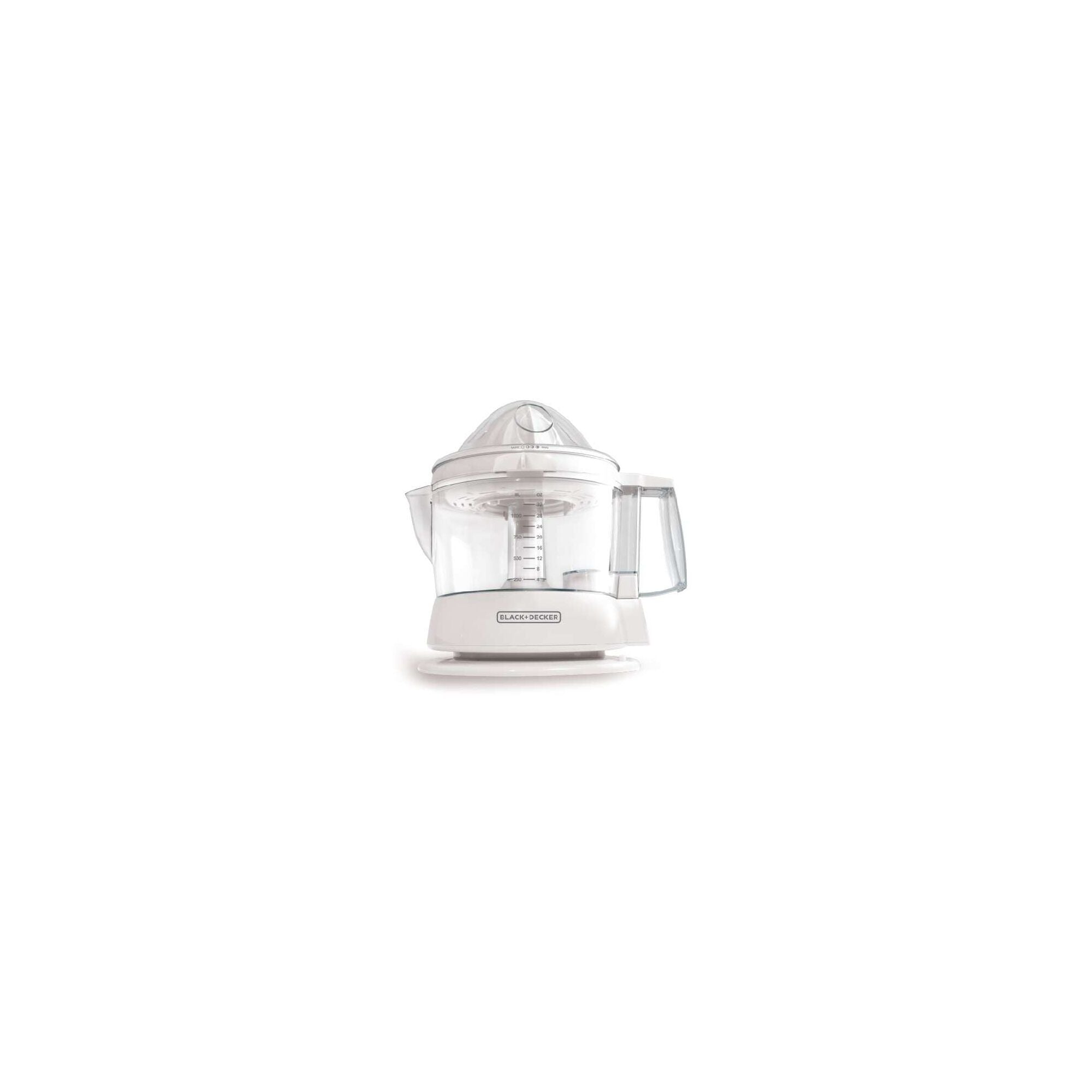
Explore this need in the finder →The BLACK+DECKER CJ630-2 is a compact electric citrus press sold with a clear, 32-ounce plastic jar. It is built for halved citrus, not for feeding apples, carrots, or leafy greens into a chute. Its case is strongest if citrus is the job, a pitcher-style receiver is useful, and adjustable pulp control matters more than a larger batch vessel or broad produce capability.
Choose it for citrus, not general juicing
The maker describes a self-reversing reamer, adjustable pulp strainer, easy-pour spout, cord wrap, and dust cover. You still have to cut each fruit in half and press the exposed side against the cone; there is no feed chute or motorized whole-fruit preparation. That makes the routine straightforward but hands-on. If your usual juice mixes apples, carrots, beets, or greens, this is the wrong process. A centrifugal or masticating extractor is designed for those ingredients; this unit has only a citrus press configuration.
The adjustable strainer gives you a way to change how much pulp passes into the jar, but the exact product listing does not give named low, medium, and high positions or a measured pulp result. Do not select it if a particular labeled setting is essential. Its self-reversing action is automatic rather than a separate speed choice, and the page does not document selectable speeds. The small and large cone arrangement is shown in the official image gallery and listed in a CJ630-family booklet, but the current CJ630-2 page text does not itemize cone sizes separately. When considering a used unit, check that its cones, jar, strainer, and cover are actually present.
Read the 32-ounce jar as a real, modest batch size
The current CJ630-2 product page calls the receiver 32 ounces and lists a plastic jar in the box. That is useful for a few glasses or a small recipe, but it is not the same as an extractor with a 50- or 70-ounce jug. Capacity is the jar’s stated volume, not a yield promise; fruit size, pulp preference, and how much you press determine the amount collected. The 32-ounce listing supports a strict 32-fluid-ounce receiver minimum, not a 34-ounce requirement. For comparison, BLACK+DECKER’s CJ625 is described with a one-liter pitcher, which converts to about 33.8 U.S. fluid ounces; that still does not clear a strict 34-ounce threshold.
The manufacturer lists the CJ630-2 at 9 inches high, 7.6 inches wide, and 7.6 inches long, and gives a listed weight of 2 pounds. The dimensions make it a compact body on paper, although “length” is not explicitly identified as front-to-back depth. The page does not state the jar’s footprint with fruit positioned, cord reach, or clearance for lifting the cone and strainer. If cabinet clearance or a tight shelf is essential, verify the exact unit and allow room to remove its parts rather than relying on a nominal body measurement alone.
Keep model-year claims separate
The live U.S. listing identifies CJ630-2 and GTIN 50875801066. It lists a two-year limited warranty and names the jar, adjustable-pulp strainer, and storage cover as included items. The listing does not provide an electrical rating, an allowed continuous-use interval, or a dishwasher-care statement for the exact suffix. Those absences matter: do not treat a nearby model’s wattage, run limit, or cleaning instructions as confirmed for this specific version.
There are CJ630-family instruction booklets, but their covers identify CJ630 rather than CJ630-2. One booklet lists a 32-ounce jar, while a separate older booklet prints “1 liter / 34 oz” and a 20-watt, 120-volt rating. The exact CJ630-2 page’s 32-ounce figure is the safer capacity value for this model; the suffixless documents do not justify assigning its wattage or promising dishwasher-safe parts for this exact listing. The page’s “storage cover” is not described as a lidded refrigerator carafe. If your purchase depends on a particular voltage, dishwasher cycle, or extended operating session, check the actual unit label and its package booklet before treating that requirement as satisfied.
Who should shortlist it?
Consider the CJ630-2 when your regular routine is halved citrus, a self-reversing cone, adjustable pulp, and an included 32-ounce jar. It is not a substitute for a whole-produce juicer, a press arm that reduces hand pressure, a large-batch pitcher, or a documented dishwasher-first appliance. In a finder, choose citrus press and require an included receiver if those are essential; select a 32-ounce minimum only if that volume is enough. A strict 34-ounce minimum, named pulp setting, confirmed dishwasher-safe parts, or specified continuous run time should rule it out until the manufacturer documents those exact points for the CJ630-2.
This assessment uses the U.S. manufacturer’s exact CJ630-2 product listing, whose original gallery shows the white press and clear graduated jar. The CJ630 family use-and-care booklet and its older companion version are cited only with their model-label and capacity differences preserved. No hands-on yield, noise, or durability test is claimed.
Key details at a glance
| Extraction method | Dedicated citrus reamer or cone press |
|---|---|
| Included juice receiver capacity | 32 fl oz |
| Adjustable citrus pulp control | Yes |
| Listed width | 7.6 in |
| Listed height | 9 in |
| Dedicated Quiet selector label | No |
| Controls and use | The exact page confirms self-reversing reaming, not a user-selectable speed or an exact pressure-activation instruction for suffix -2. A CJ630 family booklet describes pressure-activated start/stop but does not print the suffix. |
| Manufacturer jug label | Exact CJ630-2 product page: 32-ounce plastic jar included. This is receiver capacity, not expected juice yield. |
| Fast/firm juicing guidance | The exact CJ630-2 page gives no continuous-use interval. No interval from a neighboring or suffixless model is transferred. |
| Body-fit measurement note | The exact maker page lists 9.0 inches high, 7.6 inches wide, and 7.6 inches long, with 2.0 pounds listed weight. No depth axis interpretation or full working clearance is claimed. |
| Electrical-rating caveat | The exact CJ630-2 page does not give wattage. An older suffixless CJ630 booklet prints 20 W; that is not assigned to CJ630-2. |
Use the exact model’s instructions for operating limits, supplied equipment and version differences.
Sources for this assessment
- BLACK+DECKER U.S. exact CJ630-2 product page
- CJ630 family use-and-care booklet, version marked CJ630 (not suffix-specific)
- Older CJ630 family use-and-care booklet with 1 L / rounded 34 oz receiver label
- Official CJ630-2 main product image from the exact page gallery
- Official CJ630-2 second product image from the exact page gallery
- Official product-page manual support link
- CPSC recall search/status reference
- Stanley Black & Decker ServiceNet public search for CJ630-2


Now check the model against your kitchen.
Use the finder for extraction style, batch, cleanup, control, and counter-fit requirements.