
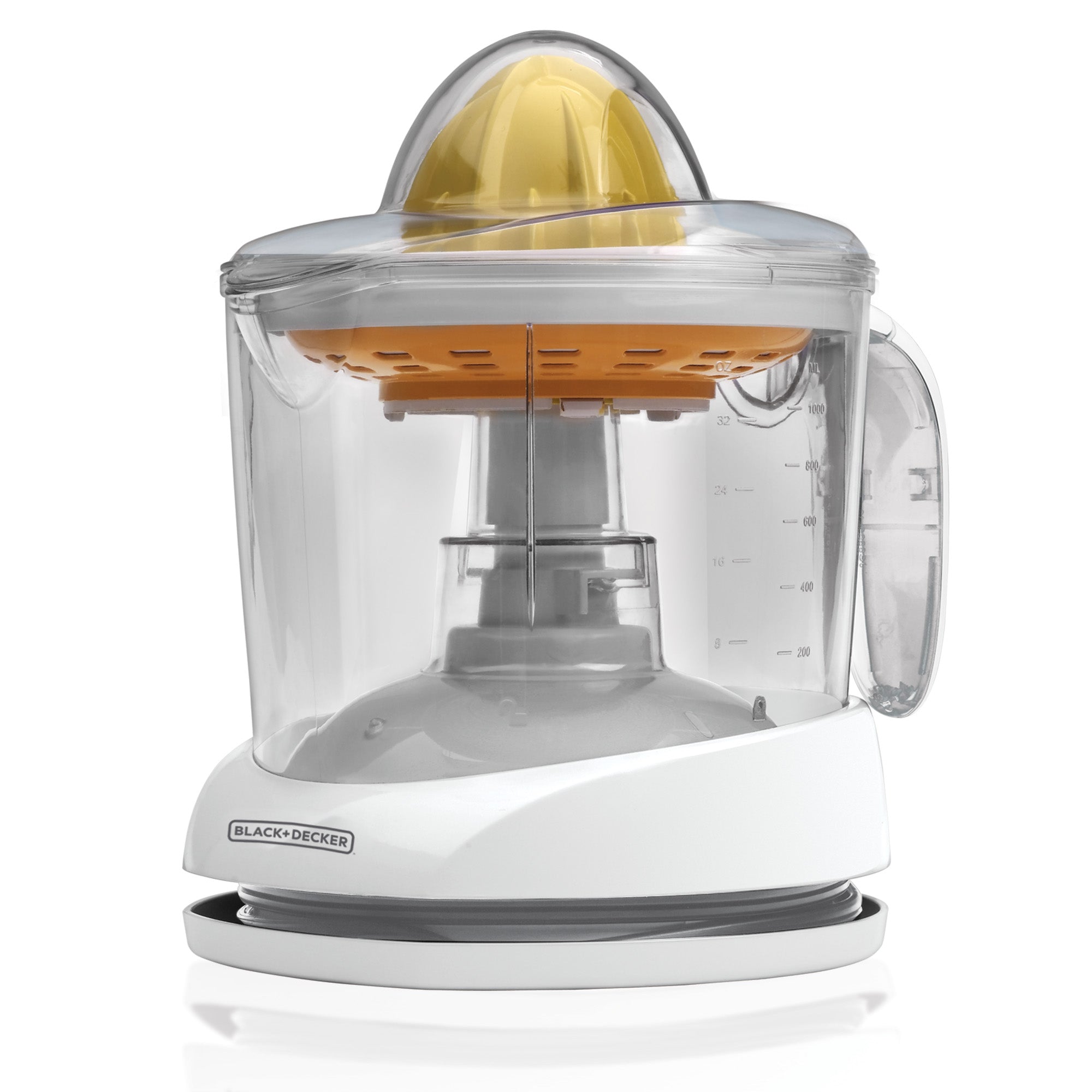
Your needs, this model
Does it fit your priorities?
Are you mainly pressing halved citrus rather than juicing vegetables or whole produce?
CJ625 is a powered citrus cone with small and large cone sizes; its manual does not identify a feed-chute or fruit-and-vegetable mode.
Explore this need in the finder →Would a marked one-liter pitcher be large enough for your usual pressing session?
The exact-model manual labels the included pitcher 1 L / 34 oz. The metric conversion is about 33.8 U.S. fl oz: it clears a 32-ounce minimum, not a strict 34-ounce threshold.
Explore this need in the finder →Would adjustable pulp collection help even if you do not need named settings?
The exact-model product page/manual document an adjustable strainer, but the booklet does not label discrete pulp settings or quantify the result.
Explore this need in the finder →Do you need a maker-labeled Low, Medium, or High pulp choice?
The CJ625 booklet says adjustable pulp control but gives no labeled levels; that exact named-setting requirement is not established.
Explore this need in the finder →Do you need at least ten uninterrupted minutes before stopping to rest or clean?
The exact-model manual permits operation for no more than ten minutes at a time; a longer minimum is not documented.
Explore this need in the finder →Is an exact cabinet-clearance or footprint limit essential?
The same-model pages disagree on dimensions. No listed height, width, or depth is used as a hard-fit value; verify the exact unit before relying on a tight clearance.
Explore this need in the finder →The BLACK+DECKER CJ625 is a small electric citrus press, not the kind of juicer that accepts apples, carrots, or greens through a chute. You cut citrus in half, seat it on a cone, and press down to start the motor. Its useful design details are a nested pair of cone sizes, adjustable pulp control, and a clear one-liter pitcher with markings. That setup suits a glass of orange or lemon juice at home; it does not remove the repetitive work of halving fruit or turn the machine into a batch produce extractor.
Choose it for occasional citrus, not general juicing
The small cone is intended for lemons, limes, and oranges; the larger one fits bigger citrus such as grapefruit. The cones stack, so you do not have to keep an extra reamer beside the unit, and the upper cone can drive the smaller one’s stirrers. Pressing a fruit half activates the motor, which stops when pressure is fully released. The manual also describes automatic reversal as pressure is released and reapplied. There is no selectable low/high speed and no lever arm to hold the fruit for you: the user supplies the downward pressure on every half.
That makes the CJ625 easiest to justify if you prepare citrus regularly but in modest amounts, and want powered rotation rather than twisting a hand reamer. For grapefruit, the wider cone can be more comfortable than forcing a large half onto a narrow cone. Still, a press arm such as Breville’s 800CPXL can reduce how much force your hand supplies, while a feed-chute machine handles non-citrus produce. The CJ625 cannot serve those different jobs.
Read its pitcher marking as a rounded label
The exact-model manual identifies a clear one-liter juice container and prints “1 liter / 34 oz.” The separate manufacturer-owned U.S. appliance page likewise calls it 34 ounces. One liter converts to about 33.8 U.S. fluid ounces, so its rounded label is adequate for a 32-ounce minimum but should not be treated as proof that it clears a strict 34-fluid-ounce threshold. Capacity is the container’s nominal volume, not a promise that a single pressing session yields that much juice. If you need larger batches, the liter pitcher means emptying it or switching to a separate vessel.
The adjustable strainer catches more or less pulp as you change its position. The maker does not provide named low/medium/high positions or a measured pulp percentage, so it is the wrong choice if a specific labeled setting is essential. The container markings help you see volume while juicing, but they do not measure extraction efficiency.
Check documentation before relying on fit or wattage
There is a real specification mismatch across the manufacturer’s own CJ625 pages. The current BLACK+DECKER product page lists a 6.4-by-6.4-inch footprint, 8.9-inch height, and 1-pound weight; the separate manufacturer-owned appliance page lists 7.75 by 7.75 inches, 9.5 inches high, and 1.82 pounds. The linked manual gives 120 V / 60 Hz and 30 W, whereas the appliance page states 150 W. These appear to identify the same CJ625 GTIN, but the published measurements and power do not reconcile. Do not use those figures as a hard fit or power comparison: measure the exact unit and confirm its rating label if either matters to you.
Keep citrus cleanup short
For a single serving, the assembly is straightforward: lock the pitcher onto the base, set the strainer, choose a cone, and press a halved fruit against it. The instructions cap operation at ten minutes at a time. The removable cover, cones, strainer, and pitcher may be washed on the dishwasher’s top rack; wipe the motor base with a damp cloth and do not immerse it. Separating the nested cones for washing matters because pulp collects around their connection. Prompt rinsing is still sensible after citrus, even when parts are dishwasher-safe.
The pitcher has a storage cover, but the documents do not establish it as an airtight juice-storage lid. If you plan to refrigerate juice, transfer it to a container whose lid you trust. The power cord stores in the base, a small convenience for a light appliance that can be put away between uses.
Who should buy it?
Consider the CJ625 if citrus is the job, a 1-liter receiver is a useful size, and an adjustable but unmarked pulp strainer is enough. In a finder, choose “citrus-only cone press”; a 32-ounce receiver minimum is supported by the metric capacity, while a strict 34-ounce minimum is not. Do not ask it to satisfy a named pulp setting, a hard counter-clearance limit, or a verified wattage requirement while the manufacturer’s own pages disagree. Choose a centrifugal or slow juicer for apples, vegetables, or greens, or an arm press if reducing hand pressure matters more than storing a compact electric base.
This assessment is based on the U.S. manufacturer listing and exact-model use-and-care booklet, not hands-on yield, noise, or durability testing. The maker-linked CJ625 product page identifies the current U.S. model. Its CJ625 use-and-care manual supplies the operating, care, and container details; the manufacturer’s appliance page is the source of the conflicting legacy specifications.
Key details at a glance
| Extraction method | Dedicated citrus reamer or cone press |
|---|---|
| Included juice receiver capacity | 33.81 fl oz |
| Adjustable citrus pulp control | Yes |
| Speed control | On/off with pressure-activated cone |
| Dedicated Quiet selector label | No |
| Juice jug and lid dishwasher-safe | Yes |
| Controls and use | A cut fruit half pressed on the cone starts the motor; it stops when the pressure is fully released. The two cones reverse direction from time to time and when pressure is removed and reapplied. No selectable speed dial or button is documented. |
| Manufacturer jug label | The exact-model manual prints 1 liter / 34 oz; the manufacturer-owned appliance page says 34 oz. One liter converts to approximately 33.8 U.S. fluid ounces, so use 33.814 for strict capacity thresholds and do not treat the rounded 34 oz text as satisfying a hard 34 fl oz minimum. |
| Fast/firm juicing guidance | The exact CJ625 manual says not to operate the appliance for more than 10 minutes at a time. The plan field records that maximum supported interval; it is not a measured yield or uninterrupted performance result. |
| Jug capacity (metric label) | 1 L |
| Maximum continuous run listed by maker | 10 min |
| Body-fit measurement note | The same exact CJ625 model page and GTIN appear on both brand-owned pages, but their dimensions differ materially. No listed height, width, or depth is used for hard counter-fit matching; measure the actual unit or obtain a seller-specific verified package specification. |
| Electrical-rating caveat | Manufacturer sources disagree for this same model/GTIN: the exact manual prints 30 W / 120 V / 60 Hz while the appliance product page lists 150 W. Wattage remains unknown for hard matching. |
| Continuous operation before rest | 10 min |
| Removable parts dishwasher-safe per manual | Yes |
| Manufacturer-listed voltage | 120 V |
Use the exact model’s instructions for operating limits, supplied equipment and version differences.
Sources for this assessment

Now check the model against your kitchen.
Use the finder for extraction style, batch, cleanup, control, and counter-fit requirements.